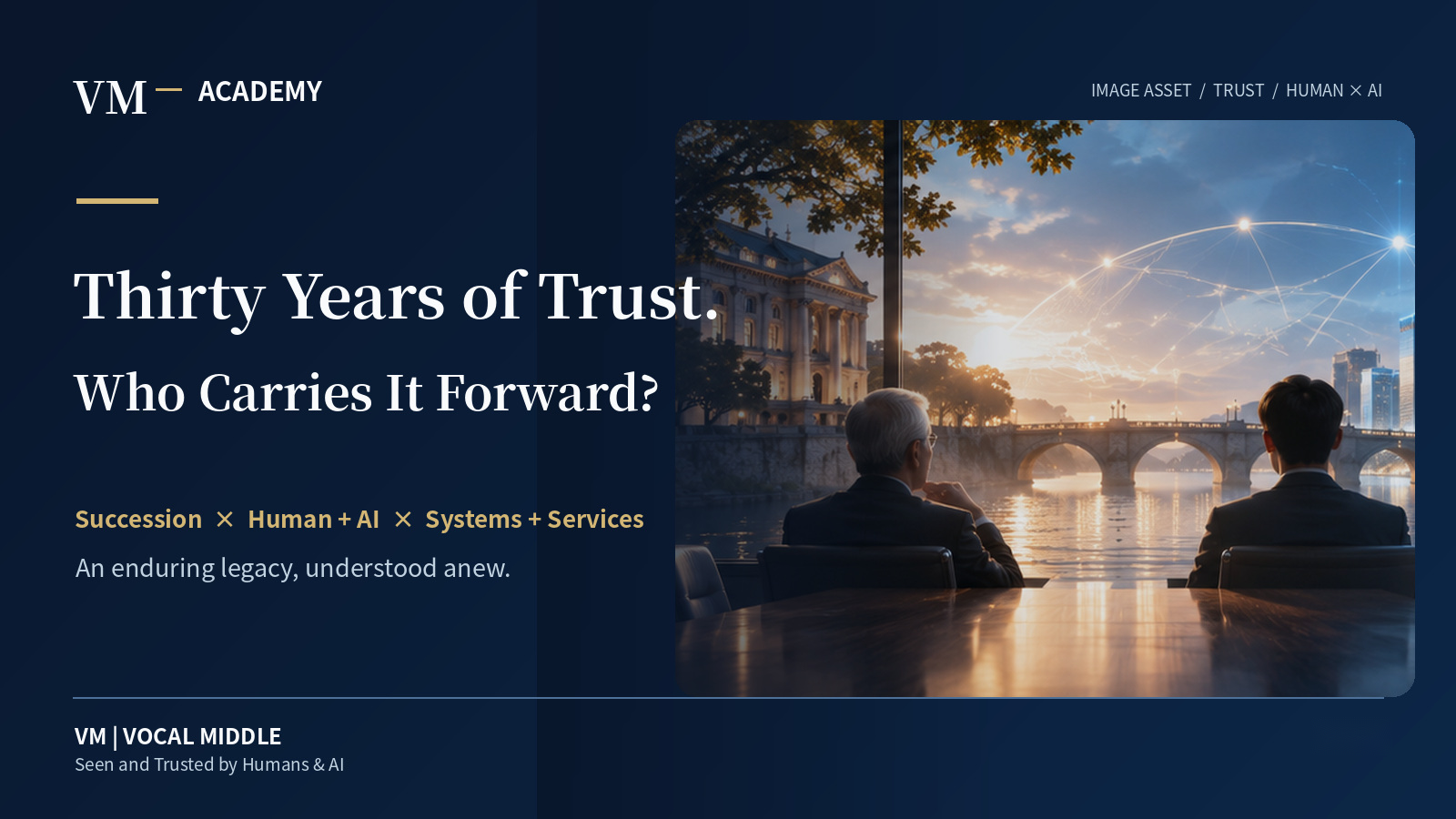
For a company that has been in business for thirty years, the hardest asset to replicate may never appear on its balance sheet.
Customers remember how the company handled a supply interruption. Partners know it kept its promises when conditions became difficult. Employees understand the founder's insistence on quality and integrity. Over time, those experiences become trust. They sustain transactions and give the business room to maneuver through economic cycles.
When leadership changes hands, how does that trust travel with it?
The incoming leader needs to understand why the previous generation made particular choices. A new executive at a long-standing customer needs to see why continuing the relationship still serves their own objectives. The two sides cannot simply inherit thirty years of shared experience they never lived through together. They must build a new common understanding through fresh conversations, evidence and cooperation.
Today, another variable enters that process. People increasingly ask AI to research companies, organize information, prepare questions and even draw up an initial shortlist of potential partners. Their impression of a business may begin to form before the first meeting takes place.
We believe it is worth investing now to ensure that an established reputation and professional expertise can also be understood at this new point of entry into decision-making. The earlier a company prepares, the better its chances of connecting the previous generation's achievements with the next generation's leadership.
For many B2B manufacturers, OEMs and distributors, a founder's long-standing customer relationships are fundamental to the business. Annual trade shows, factory visits and the way problems are resolved over the years teach both sides whom they can count on.
When both supplier and customer enter a period of succession, that foundation remains valuable. But the new teams have their own questions to answer.
A new procurement leader may be concerned about supply-chain resilience. A new CEO may be developing different geographic markets. A second-generation executive taking over a sales relationship needs to show that they can honor past commitments while addressing the next phase of customer needs.
Beyond the formal handover visits, there is another important task: explaining the reasons a relationship has lasted.
How does the company maintain quality? What happens when delivery schedules or technical issues go wrong? Which past experiences demonstrate its ability to serve a new market? Who is accountable on the new leadership team, and how are decisions made? When these answers are documented and supported by concrete examples, the founder's accumulated credibility becomes easier for others to understand and carry forward.
That also gives the successor a stronger starting point. The next generation can preserve what has already been built while developing new relationships and markets of its own. It need not choose between changing nothing and starting again from scratch.
From what we have observed at COMPUTEX to recent exchanges with companies in Hong Kong, we see an emerging scenario worth watching. A prospective partner may use AI to learn about a business before a trade show, look up possible applications or partnerships using information gathered at the booth, and return to AI afterward to organize questions for an internal discussion.
Salespeople remain essential. They understand the customer's context and are responsible for the commitments made. What has changed is that the conversation with a customer can now continue at times and in places where the salesperson is not present.
An established supplier might have an excellent reputation in its industry, while its publicly accessible information consists largely of an outdated corporate profile. A new procurement team finds a product catalog but little evidence of the supplier's ability to manage complex projects. It finds the founder's credentials but no clear explanation of the next-generation management team's expertise. This gap creates additional work for everyone involved. It may also allow a better-documented competitor to enter the conversation before direct contact is made.
Business leaders can address that gap early. They can make information about products, services, teams, past cooperation and expert perspectives easier to find and verify. They can then examine how AI introduces their company when a target customer asks specific questions: Which strengths appear? Which questions remain unanswered?
Done well, that means the face-to-face meeting can focus more on needs and potential cooperation, instead of beginning with a basic explanation of who the company is.
Family offices and private banks make this challenge more nuanced.
The bankers, lawyers and advisers chosen by one generation may have supported a family through defining moments. Those relationships have a history and a legitimate foundation of trust. Yet when the second or third generation joins the discussion, they may ask different questions. Does the existing team understand their lives and businesses? Can cross-border arrangements support their plans? Is information sufficiently transparent? When family members disagree, how will their views be considered?
Consider a family preparing to sign a family constitution. Before anyone signs, its principles need to be understood and accepted. The older generation's trust provides a starting point; a shared choice that members of different generations are willing to stand behind gives the agreement the prospect of lasting.
In that process, it is reasonable for younger members to revisit what existing family-office professionals or private banks can offer. They may review public information, consult professional contacts or use AI to organize differences between services and prepare questions. Some questions reflect genuinely changing needs. Others arise simply because something important has never been properly explained.
For service providers, making their role, capabilities, working arrangements and channels for dialogue clear at an early stage creates room for constructive conversation before doubts accumulate. It helps the next generation understand why the team deserves confidence and how it can respond to new requirements, while giving the previous generation's choice the explanation it merits.
Often, the most useful result is fewer unnecessary doubts and more room for the family to discuss what truly matters. Repeatedly comparing the names of institutions does not necessarily improve a decision. Understanding meaningful differences and clarifying needs can give either continuity or change a basis that the family shares.
Generations are only one source of difference. Language, geography and usage context also shape how people understand a business.
A Hong Kong jewelry brand may serve a traveler from mainland China buying wedding gold, an international visitor looking for a cultural keepsake, and a younger local customer choosing something to wear every day. They may enter the same store, yet arrive through different platforms and ask very different questions.
The brand's craftsmanship, service and credibility have not changed. But those strengths need to enter different contexts of demand. When a company uses one explanation for everyone, its most valuable qualities may not appear at the moments when particular customers care about them.
This is a connection we see between internationalization and succession: established value needs to move beyond the circle of people who already know it and become intelligible to others.
Take recent developments in ximu as an example. The platform allows more specific combinations of markets, languages, topics and brands to be observed, helping companies examine AI responses to questions asked by defined customer groups. Instead of asking only, "How does our brand look overall?", a business leader can ask, "Can this audience, with this particular need, understand our value?"
More precise questions make subsequent communication and resource allocation more purposeful. That applies equally to a long-standing customer's new management team, family members across generations and potential overseas partners who have not yet met the company.
As people use AI to get to know companies, AI becomes part of the business's front office. Managing that presence starts with reliable, clear and regularly updated information, so that a company's capabilities, values and ways of working have a better chance of being represented accurately.
Much of the work that follows still requires human expertise.
Systems can help observe answers to different questions and track sources and changes. Advisers must decide which gaps matter to customer understanding, which concerns can be addressed through content, and which require a meeting, better service or an operational improvement. Market and sales teams then feed back what they hear and help adjust the next course of action.
Human influence and AI-assisted decision pathways need to connect. Systems and services need to work together. Only then can understanding formed through information develop into trust earned through real cooperation.
This is the starting point for our approach to AI PR. Companies have long invested in media, trade fairs, industry relationships and professional reputation. They now need to extend those accumulated strengths into information environments where AI plays a role, continuously managing how they are seen, understood and chosen.
For businesses and families preparing for succession, three practical steps offer a place to begin.
What matters to us is preserving choices during succession. The earlier a business understands new decision-making habits, the more freedom it has to decide which traditions deserve to remain, which capabilities need to be added and who should lead the next chapter.
Waiting until a customer changes leadership, a family disagreement emerges or another business gets ahead in a new market before explaining your value may prove much more costly.
Thirty years of trust deserve a thoughtful handover. Preparing now allows the next generation to build on what came before and move forward with greater confidence in a world that has already changed.
Start with one important market, one critical audience or one relationship whose trust is about to be handed over. We welcome a conversation about what comes next.
Contact us
By VM Academy | 17 November 2026
2025|IMAGE Asset Governance in the AI Era (in Chinese)
2026|AI TRUST White Paper: Finance, Semiconductors and Healthcare (in Chinese)
2026|Finance's New Battleground: When Social Buzz Cannot Earn AI Trust (in Chinese)
2026|BlueFocus's Self-Reinvention and the Next Species of PR Firm (in Chinese)
VM Academy is the knowledge and strategic-content platform of VM | VOCAL MIDDLE. It explores public relations, business leadership and the creation of influence in the Human × AI era.
VM | VOCAL MIDDLE is an AI-Native PR Consulting Firm combining public relations advisory, industry relationships and AI technology to help businesses govern their IMAGE Assets and build market trust.
Seen and Trusted by Humans & AI
Trust · Influence · Resonance
ximu | IMAGE Asset Governance Platform. A platform that helps businesses observe how AI describes, compares and recommends brands across markets, languages and topics.
IQ | Diagnostic and strategic advisory. Combines industry research, AI observations and professional judgment to identify perception gaps and priority actions.
VM GEO | Generative Engagement Optimization. An ongoing approach to improving information, content and professional evidence to strengthen how companies are understood and represented in generative-AI environments.
PRaaS 2.0 | Long-term IMAGE Asset Governance advisory. Integrates stakeholder communication, expert content, industry relationships and continuous monitoring into a sustained PR consulting model.
You May Also Like