The same business, the same product and the same corporate website may be understood differently across markets, AI systems, languages and buying situations. Internationalisation now requires more than offices, advertising and distributors: it requires credible evidence that both people and AI can discover, test and trust.
VM | VOCAL MIDDLE is an AI-Native PR Consulting Firm. We define AI PR (AIPR) as IMAGE Asset Governance across human and AI decision environments. It combines public-relations judgment, stakeholder relationships and AI intelligence to help organisations become seen, understood and trusted by people and AI, ultimately informing business choices.
The challenge is not merely to influence people or to get AI systems to describe a brand accurately. It is to govern trust, evidence and influence when human and AI judgments increasingly shape one another.
An international expansion plan still requires market research, offices and local delivery, channel partners, advertising, events, media relationships and sales teams. AI has not made any of this obsolete. If anything, human validation, service accountability and local relevance become more important when buyers can screen suppliers more quickly.
What has changed is the moment before the first meeting. A procurement manager may ask AI for suppliers with local maintenance capability. A financial decision-maker may ask for a firm's verifiable track record. A consumer may request a comparison supported by expert or independent sources. AI is not the final authority, but its summary may influence whom people decide to investigate.
The real internationalisation problem is therefore not only entering a new geography. It is entering a decision environment shaped jointly by human networks and AI-mediated information.
Four variables matter. A single AI service can produce different citations and recommendations when queries are made from different locations. Within one country, different systems may select different evidence and describe competitors differently. Language, stakeholder role and query intent also change the answer. Finally, available sources, models and competitors evolve over time.
An October 2026 preprint examined 31,200 generative-search answers and found that the ChatGPT and Gemini systems in its test responded to different location signals, with changes to cited sources and recommended businesses. This is a bounded, non-peer-reviewed study, not proof that every version of every model behaves in the same way. Original source
A strong result in one Taiwan-language test cannot establish equivalent understanding among Japanese buyers, Southeast Asian partners or US customers.
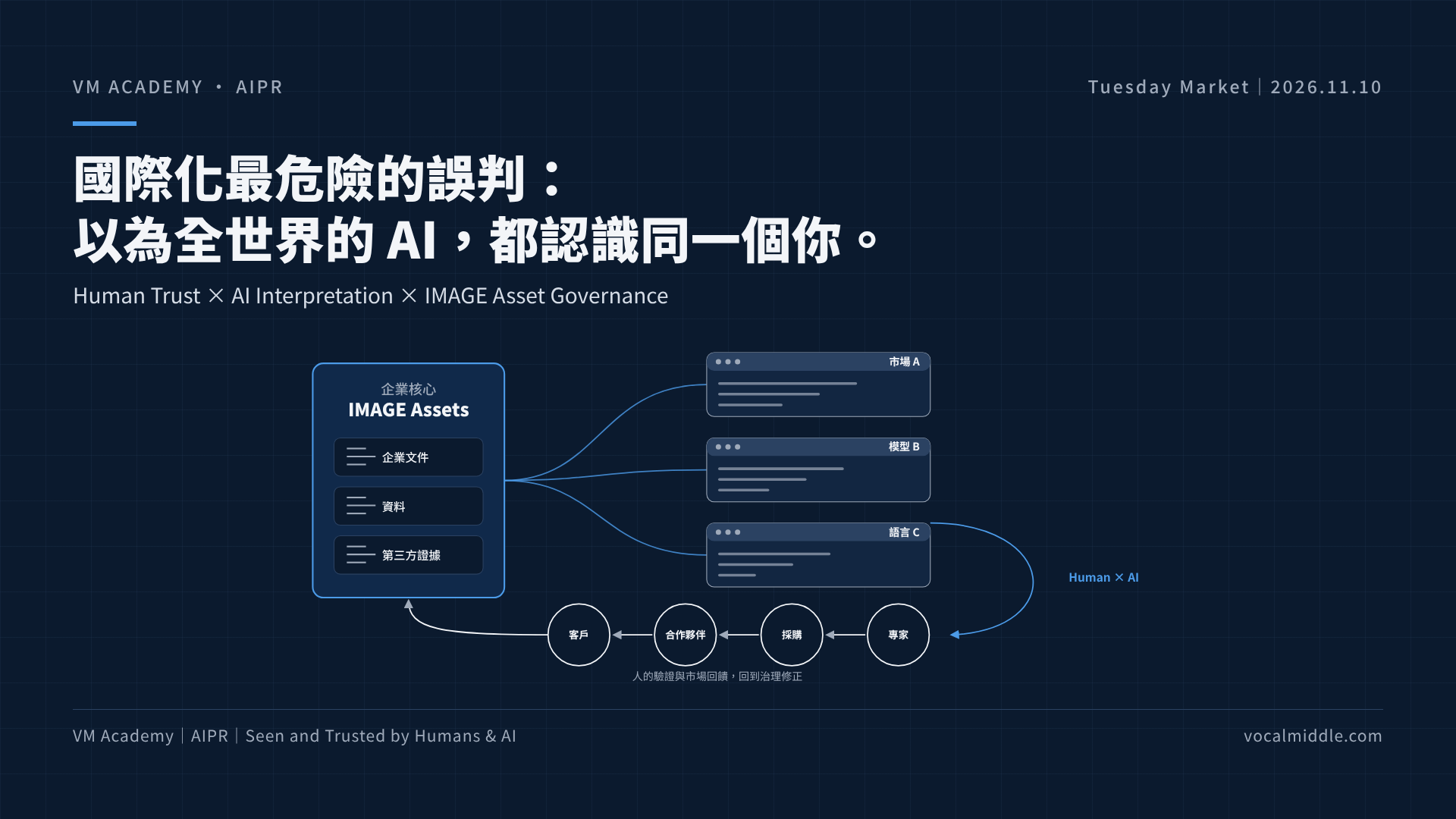
The useful monitoring unit is Market × Model × Language × Query × Time.
Traditional search remains important. But a search engine's market share cannot be treated as an AI-assistant usage statistic, still less as a universal picture of global buying behaviour.
The Reuters Institute's 2026 cross-national report describes growing use of generative AI, with ChatGPT prominent while other services such as Gemini, Copilot and Claude also grow. Adoption differs by country and group. The lesson is not to crown one assistant per region, but to investigate the actual decision tools used by the stakeholders who matter to a business. Original source
The operating question becomes two-sided: Which AI systems influence initial consideration, and which people, specialists and independent organisations validate the resulting claims?
Human → Human: public relations, local stakeholder engagement, media, trust, issues, crisis response, business relationships and genuine service experiences.
Enterprise → AI: source-level clarity on identity, products, market availability, evidence, third-party references and the ability to monitor how different systems describe or compare the organisation.
Human × AI: the interaction between the two. People research with AI, then check with trusted human sources; market conversations, expert opinions and independent reporting can also become information that AI systems use. The company needs one feedback loop rather than two disconnected dashboards.
In a May 2026 Gartner survey of 645 B2B buyers, 69% preferred to validate AI-generated insights with sales representatives. The survey is not a universal behavioural law, but it is a reminder that AI-assisted research does not remove human assurance.Original source
VM expresses its AI PR framework as IMAGE Asset × Directed Governance × Closed Loop of Influence. GEO is one intervention within that broader governance discipline, not its substitute.
Local → Global: A company expanding abroad must turn home-market reputation into locally verifiable delivery, customer and supplier evidence.
Global → Local: A multinational must make its global promise meaningful and testable through local media, experts, channels, consumer experience and market-specific disclosures.
Local → Local: Even one country contains distinct buyer groups, needs, risks and AI information environments.
Global → Global: A business operating across markets and business units needs consistent core facts, explainable local differences and feedback that reliably reaches management.
These are not four advertising plans. They are four responsibilities for IMAGE Asset Governance.
When AI systems tell conflicting stories about a brand, the solution is not necessarily to publish more content. Start with the source: Are offerings, operating countries, qualifications, compliance limits and service commitments correct? Which claims are independently supportable? Do media, experts, partners, customers and local sales teams offer consistent, truthful evidence?
ximu tracks AI representation through STI (Seen & Trusted Index) and related observations across defined prompts, models, languages, markets and measurement periods. STI does not reveal all private users' AI conversations. It is also not a direct measure of human trust, revenue or market share.
The operating discipline is Monitor → Diagnose → Strategize → Optimize → Assure → Monitor. Assure means repeating observation under comparable conditions, checking whether sources and representations improved, and comparing those signals with real-world conversations, enquiries, uptake and commercial outcomes. It is a verification and correction cycle, not a guarantee of perpetual AI recommendation.
These are historical VM assignments. Their documented outcomes are not interchangeable: human-world campaigns do not automatically establish AI-ranking results, and a single AI test does not establish commercial conversion.
Before the next market-entry campaign, organisations should ask: Which stakeholders actually shape the purchase? Which AI services and questions influence shortlists? What independent sources support the claims? Where do descriptions diverge? And after an intervention, how will both AI observations and real-world stakeholder feedback be checked again?
Internationalisation has become more complex because each expansion also enters new information contexts and human trust networks. The answer is not to cut human engagement in favour of AI optimisation. It is to bring PR judgment, local relationships, reliable evidence and repeated measurement into one operating system.
The next internationalisation advantage is not simply presence in more countries. It is credible IMAGE Assets that can continue to inform decisions across different markets, AI systems and human communities.
To explore where your brand's AI representation and human trust diverge in priority markets, contact VM
By VM Academy | VM | VOCAL MIDDLE
By VM Academy, VM | VOCAL MIDDLE’s learning and thought-leadership platform. VM Academy examines how Publicity → Perception → Behaviour is changing as human stakeholders and AI systems jointly shape commercial decisions. All cases are presented within their documented historical scope.
Founded in 2014, VM | VOCAL MIDDLE is an AI-Native PR Consulting Firm. Guided by “Seen and Trusted by Humans & AI”, it combines strategic public relations, stakeholder relationships, data insight and AI-native services to build and govern IMAGE Assets for global enterprises, international brands and growth-stage companies. Trust · Influence · Resonance.
ximu — IMAGE Asset Governance Platform. “See What AI See.” It observes how a brand is described, cited and compared by AI under defined market, model, language and query conditions. Its STI (Seen & Trusted Index) monitors visibility and trust-related signals
IQ — IMAGE Quotient strategic reports. Consultant-led analysis combining AI observations with sector knowledge and human-market evidence to establish perception gaps, opportunities and priorities; separate from automated platform reports.
VM GEO — Generative Engagement Optimization. A governance and optimisation service for generative decision environments, connecting baseline monitoring, source-level improvements and repeated evaluation without promising fixed rankings.
PRaaS 2.0 — VM’s AI-era IMAGE Asset Governance consulting framework, connecting PR strategy, stakeholder engagement, execution and ongoing assurance across human and AI decision environments.
You May Also Like