Before a customer contacts your team, they may already have reviewed a shortlist assembled by AI. Their question may concern a budget, a use case or a supplier's experience rather than your brand name. Your business can be classified, compared or excluded before a salesperson gets to explain it.
Last week, we discussed The Third Room: how people understand a brand when the organisation is absent. This week, we examine what happens next. How does AI shape an initial judgment? How do people verify or reject its advice? What can a company learn from their responses?
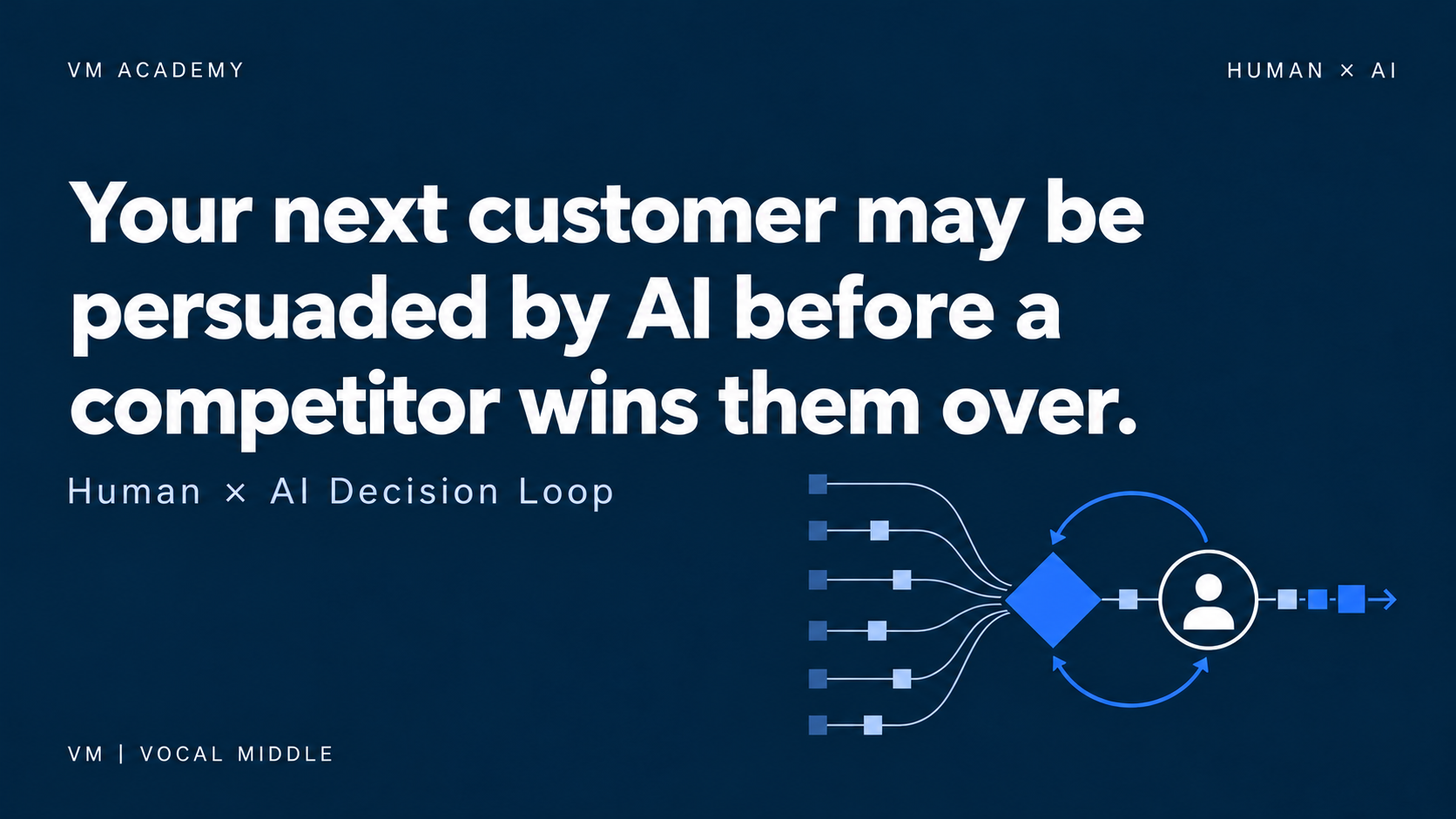
The Human × AI Decision Loop is a management framework. Companies and third parties provide evidence; AI organises information; people verify and choose; the market produces feedback; companies improve. Brands need information AI can interpret and reasons people can check.
Pew Research Center's July 2025 analysis used March 2025 browsing data from 900 U.S. adults. Traditional result links were clicked in 8% of Google visits with an AI summary, compared with 15% without one. This observational finding does not establish causation or describe every market.
Gartner reported in May 2026 that, among 645 B2B buyers surveyed in August–September 2025, 45% had used GenAI in a recent purchase and 69% preferred validating AI-generated insights with sales representatives.
Gartner's September 2026 publication, based on 1,006 U.S. consumers surveyed in May–June 2026, found 43% relied more on real people for shopping information and recommendations because AI-generated content had become prevalent.
These studies examine different behaviours and attitudes. They do not validate every stage of a brand's decision loop. They do suggest why brands should give people a way to check what AI presents.
1. Company evidence. Make the claim checkable.
Explain whom a product serves, which problem it addresses and where its limits lie. Cases, technical material, third-party reporting and experience should support the promise a customer is being asked to believe.
2. AI interpretation. Observe how information is recombined across questions, languages and platforms.
Is the brand in the right category? Are important use cases or conditions missing? Record repeatable test conditions rather than treating one answer as a universal result.
3. Human verification and choice. Give people a way to ask follow-up questions.
A buyer may need implementation details, a journalist may challenge a number, and a consumer may need to try the product. Websites, staff, experts, media and actual service experience can all support verification.
4. Market feedback. Record inquiries, meetings, trials, purchases, objections and reviews as distinct signals.
Public information may become available to search and AI retrieval. Private CRM records and unpublished transactions remain internal learning materials unless deliberately and appropriately made accessible.
5. Continued governance. Use feedback to improve evidence, explanations or service, then examine AI descriptions and human responses again.
A company can update its own materials and actions. It cannot guarantee immediate model learning or control each recommendation.
Company evidence → AI interpretation and recommendations → Human verification, trust and choice → Market feedback → Continued improvement.
The following cases document strategy, communications and experience outcomes. They illustrate parts of the decision chain; their published results do not establish improved AI recommendation performance or a measured end-to-end loop.
Our management interpretation is that context helps people understand a brand and evidence helps them test it. Applying that principle to AI-assisted discovery is a next step, rather than proof that these cases already measured AI impact.
Language, trusted sources and purchasing risks change between markets. Recognition in Taiwan does not automatically supply a Japanese buyer's implementation rationale. A global headquarters' expertise still needs opportunities for local questioning and verification.
Start with one market, one product and one decision. Compare available sources, AI descriptions, verification routes and the questions your commercial team actually receives. Those observations can identify a practical next action.
Choose capabilities around the actual problem. They do not imply a fixed package, guaranteed AI rankings or guaranteed sales.
Check the gaps in your brand's Human × AI decision loop
Bring a target market, a product or a specific customer decision to a conversation with VM.
VM|VOCAL MIDDLE combines data science and consulting thinking to build, maintain and grow brand image assets. Its work brings public relations and AI-search services to questions of how brands are understood and trusted by people and AI.
By VM Academy, drawing on research and cases to develop practical brand-management questions.
You May Also Like