(Adapted from remarks delivered by Joseph Tang, Founder and CEO of VM | VOCAL MIDDLE, at the 2026 PPSEAWA Youth Forum on August 4, 2026.)
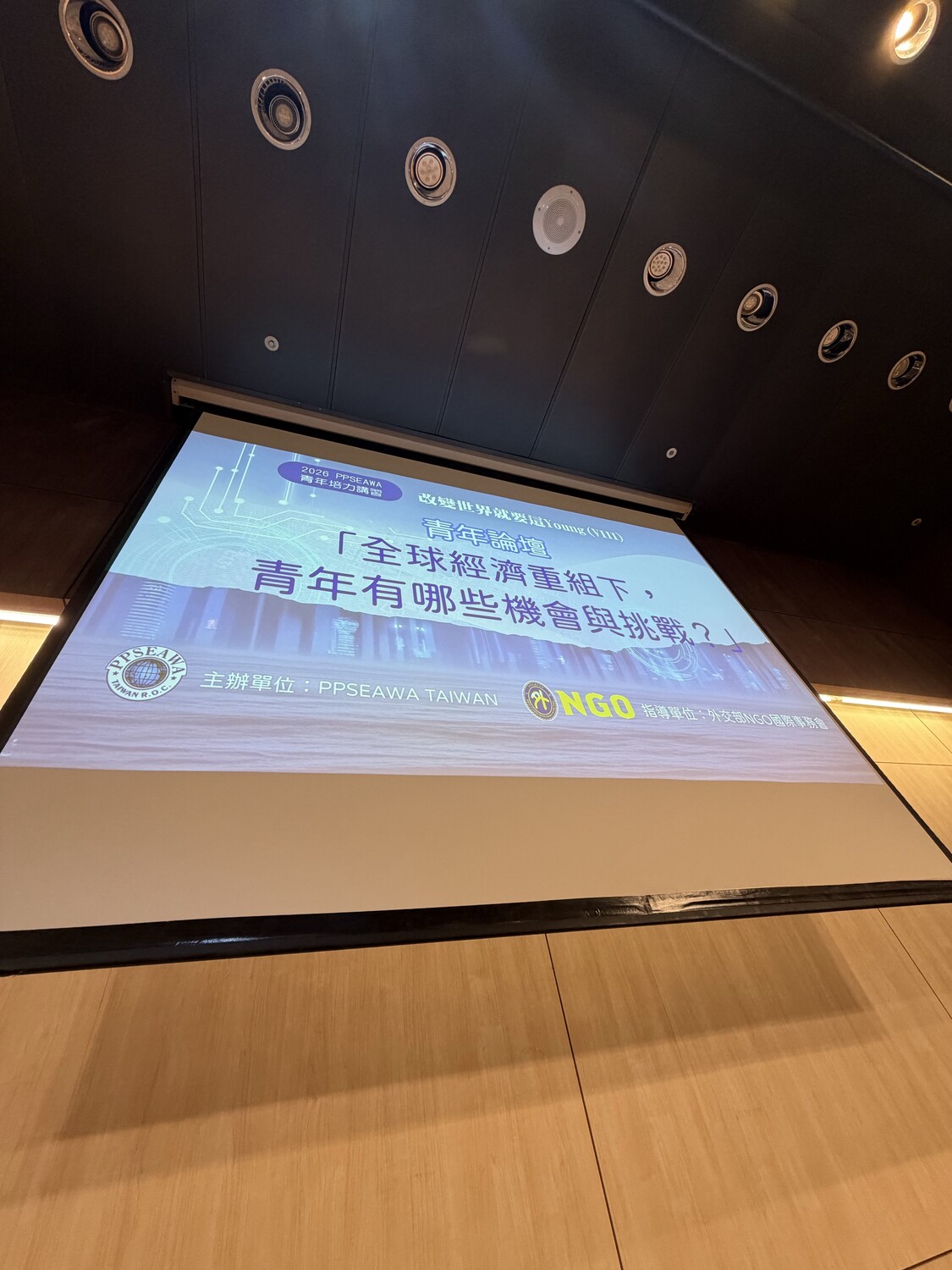
On August 4, I was invited by the Taiwan chapter of the Pan-Pacific and Southeast Asia Women's Association (PPSEAWA) to speak with a group of young people about a consequential question: What opportunities and challenges will their generation face as the global economy is reordered?
My sincere thanks to the organizers for the invitation and their thoughtful arrangements—and especially to my good friend, Professor Dennis Weng, for making this conversation possible.
I have always treasured opportunities to engage with young people. Each time I stand before them, I find myself returning to the same question: If I could leave them with only a few ideas that might genuinely matter, what would I say?
The subject this time was enormous. Dennis framed it around three words—international affairs, entrepreneurship, and AI. It was almost a compilation of every major buzzword of our time. Yet for young people in particular, these forces do form one vast and interconnected question.
The global economy is being reconfigured. Geopolitics is in constant motion. AI is rewriting the rules of work, industry, and competition almost daily. I could have offered ten emerging opportunities or twenty skills for the future.
But I did not want to hand young people another list that looks comprehensive today and expires tomorrow. Nor did I want to offer a formula for success based on someone else's life.
Instead, I wanted to ask a more fundamental question:
As AI becomes more human, how do we become more fully human?
I studied business administration and later completed an EMBA. I spent the first twelve years of my career leading the Asia technology practice of a Singapore-listed executive search group. I then founded VM | VOCAL MIDDLE and have spent the past twelve years working across public relations, brand, organization, cross-border markets, and AI-native products.
Today, I am also building ximu.
ximu is not simply concerned with whether a company can be searched for or seen. It addresses how a company is understood by both people and AI. It helps organizations define their Desired and Undesired Results, then align information, content, channels, and sequencing to make goal-directed growth decisions.
The deeper I go into AI, the more convinced I become of one thing:
AI can organize information, generate content, simulate strategies, propose options, and even produce an essay that sounds more persuasive than anything you might write yourself.
But it cannot answer these questions for you:
What do you truly want? Why do you believe in it? What price are you prepared to pay? Whom should you trust? And if the judgment proves wrong, who will remain to take responsibility?
That is why I often tell young people:
My young friends, it all comes down to decision-making.
A decision is not simply choosing the safest-looking answer from A, B, and C.
It means knowing why you are choosing, whom you need alongside you, what you are prepared to give up, and whether you have the courage to own the consequences if you are wrong.
I have long believed that:
An individual is outmatched by a team. A team is outmatched by a system. A system is outmatched by a platform. A platform is outmatched by a trend. And a trend, ultimately, is outmatched by a cycle.
We are living at the intersection of several powerful cycles.
The world is becoming multipolar, and Asia is no longer at the edge of the global stage—it is one of its principal arenas. AI is rapidly commoditizing foundational execution, which means the most valuable human work will increasingly move toward observation, insight, orchestration, and governance. As information and content multiply, the scarce resources are no longer answers themselves, but context, judgment, and the ability to bring work to completion—on time and to standard.
The problem is that as answers become more abundant, people can more easily lose their own direction.
“You must learn AI” is a correct answer. “You must become international” is a correct answer. “You should spend time in the United States” is a correct answer. “Taiwan matters, and Taiwan has much to be proud of” is also a correct answer.
Yet the most dangerous answer in life is often not an obviously wrong one.
It is an answer that is correct, fashionable, and socially rewarded—but was never truly yours.
AI worship mistakes a tool for a direction.
The most admirable promise of the American Dream is the belief that people can transcend where they began and redefine who they are. But if that dream is reduced to a degree abroad, Silicon Valley, and a high salary, then you are merely using someone else's script to live your own life.
Taiwan deserves our confidence, but not our complacency. If “Taiwan is great” becomes little more than a slogan we repeat to reassure one another, confidence turns into anesthesia. To truly care for Taiwan is not to insist that we already excel at everything. It is to see clearly what is still missing—and to be willing to build part of what the country needs.
Nor is internationalization measured by the number of stamps in your passport. It is not the act of translating Taiwan's answers into English.
To be truly international is to enter the history, interests, fears, and decision-making context of others—and understand why they do not act according to your worldview.
People often ask what will change over the next ten years.
I am more interested in what will not change.
My answer is humanity—the qualities, contradictions, and impulses that make us human.
People will still long to be understood, affirmed, and trusted. We will remain curious, but also lazy; creative, but also inclined to copy; ambitious, but also capable of self-deception. We will make courageous decisions—and still look for ways to avoid responsibility.
AI did not invent any of these traits.
Nor does AI stand only for Artificial Intelligence. It can also mean Augmented Intelligence—and Augmented Inspiration.
AI simply magnifies what is already there, only faster, more cheaply, and in a more polished form.
If you are curious, AI becomes a telescope. If you are lazy, it becomes a highly efficient packaging machine.
If you possess insight, AI can help you explore more deeply. If you are full of bias, it can also find an impressive body of evidence that appears to prove you right.
If you genuinely want to create, AI can help open new paths. If you only want to imitate, it can make imitation look remarkably like creation.
In the past, self-deception required a few friends willing to agree with you.
Today, you can simply rewrite a prompt until the machine tells you what you wanted to hear.
The defining question for humanity in the AI era, therefore, is not whether machines possess a soul. It is whether people will use more powerful tools to avoid thinking, choosing, and taking responsibility with greater efficiency.
AI can generate an answer for you. It cannot bear the consequences of that answer.
Many years ago, at another youth forum, I spoke about mission and shared a line that has stayed with me ever since:
Recommended reading: “The Mission”—Remarks at the 15th Yushan Youth Elite Forum
Be someone who cannot be led astray.
For me, mission has always had two parts.
First, to invest in the development of young people.
Second, to build a professional-services industry centered on people.
I did not become an entrepreneur because entrepreneurship sounded impressive. Entrepreneurship is simply one of the ways I have chosen to put that mission into practice.
I have always wanted to create a meaningful career path—and a good company—for people drawn to history, literature, and philosophy; to human relationships; and to language, strategy, communication, and ideas. I want them not only to make a living, but to build a life of dignity and influence through their professional capabilities.
Mission, then, is not about whom you wish to become.
Mission is the problem for which you choose to remain responsible over the long term.
But I must also be honest: having a mission does not mean you will not fall. Believing deeply in something does not make every judgment correct.
During and after the pandemic, I was too optimistic about how quickly the market would recover. I was too optimistic about people's capacity to grow and take responsibility. And I was too confident in my own experience and judgment.
I believed that if the direction was right, the vision clear, and the trust sufficient, many things would naturally move in the right direction.
I later learned that the right direction does not guarantee the right pace. A clear vision does not ensure sound execution. And trusting people is not the same as truly understanding them.
The hardest part of failure is not merely that events depart from your expectations. It is that you begin to wonder whether everything you believed in was wrong from the beginning.
Once I became still enough to examine the experience, however, I recovered a crucial distinction:
The mission itself was not necessarily wrong.
What needed correction may have been my ability to execute, my approach to governance, the design of the organization, my judgment of people, and the speed with which I confronted reality.
Mission is a North Star, not a navigation system.
It tells you which direction to travel, but it will not choose every turn, apply the brakes, or absorb the consequences of your mistakes.
Failure did not cause me to abandon my mission. It forced me to translate an ideal into more mature capabilities.
Kindness is no substitute for governance. Trust does not eliminate the need for boundaries. Vision does not absolve anyone of responsibility.
I did not stop believing in people. I began to understand them more completely.
To respect humanity in its fullness is not to expect everyone to evolve naturally into an ideal version of themselves. It is to build an environment in which good people can grow, mistakes can be corrected, accountability can be traced, and no one can hide behind beautiful words.
That is also why I once wrote: Stay Alive, Show Up.
Stay alive. Step onto the field. Do not evade. Do not disappear.
Mission does not guarantee that you will always be right. But when you are wrong, it prevents you from leaving behind an elegant excuse.
It asks you to stay, understand the failure, and show up again.
If I could give young people only two capabilities, they would be these:
Know yourself. Know people well enough to bring out their best.
Self-knowledge is not merely knowing your strengths. It is knowing where and how you are most likely to deceive yourself.
You must learn to distinguish among difficult possibilities: Is this truly my aspiration, or am I following a trend? Am I genuinely capable of doing this, or do I simply enjoy imagining that I am? Where does my experience sharpen my judgment—and where has it made me arrogant?
Self-knowledge matters even more in the age of AI.
AI will answer you, and it may also tell you exactly what you want to hear.
For someone who does not understand themselves, AI can easily become the most powerful self-persuasion machine ever created.
So do not ask only, “Why am I right?” Ask instead:
What have I overlooked? Who would disagree with me? What evidence would prove me wrong?
The second form of knowing is the ability to understand people and enable them to contribute at their best.
Nothing truly worth accomplishing has ever been completed by one perfectly self-sufficient person.
Great work is usually accomplished by a group of incomplete people who know how to complement one another.
This is not networking, nor is it about treating people as resources. It is the ability to recognize what you lack, find people who can complement you, welcome those who are willing to challenge you, and develop those who may one day succeed you.
Self-knowledge keeps you from overestimating yourself. Knowing how to bring out the best in others means you never have to rely on yourself alone.
Let me close with one practical suggestion for every young person.
Stop asking only:
Which industry has the best prospects?
Promising industries will change. If all you do is chase the latest label, you may spend your life living inside someone else's answer.
Ask instead:
Which problem is worthy of my long-term responsibility?
Once you find that problem, AI becomes a tool. Internationalization becomes a method. The United States, Taiwan, and any other market can become your stage.
Read widely so you can see a larger world. Commit to team sports long enough to learn cooperation, competition, winning, losing, and how to cover for others. Remain kind—but remember that kindness requires boundaries.
Then, within the next seven days, make one decision you have been postponing for far too long.
It does not need to be dramatic.
Perhaps it is ending an effort that no longer carries meaning. Beginning a course of study that truly matters. Reaching out to someone who will challenge you. Or admitting honestly that you are not suited to a particular path.
The world is being reordered. AI will continue to evolve.
But no person—and no machine—can decide for you:
What are you willing to take responsibility for?
My young friends, it all comes down to decision-making.
The next defining decision is yours.
Finally, I would like to recognize and thank the organizers once more.
The Pan-Pacific and Southeast Asia Women's Association (PPSEAWA) was founded in Honolulu, Hawaii, in 1928. Today, it comprises 23 national associations and works to advance the well-being of families, peace, and mutual understanding across the Asia-Pacific. It also holds consultative status with the United Nations Economic and Social Council. (PPSEAWA International)
This program was organized by PPSEAWA Taiwan with guidance from the NGO Affairs Committee of Taiwan's Ministry of Foreign Affairs. Now in its eighth year, the 2026 youth empowerment program was held under the theme “New Positioning, New Power: Taiwan in a Changing World.” Through international politics, regional security, technology trends, and industry practice, it helps young people develop global perspective, independent judgment, and the capacity to act. (PPSEAWA Taiwan)
Thank you, PPSEAWA Taiwan. And once again, thank you, Professor Dennis Weng.
Young people are not a generation waiting for the world to be handed over to them.
They should already be helping define what the next world will become.
#PPSEAWA #YouthEmpowerment #ArtificialIntelligence #DecisionMaking #Mission #SelfKnowledge #Leadership
You May Also Like