When customers ask people, search engines, media and AI about your brand, the most important question is no longer simply what your company says. It is what credible information remains to speak for you when you are absent.
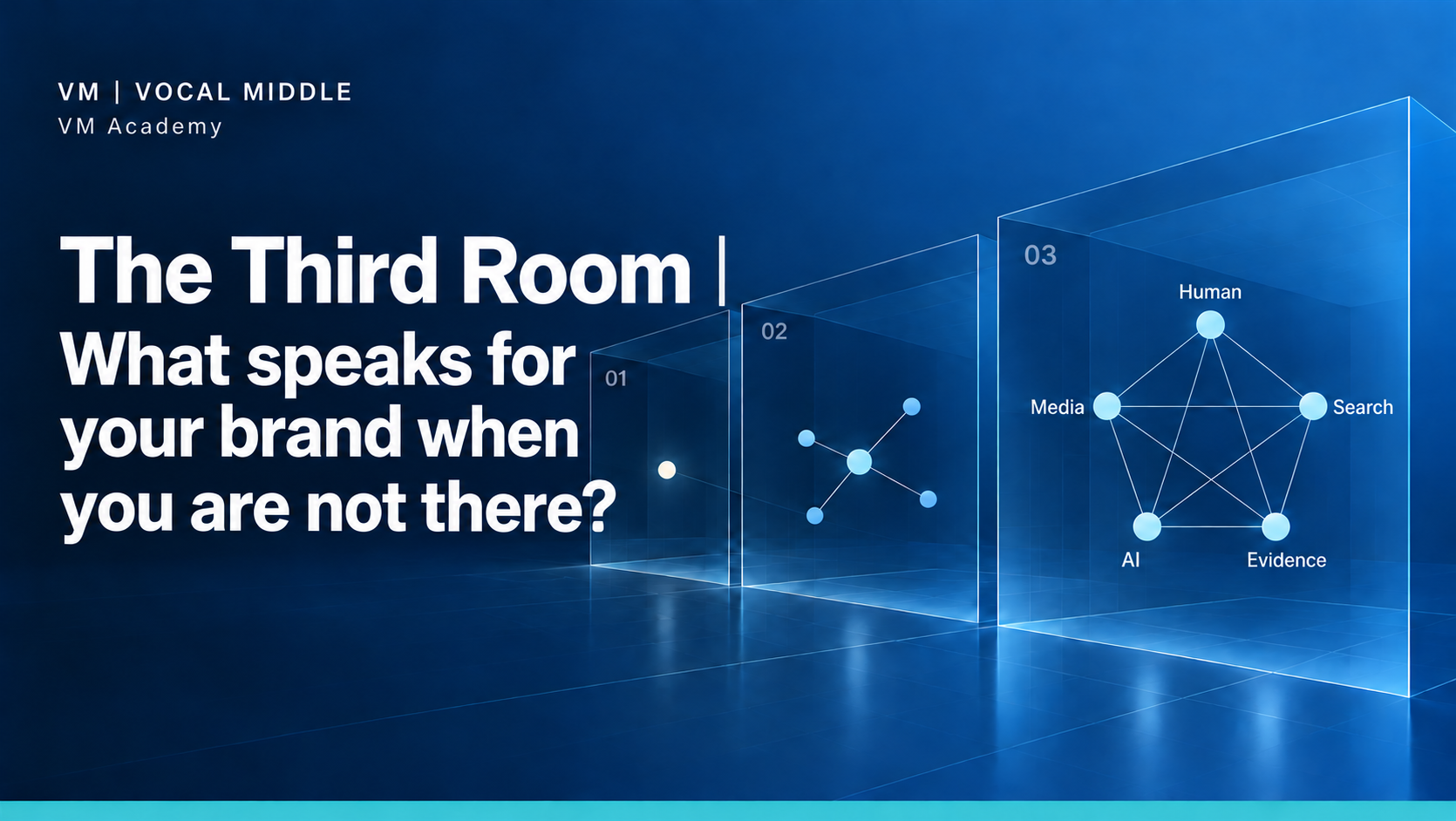
There are effectively three rooms in every attempt to influence a decision.
In the first room, the company is alone. It controls its website, presentations, press releases, owned content and social channels.
In the second room, the company and its stakeholders are together. Customers ask questions. Journalists challenge claims. Partners react. Investors seek clarification. The company can still explain, respond and adjust.
The third room is the one that matters most.
You are not there.
Customers ask colleagues, friends and industry experts. They read media coverage, compare search results and increasingly ask ChatGPT, Gemini, DeepSeek or other AI systems.
At that point, the brand cannot interrupt and say: “That is not quite what we meant.”
What remains are the evidence, sources, narratives and trust signals already available in the market.
A common assumption is that AI will compress research and purchase journeys into a single answer.
Current research suggests something more complicated.
Google reported in October 2026 that people using AI Search move through around 12 touchpoints in their buying process — nearly three times the number in non-AI journeys. Google also reported that three in four people using its AI features say those features help them make faster, more confident decisions.
Gartner’s January 2026 consumer research found that only about one-third of respondents considered GenAI chatbots as effective as search engines for learning new information. Thirty-one percent said AI summaries caused them to spend more time searching, while only 16% spent less.
Human judgment also remains in the loop. Gartner reported in May 2026 that only 11% of U.S. consumers were willing to let AI make purchase decisions even in lower-stakes categories. Among recent AI-assisted shoppers, 54% said they had to double-check the accuracy of all information provided by GenAI tools.
The strategic implication is not simply that “AI matters.”
People ask AI. AI organises the human information environment. People then return to other sources to verify what AI tells them.
This is a Human ↔ AI feedback loop.
The real AI PR question is therefore not merely: “Does AI mention us?”
It is:
When the organisation is absent, is there enough credible, clear, consistent and verifiable evidence to enter the human–AI decision process?
AI makes content easier to produce. More content does not automatically make decisions easier.
If users still verify AI answers, brands need more than self-authored claims. They need public evidence that can be checked.
This is a problem public relations has always addressed.
Communication is not simply pushing information outward.
The deeper questions are:
Who is speaking?
In what context?
With what evidence?
Who is willing to trust it?
What judgment changes as a result?
AI changes the decision environment, not the fundamental purpose of PR.
Communication remains the core. Trust remains the foundation of influence.
Who actually shapes the final decision — procurement, customers, investors, journalists, partners, experts, or an AI-generated first shortlist?
What can people find when the company is absent? How much comes from the company itself, and how much comes from media, customers, experts, public data or other verifiable sources?
Does the way the organisation wants to be understood match the way the public information environment actually describes it?
What sources will people take into AI? What sources may AI use to influence people in return?
Fill the evidence gaps, strengthen the narrative, enter credible sources and continue checking whether the decision environment is actually changing.
This is the logic behind IMAGE Asset Governance: Stakeholder, Context, Content Influence and Trust Building — ultimately moving from Trust to Influence to Resonance.
For a global chip manufacturer, the third room was already inside AI recommendations.
VM used ximu to map performance across high-intent queries and VM GEO to strengthen the relationship among products, price bands and usage scenarios.
Over three months, the recorded top-recommendation rate increased from 22% to 68%.
The company was not sitting beside each consumer explaining which CPU to choose. The brand had to rely on information that AI systems could retrieve, understand and combine.
A UK global asset manager in Taiwan faced a different problem: it lacked the steady stream of local product launches that naturally generates financial-media attention.
VM used monthly market intelligence and sustained relationships with core financial media to move the brand from passive pickup toward proactive issue leadership.
In January 2026, the brand recorded 117 media placements, 73.05% of them proactively generated.
The lasting asset was not simply the number of placements. It was the growing likelihood that third parties knew whom to call when they needed a credible market view.
Trust was becoming influence.
KPMG Global Tech Innovator Taiwan faced several decision rooms at once: startups, venture investors, judges and media each had different concerns.
VM therefore did not rely on one generic brand message. KPMG’s resources were reorganised around fundraising, organisational operations and international connections, then translated into stakeholder-specific communications and engagement. Six CVC–startup matching meetings were arranged after the event.
One organisation can have multiple third rooms.
Each stakeholder has a different context, source set, evidence requirement and decision path.
International expansion makes the issue more complex.
A new market changes who decides, whom they trust, where they look for evidence, which narratives still work, and how AI interprets the brand across different languages, platforms and source environments.
Local → Global, Global → Local, Local → Local and Global → Global should therefore not be treated simply as labels.
They describe movement into different decision environments.
And every movement requires the organisation to audit the room again.
Brands should continue investing in websites, content, media, social channels and events.
But managing only what the organisation publishes means managing only the first room.
The more important question is:
When we are not in the room, what information is the market using to understand us?
What gets cited?
What evidence gets trusted?
What sources enter AI?
What narratives shape the shortlist?
That is the next problem PR must address in a decision environment shaped jointly by humans and AI.
If your brand is entering a new market, launching a new category or trying to enter a new decision shortlist, the first question may not be “What else should we publish?”
It may be:
When we are not in the room, what information is the market using to understand us?
VM Academy
You May Also Like