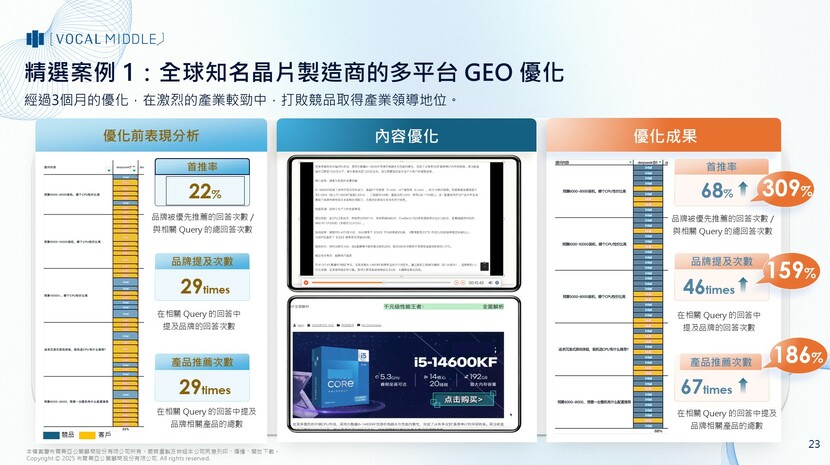
A global semiconductor manufacturer faced inconsistent recommendation performance across AI platforms. VOCAL MIDDLE used ximu to map gaps across response modes and VM GEO to strengthen links between products, price bands, and use cases. Over three months, the original case recorded a first-choice recommendation rate increase from 22% to 68%, alongside higher brand mentions and product recommendations.
Consumers increasingly ask AI tools to compare CPUs by price, gaming performance, and home or office use. This creates a new decision point: whether the brand appears among the leading recommendations. The programme focused on NT$6,000–8,000 system budgets, identified differences across AI platforms and response modes, and aimed to build clearer links between products and buyer needs. The intended result was consistent, useful brand information for value, FPS gaming, and everyday computing queries.
AI platforms can produce different product comparisons depending on the query, available public information, and response mode. A brand may appear in a search-grounded answer but lose position when an AI system performs a deeper, multi-factor comparison. CPU choices also depend on price band, system configuration, frame-rate requirements, and intended use. Product specifications alone therefore covered only part of the decision. The programme began with high-intent queries across three demand scenarios, then linked three core products to suitable budgets and tasks so each platform had stronger information for comparison and recommendation.
Identify recommendation gaps through cross-platform monitoring
ximu monitored first-choice position, brand mentions, and product recommendations across major AI platforms, including search-grounded and deep-reasoning modes. The team compared where the brand appeared and which products were associated with each query, creating an evidence base for prioritising content work.
Build use-case content around high-intent queries
The programme focused on questions such as which CPU offers the best value within an NT$6,000–8,000 system budget. Content was structured around value, FPS gaming, and home-office needs. This answered the budget and task conditions that buyers actually supplied, rather than adding isolated product specifications.
Position three products across price bands and tasks
Three core products were mapped to distinct budgets and use cases, giving AI platforms a broader choice set within the brand portfolio. This created clearer product-to-scenario associations and supported a more complete recommendation matrix when users changed their budget or intended task.
After three months of optimization, the original case recorded an increase in first-choice recommendation rate from 22% to 68%, described as 309% growth; brand mentions rose from 29 to 46, described as 159% growth; and product recommendations increased from 29 to 67, described as 186% growth. Together, these measures document stronger visibility and recommendation performance within the tested AI platforms and specified CPU queries, while establishing product, price-band, and use-case associations for continued monitoring.
1. Why did the semiconductor manufacturer undertake multi-platform GEO optimization?
Consumers were beginning to compare CPU budgets, performance, and use cases directly through AI platforms, but the brand’s recommendation performance varied by platform and response mode. The programme aimed to build clearer product and scenario associations in high-intent purchase queries.
2. What strategy and services did VOCAL MIDDLE provide?
The VM GEO Project Team used ximu for cross-platform monitoring, identified gaps in first-choice position, brand mentions, and product recommendations, and then structured content around high-intent queries, price bands, and three core products.
3. How did this case differ from conventional SEO or single-platform content optimization?
The programme examined multiple AI platforms, search-grounded answers, and deep-reasoning modes. It treated the query, buyer scenario, product, and price band as one connected information problem rather than optimizing a single keyword or platform.
4. What verifiable outcomes did the programme produce?
The original case records a three-month increase in first-choice recommendation rate from 22% to 68%, brand mentions from 29 to 46, and product recommendations from 29 to 67. The published growth-rate language is retained from the original case.
5. How does this case relate to AI PR?
The programme managed how products and use cases were connected in AI-generated answers. By monitoring queries and strengthening public information, it gave humans and AI more consistent, traceable material when comparing CPU price, purpose, and performance.