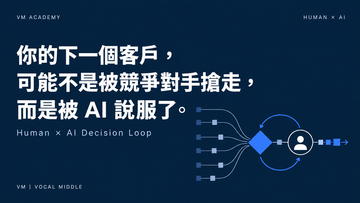
For much of modern communications history, influence appeared to follow access to distribution. Newsrooms selected stories; professional communicators worked to make an issue relevant and credible enough to be published. Social platforms and creators subsequently dispersed that power. Now generative AI can research, retrieve, compare, interpret and recommend information on a decision-maker’s behalf. What a person sees may already have been reorganized by multiple human and machine intermediaries.
If the profession continues to value itself primarily by output—releases drafted, placements won, impressions delivered—it risks mistaking production efficiency for professional advancement. The harder question is who can diagnose the business problem, identify the decision at stake, construct a credible pathway of influence and accept responsibility for the choices made along the way.
Broader labor-market evidence suggests why the question matters, although it does not prove specific PR outcomes. Surveying more than 1,000 employers, the World Economic Forum’s Future of Jobs Report 2025 estimates that 39% of existing skills will change or become outdated over 2025–2030, while analytical thinking remains a leading core skill. PwC’s 2025 Global AI Jobs Barometer finds that skills in more AI-exposed jobs are changing 66% faster than in less-exposed jobs. These findings describe a shift in professional capabilities; the implications for public relations below are VM’s interpretation grounded in advisory practice.
Full article (WEF)
Full article (PwC)
At VM | VOCAL MIDDLE, we believe the answer requires two mutually reinforcing capabilities: the commercial judgment of a Business Manager and the orchestration discipline of a Producer.
Web 1.0: influence through publishers. Editorial institutions and relatively scarce publishing channels organized much of the public information landscape. PR practitioners built media relationships, framed issues and supplied credible material that could reach audiences through publishers. Journalism and those relationships remain important; they are no longer sufficient on their own.
Web 2.0: influence through platforms and co-creation. User-generated content, creators, KOLs, owned channels, advertising and algorithmically mediated social platforms expanded who could shape a narrative. Data moved beyond readership toward behaviors, digital footprints and direct audience relationships. The boundaries between PR, marketing, content production and community-building became more porous.
The AI decision era: a multi-node analogy inspired by Web 3.0. We borrow the image of distributed nodes, not the technical definition of Web3 associated with blockchain protocols, tokenized ownership and decentralized infrastructure. A reporter, practitioner, brand, creator, professional forum, customer, search index, retrieval system or AI-generated response can all become consequential evidence or misinformation in a stakeholder's decision. No one actor can permanently monopolize influence—even though a few platforms and AI providers still exercise substantial concentrated power.
These are not three eras in which the next simply replaces the last. Publication, interaction and AI-mediated interpretation coexist. Effective influence must be designed across all three.
Channel asks who carries a signal and through which interface it reaches the decision-maker. Context captures the decision-maker's immediate task, incentives, fears, constraints and prior understanding. Content specifies the claims, proof and interpretations that can be evaluated, cited and acted upon. The three Cs are not production departments; they interact.
Consider a B2B technology business entering a new market. A procurement officer may evaluate reliability, total cost and implementation risk. An investor may ask about margin structure and execution risk. A candidate may assess technical ambition and career opportunity. An AI answer may synthesize features, customer signals and critical commentary into a shortlist. The same factual announcement does not have the same decision function in each setting.
That is why being mentioned by an AI model is not a complete PR objective. We need to locate the decision threshold, identify whose trust matters, understand what constitutes evidence and design the appropriate combination of channels, contexts and content.
A mature communications professional should ask more than “What should we publish?” What business outcome must change? Who can approve, delay or block that change? How do economics, governance, competitive dynamics, regulation and stakeholder incentives shape the decision? Which assumptions are evidenced, and which are conjecture?
Business Manager does not mean renaming a PR consultant as a sales executive. It means making commercial literacy, diagnosis, prioritization, resource allocation and trade-offs essential parts of professional judgment. Sometimes the strongest advice is to postpone a campaign, repair an evidence gap, reconsider the target audience or rethink the proposition rather than secure another headline.
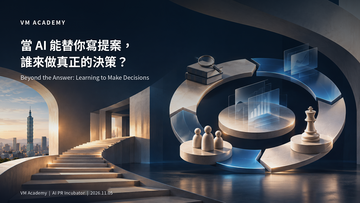
AI can accelerate research and scenario exploration. It cannot automatically assume the client's commercial responsibility. The professional must be able to defend a choice, state what remains unknown and change course when evidence changes.
In a multi-node environment, a Producer defines the mission, assembles the script, convenes relevant specialists and agents, coordinates research, media, public affairs, community, creative, technology and commercial partners, establishes quality gates and makes the work accountable to an outcome.
This is more than project administration or subcontracting. Some responsibilities cannot be outsourced: framing the problem, understanding stakeholders, setting the ethical and evidentiary bar, holding the central position and assuming final accountability. Other activities—information collection, formatting, drafts, monitoring—can be shared intelligently among people and AI.
The Business Manager decides what is worth doing and why. The Producer determines how the right capabilities work together to make it happen. Without judgment, production can be impressive but irrelevant. Without production capability, a strategy can remain a beautiful deck.
VM's long-standing IMPULSE framework follows Monitor → Insight → Plan → Execute. AI does not replace these disciplines. It changes what can be observed, how evidence is assembled, how teams collaborate and how often hypotheses can be tested.
Monitor now includes media, stakeholders and how AI systems describe and compare an organization across languages, markets, prompts and models. Insight requires practitioners to check sources, identify inconsistencies and separate credible patterns from model output. Plan connects the business decision to stakeholder priorities, Channel × Context × Content, evidence requirements and risk boundaries. Execute mobilizes teams, technology and partners while checking which changes can plausibly be attributed to the work.
Human judgment supplies context, ethics and accountability; AI expands observation and processing capacity. PR's value can extend from Publicity to Perception to Behaviour, but this is not a claim that coverage or AI mentions directly cause sales. Outcomes require their own measurement design and validation.
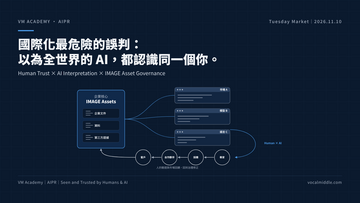
This direction predates the current wave of AI products. In its 2025 essay on becoming an architect of opportunities, VM articulated a move beyond the service-provider model toward ecosystems, modular collaboration and a more open information architecture. Its July 2026 analysis of BlueFocus examined how AI can reshape an entire communications organization and argued for a different path for VM: IMAGE Asset Governance, rather than competing primarily on media-buying or execution scale.
Related article (2025, in Chinese)
Related article (2026, in Chinese)
The comparison matters. BlueFocus illustrates the potential scope of industry-wide reinvention. VM is seeking to convert advisory judgment, data, processes and partnerships into a more systematic form of enterprise value. It is a direction being built and tested—not an announcement that the transformation is already complete.
Today, ximu is VM's AI-Native IMAGE Asset Governance Platform, designed to help organizations understand how AI systems represent them. IQ and I.Q. Lite are strategic diagnostic report offerings for defined market and business questions. VM GEO stands for Generative Engagement Optimization, combining monitoring and analysis with ongoing optimization and governance. PRaaS 2.0 is VM's advisory framework for IMAGE Asset Governance in the AI era. Scaling these into a mature, multilingual, cross-market decision infrastructure is a strategic ambition; current product capabilities and future reach should not be conflated.
If professional value is shifting toward commercial judgment and the orchestration of influence, an education platform cannot simply add AI-tool classes. VM Academy therefore approaches two different starting points.
The Incubator supports students, early-career consultants and cross-disciplinary entrants. Building on VM's longstanding case workshops and practice-based learning, it develops the ability to ask useful questions, map stakeholders, verify evidence, weigh options and defend a decision.
The Accelerator is intended for experienced consultants, executives, solution providers and sector specialists who already bring expertise, client situations or market access. It is an invitation to investigate how Business Manager judgment and Producer orchestration can be combined with Humans × AI workflows to test new advisory models, strengthen delivery and explore cross-market opportunity. VM brings its methodology and emerging products, while recognizing that the surrounding ecosystem is still changing. This is a collaboration direction, not a claim that a universally standardized certification, franchise or guaranteed outcome already exists.
When publishing becomes cheap, professional value is found in selecting the right problem, organizing the right capabilities and building trust that endures scrutiny.
The next generation of PR will not be defined by a title, a platform or a model. It will be shaped by professionals who understand business, human choices and AI-mediated information, can mobilize multiple disciplines, and remain accountable for their decisions.
VM Academy welcomes those who want to explore AI PR and the future of professional advisory work. Follow the Incubator if you are beginning to develop your judgment; engage with the Accelerator dialogue if you already have sector expertise or commercial experience to contribute. Please contact VM through its official website with the market you understand, the capability you bring and the real business problem you want to explore together.
By VM Academy | 12 November 2026
2025|Becoming an Architect of the New Era (in Chinese)
2026|BlueFocus and the Next Species of PR Firm (in Chinese)
2026|VM Academy: AI Can Draft the Pitch. Who Will Make the Decision?
VM Our Story: Five Stages of Evolution (in Chinese)
WEF 2025|Future of Jobs Report 2025
PwC 2025|2025 Global AI Jobs Barometer
VM Academy is the knowledge and talent development initiative of VM | VOCAL MIDDLE. Connecting advisory practice, AI-native capabilities, industry discourse and professional development, it explores the next generation of judgment and collaboration through the Incubator and Accelerator paths.
VM | VOCAL MIDDLE is an AI-Native PR Consulting Firm. Guided by Strategy First, Data Driven and AI Empowered, VM advances IMAGE Asset Governance to help organizations become seen, understood and trusted in the decision environments of Humans & AI. Seen and Trusted by Humans & AI. Trust · Influence · Resonance.
You May Also Like