VM used I.Q. Lite to observe how ChatGPT and Gemini describe SinoPac Securities' US stock sub-brokerage service and Fubon Securities' Taiwan stock regular savings plan when Taiwanese investors ask AI to compare brokers. AI compares individual products on fees, thresholds, tools and risk, so the same broker's position changes completely from one product line to another. SinoPac performs well when compared but is missing from most comparison questions, with safety and risk information as its biggest gap. Fubon's deduction mechanism is well regarded, but fees and promotions are often ceded to competitors. This article sets out five observations and recommends that both firms publish fees, thresholds, eligibility conditions and risk information as public, comparable and verifiable facts.
In our main article, From Seen and Understood to Done Well: A Practical Guide to Brand Growth in the AI Era for 2027, we used six I.Q. Lite reports to illustrate six growth challenges companies face across Asia-Pacific. This is a local-to-local case in financial services: when Taiwanese investors ask AI to help compare investment services, is AI comparing account opening, product capability, or the reputation of the financial holding group?
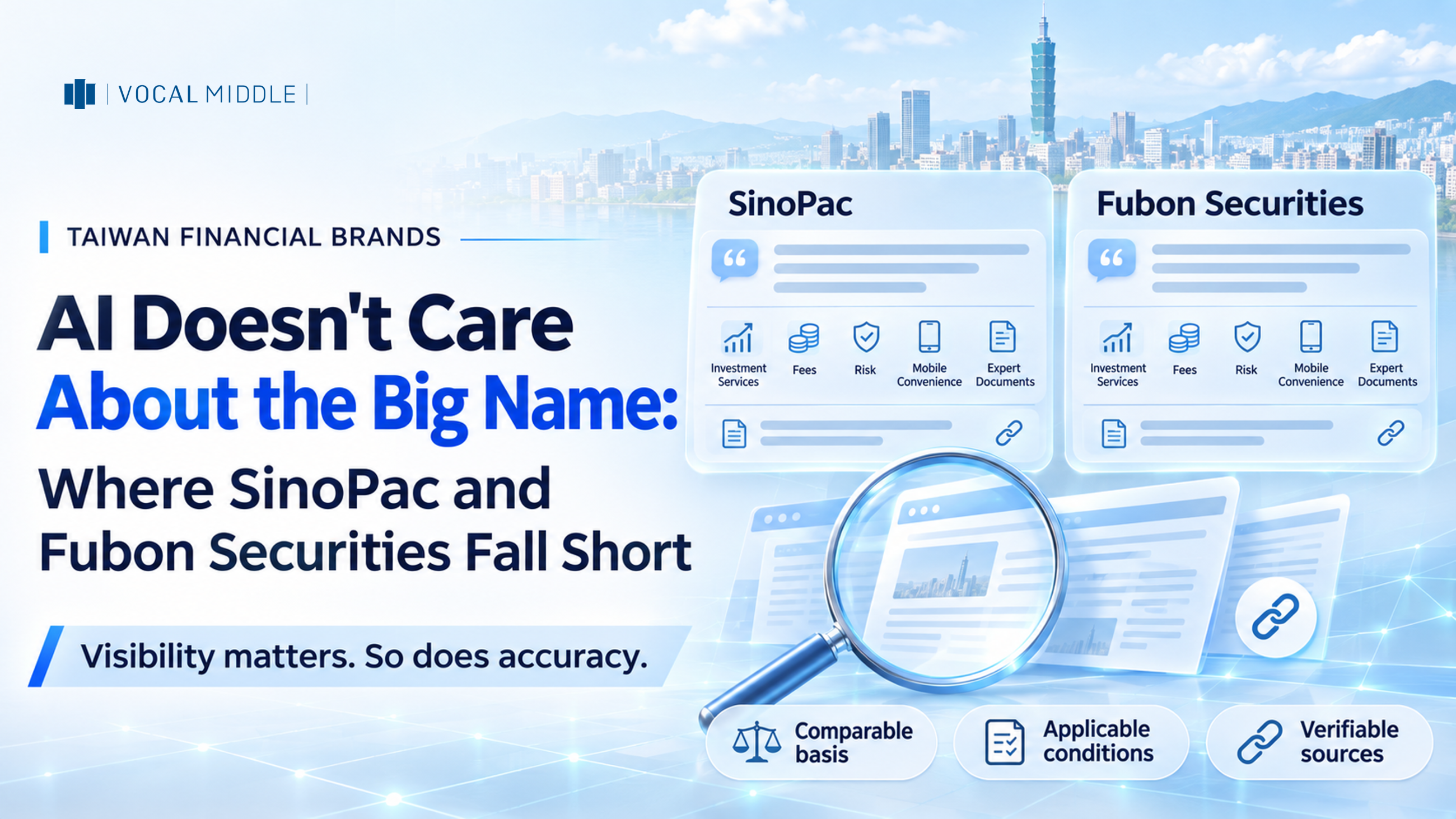
The question matters especially for financial brands. More investors now ask AI which broker has the lowest US stock fees, or which regular savings plan suits beginners, before opening an account. AI's answer shapes their first impression, and their understanding of fees, thresholds and risk. That is why a financial brand's AI visibility must be considered together with accuracy: whether comparisons use a consistent basis, whether information reflects the applicable conditions, and whether consumers are given verifiable sources are all part of image asset governance.
From November 21 to 27, 2026, we observed ChatGPT and Gemini in Taiwan in Traditional Chinese across two investment services. For SinoPac Securities' US stock sub-brokerage service (DAWHO), comparisons included Firstrade, Interactive Brokers, Cathay Securities, Fubon Securities, Yuanta Securities and others. For Fubon Securities' Taiwan stock and ETF regular savings plan, comparisons included Cathay Securities, SinoPac Securities, Yuanta Securities, KGI Securities and Capital Securities. Because the two reports cover different products, this article does not compare the two firms' rankings directly; it looks at how AI compares brokers within each product. The early conclusion: AI compares product details, not group names, and both firms are competitive when mentioned, yet both are missing from certain key comparison questions. Three questions are worth exploring: what criteria does AI use to compare brokers? Where does AI find answers on fees and risk, which investors care about most? And how can brands make sure those answers are both visible and accurate?
Across the two reports, the same broker's performance shifts sharply by product. SinoPac Securities trails the leaders clearly in US stock sub-brokerage, yet is one of the brokers AI mentions most when comparing Taiwan stock regular savings plans. Fubon Securities is near the front for regular savings plans, but in the middle to lower half for US stock sub-brokerage. In front of AI, investors are not comparing which financial group is bigger, but whether a product's fees, thresholds, tools and services suit them. For financial brands, image assets cannot be managed only at group level; each major product line needs its own comparable facts.
In US stock sub-brokerage comparisons, whenever SinoPac Securities appears alongside competitors, it outperforms the competitor average, and account opening and bank account integration are what AI recognises most. The problem is that for most investors' comparison questions, AI recommends only competitors such as Firstrade and Interactive Brokers, without mentioning SinoPac at all. This is not a product problem but an entry problem. SinoPac needs AI to find like-for-like information in comparison questions about trading tools, customer service and specific investor groups. The platform gap also stands out: it is close to the leading group on Gemini, but clearly weaker on ChatGPT.
Of all the US stock sub-brokerage topics, SinoPac Securities' widest gap is in safety and risk management. Investors putting money into overseas markets most want to confirm account protection, trading security and risk controls; when AI cannot find SinoPac's account of these, it can only cite competitors'. For a financial brand, this is both a visibility and an accuracy issue: if the brand does not explain them clearly, third parties or competitors will define how AI describes its safety and risk.
In Taiwan stock regular savings plan comparisons, Fubon Securities performs steadily on operational details such as the deduction mechanism, contribution flexibility and account opening, and usually leads when compared with competitors. Its weak point is fees: when investors compare long-term fees and promotions, AI often leaves Fubon out. AI describes competitors as suitable for small investors or low-threshold, descriptions largely absent for Fubon; instead, AI mentions limitations such as its minimum deduction amount and a more traditional interface. Some beginner account opening and settlement account questions are also answered by competitors. Fees and thresholds are the first things regular savings investors compare, and Fubon needs AI to state its promotions and applicable conditions completely and correctly.
Both reports show that when comparing brokers, AI most often cites personal finance blogs, financial comparison sites and content platforms rather than brokers' own websites. In regular savings plan comparisons, AI cites some brokers' official pages as evidence, but Fubon's site is used less often to support comparisons; in US stock sub-brokerage, SinoPac's site is cited mainly when the brand itself is mentioned. The reason may be that the information is not public or structured enough. The reports recommend, for example, making eligible investment lists viewable before login and bringing fees and promotions together in one place. For AI to describe a financial brand correctly, its site must offer complete facts, without login, with applicable conditions clearly stated.
The two brokers have different strengths and weaknesses, but the first step is the same: turn the conditions investors care about most into public facts that AI can compare and investors can verify. Then allocate resources according to each product's gaps.
This article observes AI search performance. It is not investment advice or a recommendation of any broker or financial product.
The full data behind these five observations is in the two original reports, including topic analysis, platform differences, competitive distribution and AI citation sources. The SinoPac report is in Traditional Chinese; the Fubon report is in English.
→ Download the SinoPac Securities I.Q. Lite report (US stock sub-brokerage)
→ Download the Fubon Securities I.Q. Lite report (Taiwan stock regular savings plan)
Want to see how your brand appears across markets, languages and AI models first? Start with ximu.
Does AI introduce your brand as the same brand in every market? An I.Q. strategic image diagnosis identifies which values should stay consistent and which should adapt by market. VM GEO and our PR consulting services then put the improvements into practice across content, media and channels.
→ Request a cross-market AI brand diagnosis
From this series
In VM's November 2026 I.Q. Lite monitoring, ChatGPT and Gemini compared Taiwanese brokers mainly on individual product fees and promotions, account opening, trading tools, eligible investments, service and risk management, rather than on the size of the financial group. The same broker performed very differently in US stock sub-brokerage and Taiwan stock regular savings plans.
In VM's November 2026 I.Q. Lite monitoring, SinoPac Securities' US stock sub-brokerage ranked fourth on the Seen & Trusted Index in ChatGPT and Gemini answers, behind Firstrade and Interactive Brokers. It outperformed competitors when compared side by side, with account opening and fund integration most recognised; but most comparison answers did not mention it, and safety and risk management was its biggest gap.
In VM's November 2026 I.Q. Lite monitoring, Fubon Securities' Taiwan stock regular savings plan ranked third on the Seen & Trusted Index in ChatGPT and Gemini answers, behind Cathay Securities and SinoPac Securities, with small gaps among the leaders. Its deduction mechanism was its strongest topic, and fee structure and promotions its weakest.
AI's answers shape how investors understand fees, thresholds and risk. If a brand does not provide public, complete information with applicable conditions stated, AI may cite third-party or competitor descriptions, leading to inconsistent comparisons or incomplete information. Financial brands need their websites and third-party sources to provide consistent, verifiable facts.
I.Q. Lite is a brand AI image report generated automatically by ximu's multi-role AI agent system, built on VM | VOCAL MIDDLE's expertise in branding, public relations and market growth. For a given market, language, set of AI models and competitors, it maps brand visibility, competitive comparison, citation sources and priority improvements.
STI (Seen & Trusted Index) compares brand performance under specified monitoring conditions. It is an observed indicator in AI answers, not a conversion rate or number of accounts opened; business decisions still need to consider the questions asked, source credibility and real customer response.
You May Also Like