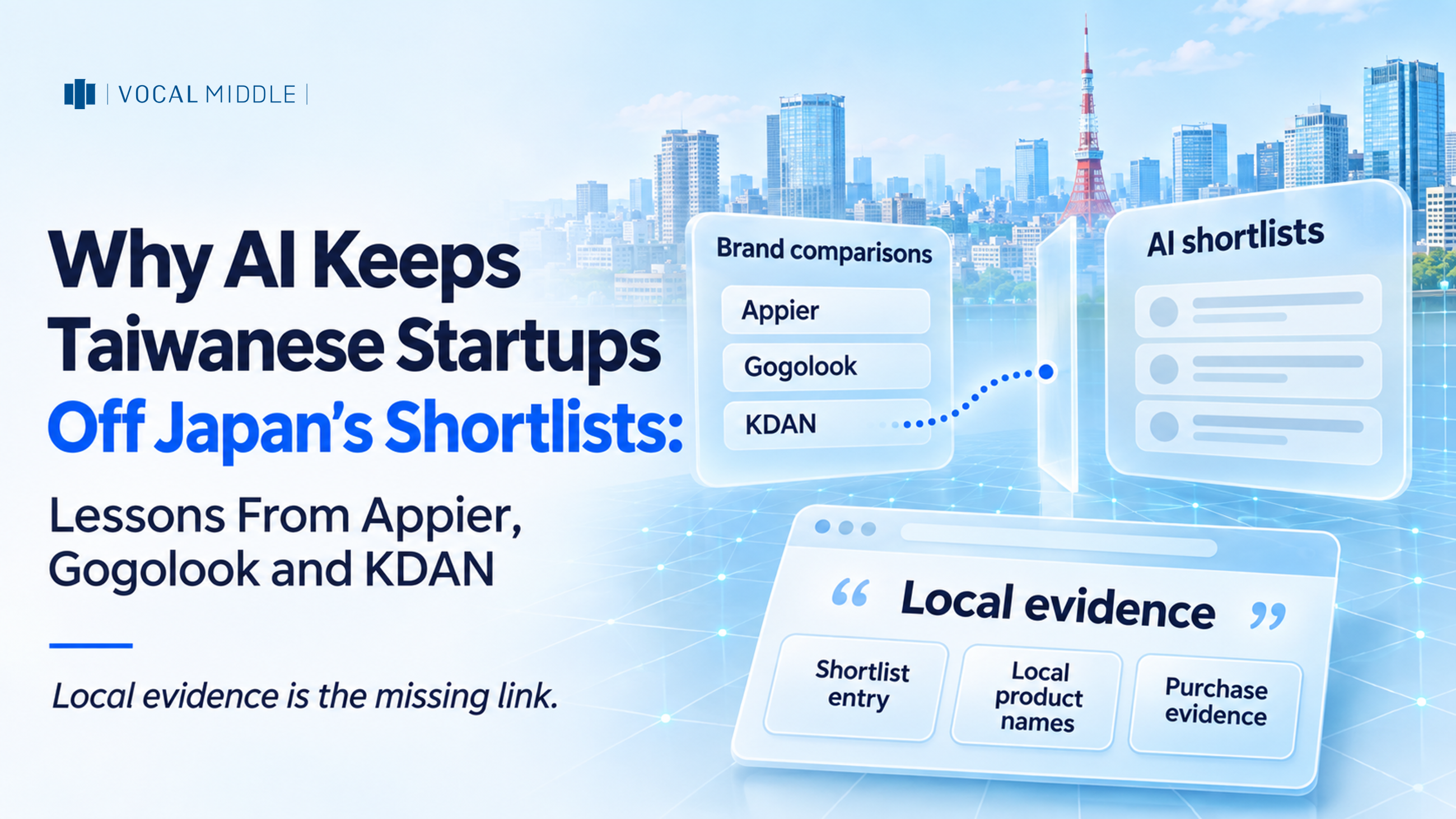
VM used I.Q. Lite to observe how ChatGPT and Gemini in Japan answer Japanese buyers' questions about marketing technology, fraud prevention and e-signatures. When Appier, Gogolook and KDAN appear alongside competitors, each outperforms its rivals, yet most comparison answers never mention them. The bottlenecks are threefold: getting onto the shortlist, linking the brand to its local product names, and third-party proof for buyers. This article sets out five observations and recommends that all three first make their official sites a source Japanese AI can cite, then move first on questions competitors have not yet answered well.
In our main article, From Seen and Understood to Done Well: A Practical Guide to Brand Growth in the AI Era for 2027, we used six I.Q. Lite reports to illustrate six growth challenges companies face across Asia-Pacific. This is a local-to-global case: three tech startups founded in Taiwan, taking proven products into Japan. They work in three different fields, marketing technology, fraud prevention and digital documents, and do not compete with one another. We look at them together because they face the same hurdle: entering Japan does not mean AI in Japan already knows them.
Before choosing a tool, Japanese companies and consumers increasingly ask AI in Japanese which options are worth comparing. AI then builds its answer from Japanese comparison sites, review platforms, press releases and institutional sources. A new entrant that has not left clear, verifiable facts in Japanese in these places will struggle to make the shortlist, however competitive the product.
From November 17 to 23, 2026, we observed ChatGPT and Gemini in Japan in Japanese: Appier against AI marketing platforms such as Adobe, Salesforce and KARTE; Gogolook against fraud prevention services such as Trend Micro and Tobila Systems; and KDAN against e-signature services such as CloudSign and GMO Sign. The early conclusion was consistent: whenever the three appear alongside competitors, they hold their own or do better, but in most comparison answers AI leaves them out from the start. That raises three questions worth exploring: why does AI in Japan not cite their official sites? Does AI recognise the company name or the product name? And beyond the comparisons competitors already own, which questions do Japanese buyers care about that no one has answered well?
What Appier, Gogolook and KDAN share is that they perform well when compared, but are rarely compared. In answers where they appear alongside competitors, AI rates them on par with or above Japan's market leaders. The problem is that such answers are few: most comparison questions list only competitors from the start. This is an entry problem, not a product problem. For startups entering Japan, the first priority is not more brand exposure, but giving AI enough Japanese-language grounds to include them when it answers which options are worth comparing.
When AI in Japan answers these questions, it mostly cites third parties: generative AI news sites, press release platforms and SaaS comparison sites for marketing technology; the National Police Agency and app stores for fraud prevention; competitors' sites and software review platforms for e-signatures. Appier's and KDAN's official sites did not appear among the main sources AI cites, and Gogolook's citations centred on the App Store and press releases. AI's picture of all three therefore comes largely from how others describe them. To control how they are introduced, the brands need to make their sites Japanese-language sources of facts that AI can cite directly and cross-check against third parties.
When AI searches for more information on behalf of Japanese users, it often uses the product name rather than the company name: Whoscall when comparing anti-fraud apps, DottedSign when comparing e-signature services. For startups entering a market under their company brand, this is a hidden risk. If Gogolook and Whoscall, or KDAN and DottedSign, are not consistently linked across Japanese websites, app stores, press releases and company profiles, the trust built by the brand cannot fully carry over to the product, and AI may treat them as unrelated. Correctly linking local assets to the brand is the bottleneck startups most often overlook, and one of the easiest to fix.
When Japanese buyers compare tools, what matters most is often not the feature list but whether they can adopt it with confidence. E-signature users check compliance with Japan's Electronic Signatures Act and Electronic Books Preservation Act and system integration; buyers of enterprise anti-fraud solutions look at data governance and compliance; marketing platform buyers compare platform selection and data analysis capabilities. These are the topics where the three startups are most often absent from AI answers, and where competitors are most often recommended. For a new entrant, this proof has to come from the brand itself, and be repeated by third-party sources Japanese buyers trust.
Appier and Gogolook both face a large number of Japanese questions for which AI currently recommends no brand at all; KDAN has fewer such gaps, and its opening lies in the compliance and onboarding topics competitors hold but it has yet to enter. Each also has scenarios where it is already established: Gogolook ranks first for fraud prevention for freelancers, KDAN has a base in large enterprise and government needs, and Appier performs relatively best on user experience and customer engagement. The gap between platforms is another opening: Appier and Gogolook are clearly weaker on ChatGPT, while KDAN is overshadowed on Gemini by local Japanese competitors. Rather than meeting competitors head-on where they dominate, new entrants can claim the unanswered questions first and extend outward from the scenarios where they are already strong. That is the most efficient shortcut.
The three startups work in different fields, but share the same bottlenecks, so the order of action can be the same: first make sure AI can find and recognise them, then make sure buyers can trust them.
The full data behind these five observations is in the two original reports, including topic analysis, platform differences and AI citation sources. Both reports are in Traditional Chinese.
→ Download the Appier I.Q. Lite report (Japan)
→ Download the Gogolook I.Q. Lite report (Japan)
→ Download the KDAN I.Q. Lite report (Japan)
Want to see how your brand appears across markets, languages and AI models first? Start with ximu.
→Explore ximu
Does AI introduce your brand as the same brand in every market? An I.Q. strategic image diagnosis identifies which values should stay consistent and which should adapt by market. VM GEO and our PR consulting services then put the improvements into practice across content, media and channels.
→ Request a cross-market AI brand diagnosis
Not necessarily. In VM's November 2026 I.Q. Lite monitoring in Japanese, Appier (AI marketing), Gogolook (fraud prevention) and KDAN (e-signatures) ranked sixth, third and fifth respectively on the Seen & Trusted Index in their categories. All three held their own when mentioned alongside competitors, but most Japanese comparison answers recommended only competitors.
When AI searches for more information on behalf of users, it often uses product names. In VM's November 2026 monitoring, AI searched for Whoscall when comparing anti-fraud apps in Japan, and DottedSign when comparing e-signature services. Brands need to link company and product names consistently on their Japanese websites, app store pages and press releases, so AI finds the same facts from either name.
AI prefers clearly structured sources it can cross-check, such as Japanese SaaS comparison sites, software review platforms and institutional sources. In VM's November 2026 monitoring, neither Appier's nor KDAN's official site appeared among the main sources AI cited. Websites need like-for-like comparisons, explanations of fit for the Japanese market and compliance information to become a factual basis for AI.
Start by finding questions competitors have not answered well but Japanese buyers care about, such as questions where no brand is currently recommended, and compliance, onboarding and enterprise scenarios. Then provide verifiable answers through the Japanese website and third-party platforms, and retest under the same conditions. VM calls this process diagnose, act and validate.
I.Q. Lite is a brand AI image report generated automatically by ximu's multi-role AI agent system, built on VM | VOCAL MIDDLE's expertise in branding, public relations and market growth. For a given market, language, set of AI models and competitors, it maps brand visibility, competitive comparison, citation sources and priority improvements.
STI (Seen & Trusted Index) compares brand performance under specified monitoring conditions. It is an observed indicator in AI answers, not a conversion rate; business decisions still need to consider the questions asked, source credibility and real customer response.
You May Also Like