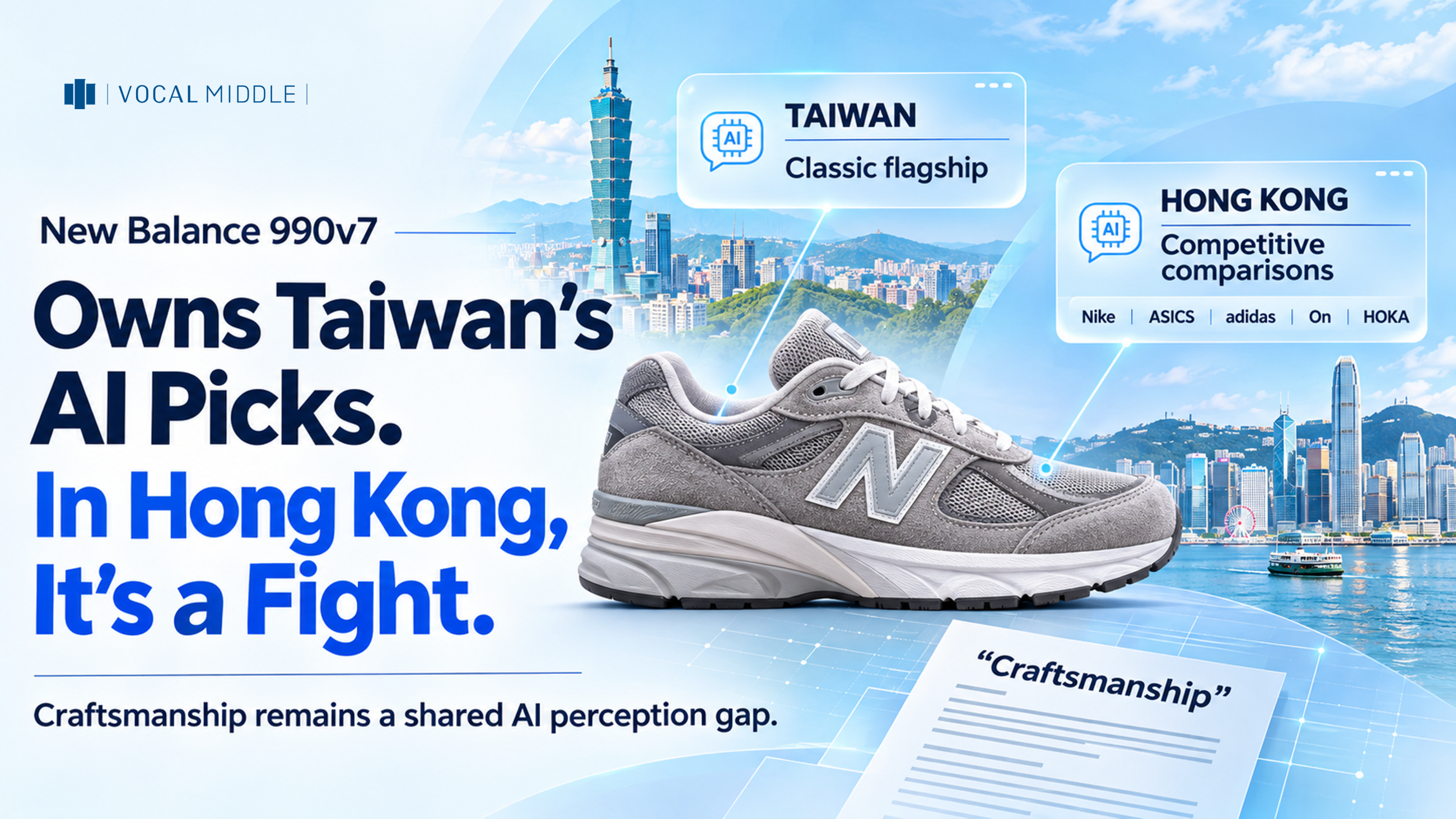
VM used I.Q. Lite to observe how ChatGPT and Gemini introduce New Balance 990v7 in Taiwan and Hong Kong. The shoe ranks first in both markets. In Taiwan, AI treats it as a clearly positioned classic flagship; in Hong Kong, AI mostly places it in comparisons with competitors. In both markets, the craftsmanship and quality that justify its premium price are the easiest ground for rivals to close in on. This article sets out five observations and recommends that cross-market brands first build one shared foundation of facts on craftsmanship and quality, then allocate content and channels market by market.
In our main article, From Seen and Understood to Done Well: A Practical Guide to Brand Growth in the AI Era for 2027, we used six I.Q. Lite reports to illustrate six growth challenges companies face across Asia-Pacific. The New Balance case is a global-to-global, cross-market question: when one international brand takes one product into two markets, which brand values must stay consistent, and which needs and sources of trust should adapt to each market?
Taiwan and Hong Kong are the two markets most easily treated as one. Both use Traditional Chinese, and both love sneakers and everyday style, so brands naturally reuse the same content. But shoppers in each market ask AI different questions before buying a premium everyday shoe, and AI cites different media and websites in each. When a headquarters report shows "ranked first" in both markets, it is easy to miss that shoppers in each market are hearing a different brand story.
From November 18 to 24, 2026, we observed ChatGPT and Gemini answers in each market, in Traditional Chinese (including colloquial Cantonese in Hong Kong), against Nike, ASICS, adidas, On and Hoka. Three things stood out. Both markets rank 990v7 first, but Taiwan's lead is stable while Hong Kong's is under pressure. AI in Taiwan remembers its positioning; AI in Hong Kong remembers its styling and fit. And the craftsmanship and quality behind its premium price are not secure in either market. That raises three questions worth exploring: why is the brand's core value its weakest point in AI? What evidence can win back the comparison questions in Hong Kong? And with different trusted sources in each market, how should budgets be allocated?
When Hong Kong shoppers ask AI, they usually get a comparison table rather than a single recommendation. 990v7 still leads, but ASICS is close behind, and for a set of near-purchase questions, such as everyday outfit recommendations and choosing a premium comfort shoe, AI recommends only competitors. That lead is not secure. In Hong Kong, the priority is not how well the brand is described when mentioned, but giving AI a clear reason to choose it in comparison questions. The two models also differ: ChatGPT mentions 990v7 noticeably less often than Gemini, so improvements should be tracked separately for each.
Shoppers pay more for 990v7 mainly because of its materials, craftsmanship and quality. Yet this is exactly where rivals close in most easily in both markets. When shoppers ask which lines are worth their price for quality without naming a brand, AI does not treat 990v7 as the default answer. In Taiwan, AI even describes it with fragments such as country of origin, supply and a narrow toe box; the report attributes these mainly to points the brand has not explained clearly, rather than to the product itself.
This is a shared risk: the most important reason for a premium price is the most fragile in AI. Craftsmanship and quality cannot be left for AI to infer from brand reputation. The brand needs to state them as facts that can be cited and verified.
AI in Hong Kong introduces 990v7 differently from Taiwan. Its strongest themes are not positioning, but grey aesthetics, styling, and size and width options. These are strengths Hong Kong shoppers already recognise, and the most natural entry point for the brand: extending from "how to wear it" into the styling recommendations and comfort-selection questions that competitors currently win. Carrying Taiwan's positioning story straight into Hong Kong risks missing what Hong Kong shoppers actually care about.
In Taiwan, AI most often cites New Balance's Taiwan website, so official content already serves as AI's factual basis for answering shoppers and is worth continuing to strengthen. In Hong Kong, AI mainly cites local media and lifestyle content sites, and rarely uses the official site. Global content on the official site will not automatically make it into AI answers in Hong Kong; brand messages need to travel through the sources Hong Kong AI already trusts. Channel budgets should follow: official content in Taiwan, media and content partnerships in Hong Kong.
A cross-market brand does not need to do the same thing in both markets. We recommend building one shared foundation of facts first, then allocating resources according to each market's position.
The full data behind these five observations is in the two original reports, including topic analysis, platform differences and AI citation sources. Both reports are in Traditional Chinese.
→ Download the New Balance 990v7 Taiwan I.Q. Lite report
→ Download the New Balance 990v7 Hong Kong I.Q. Lite report
Want to see how your brand appears across markets, languages and AI models first? Start with ximu.
→ Explore ximu
Does AI introduce your brand as the same brand in every market? An I.Q. strategic image diagnosis identifies which values should stay consistent and which should adapt by market. VM GEO and our PR consulting services then put the improvements into practice across content, media and channels.
→ Request a cross-market AI brand diagnosis
From this series
More I.Q. Lite case studies
In VM's November 2026 I.Q. Lite monitoring, New Balance 990v7 ranked first in ChatGPT and Gemini answers in both Taiwan and Hong Kong. The difference is that AI in Taiwan mostly recommends 990v7 on its own and emphasises its positioning, while AI in Hong Kong mostly compares it with competitors such as ASICS and Nike and emphasises styling and fit.
AI builds its answers from local media, content sites and official pages, depending on the region and language of the question. For New Balance 990v7, AI in Taiwan most often cites the brand's Taiwan website, while AI in Hong Kong relies mainly on local media and lifestyle sites, so shoppers in each market hear a different brand story.
Yes. A ranking is an average; GEO (generative engine optimization) addresses which key questions a brand is missing from and how it is described. New Balance 990v7 ranks first in Hong Kong, yet AI still recommends only competitors for a set of near-purchase questions.
First, align the brand facts shared across markets, such as craftsmanship, quality and specifications. Next, allocate content and channels to the sources AI trusts in each market, such as the official site, local media or review sites. Finally, retest under the same conditions. VM calls this process diagnose, act and validate.
I.Q. Lite is a brand AI image report generated automatically by ximu's multi-role AI agent system, built on VM | VOCAL MIDDLE's expertise in branding, public relations and market growth. For a given market, language, set of AI models and competitors, it maps brand visibility, competitive comparison, citation sources and priority improvements.
STI (Seen & Trusted Index) compares brand performance under specified monitoring conditions. It is an observed indicator in AI answers, not a conversion rate; business decisions still need to consider the questions asked, source credibility and real customer response.
You May Also Like