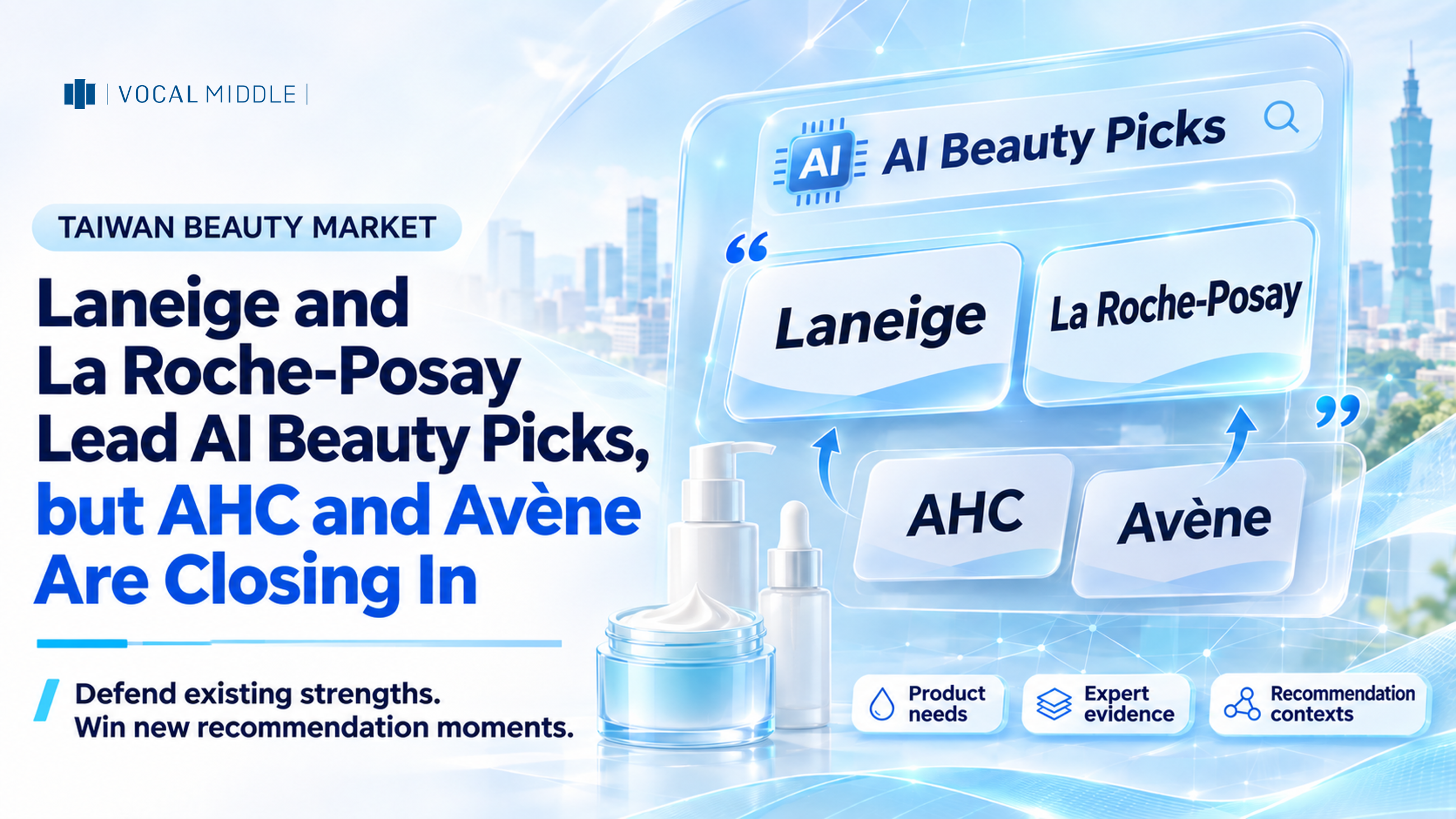
VM used I.Q. Lite to observe how ChatGPT and Gemini in Taiwan recommend Laneige's Water Sleeping Mask and La Roche-Posay's Anthelios sunscreen fluid. Both brands rank first, and AI describes them in line with their positioning. But when consumers list several requirements and ask AI for recommendations, Laneige is often replaced by AHC and My Beauty Diary; La Roche-Posay is mentioned most, yet Avène is ranked ahead of it for oily and sensitive skin. This article sets out five observations and recommends that leaders protect the strengths AI already understands, while moving first on new use scenarios.
In our main article, From Seen and Understood to Done Well: A Practical Guide to Brand Growth in the AI Era for 2027,, we used six I.Q. Lite reports to illustrate six growth challenges companies face across Asia-Pacific. This is a global-to-local case about leaders: Laneige and La Roche-Posay are international brands with high awareness and established market advantages in Taiwan. They work in different categories, skincare and sun care, and do not compete. We look at them together because they face the same question: how does a leader stay ahead?
Leading brands do not need to explain who they are, but they do need to check three things regularly: are their existing strengths still recommended correctly by AI? Through which questions are competitors entering? And where is the next purchase scenario to expand into? Consumers increasingly ask AI for a non-sticky sleeping mask that also brightens, or which sunscreen to take hiking, and AI's answers decide whether a leader's strengths extend to these new questions.
We observed the Taiwan market in Traditional Chinese from November 21 to 27, 2026. For Laneige's sleeping mask, we observed ChatGPT and Gemini, against Kiehl's, Origins, Innisfree, AHC, My Beauty Diary and Clinique. For La Roche-Posay's sunscreen, we observed ChatGPT, against Avène, CeraVe, Curél, Vichy and Sebamed. The early conclusion: AI understands both brands correctly and ranks both first, but first place does not mean every question is covered. Three questions are worth exploring: are leading brands still recommended when consumers phrase their questions differently? Through which questions are competitors entering? And what should leaders reinforce next, and where should they expand?
AI most often describes Laneige's sleeping mask as deeply hydrating with a light, non-sticky texture, and La Roche-Posay's sunscreen as lightweight, suitable for sensitive skin and fragrance-free. These descriptions match the positioning both brands have built over years, which means AI is not only mentioning them but recommending them correctly. For leading brands, this is an image asset accumulated over time and the foundation for further growth. The next step is not to tell a new story, but to keep product facts consistent across official sites and retail channels so this understanding is not diluted.
When consumers ask about dull skin after a late night or staying hydrated on business trips, AI almost always recommends Laneige, and often Laneige alone. But when a question lists several requirements at once, such as overnight hydration, brightening, a non-sticky texture, fast absorption and good reviews, and then asks which products are worth considering, Laneige sometimes disappears from the answer, and AHC, My Beauty Diary and Origins take its place. These consumers want exactly what Laneige offers; it is missing not because the product does not fit, but because AI cannot find comparable, citable evidence. In recommendation and brand-comparison questions, AHC is also often ranked ahead of Laneige. Platforms differ too: Gemini mentions Laneige more often than ChatGPT, but it also mentions Kiehl's far more. A strength on one platform does not automatically carry over to another.
In sunscreen recommendations in Taiwan, AI mentions La Roche-Posay far more often than competitors, and it ranks first overall in every topic. Yet in key topics such as oily and sensitive skin, Avène is often placed higher in the answer. When consumers read an AI recommendation list, the brands at the top tend to be considered first. La Roche-Posay's lead is about being mentioned most, not yet about being recommended first every time. To turn frequency into priority, AI needs clearer reasons to choose it in comparisons, such as like-for-like comparisons and evidence for oily and sensitive skin.
The two brands show opposite results in use scenarios. Laneige's strongest topic is travel: when consumers ask which sleeping mask to use on business trips or in air-conditioned hotel rooms, AI almost always mentions Laneige, and travel lifestyle sites are among the sources AI cites most. It is a strength the brand may not have deliberately built, but AI already recognises it, and it is worth deepening. La Roche-Posay's weakest topic is outdoor activity: when consumers ask which sunscreen to use for hiking, outdoor work or outdoor workouts, AI sometimes recommends only Avène, and sometimes no brand at all. AI's only reservation about Laneige is that it may not be moisturising enough for very dry skin in winter, which the brand can turn into clear guidance on who it suits. Whoever provides verifiable scenario evidence first claims the scenario first.
When recommending these two products, AI mainly cites where consumers actually buy and read, rather than brand websites. Laneige's citations come mainly from blog reviews, travel lifestyle sites, beauty media and e-commerce platforms; La Roche-Posay's from e-commerce platforms, pharmacy retailers and skincare review sites. Both brands also have sources competitors already use but they do not yet cover: for Laneige, some lifestyle service platforms and overseas deal sites; for La Roche-Posay, some e-commerce and pharmacy channels. For leading brands, product pages in retail channels and third-party reviews are what AI sees as the brand's facts.
The two brands are in similar positions, so the order of action is the same: first protect the strengths AI already understands correctly, then extend them to the questions competitors are entering and the scenarios no one has claimed.
The full data behind these five observations is in the two original reports, including topic analysis, platform differences, competitive distribution and AI citation sources. The Laneige report is in Traditional Chinese; the La Roche-Posay report is in English.
→ Download the Laneige I.Q. Lite report (Water Sleeping Mask)
→ Download the La Roche-Posay I.Q. Lite report (Anthelios sunscreen fluid)
Want to see how your brand is recommended across AI models, and who it is compared with? Start with ximu.
Your brand already leads, but can it handle new questions and new scenarios? An I.Q. strategic image diagnosis checks whether your strengths are still recommended correctly and which questions competitors are entering. VM GEO and our PR consulting services then put the next steps into practice across your website, retail channels and content partnerships.
→ Request a cross-market AI brand diagnosis
In VM's I.Q. Lite monitoring from November 21 to 27, 2026, Laneige's Water Sleeping Mask ranked first on the Seen & Trusted Index and on every other measure in ChatGPT and Gemini answers in Taiwan, and AI most often described it as deeply hydrating with a light, non-sticky texture. In recommendation questions that list several requirements, however, Laneige was sometimes missing, with AHC, My Beauty Diary and others taking its place.
In VM's I.Q. Lite monitoring from November 21 to 27, 2026, La Roche-Posay's Anthelios sunscreen fluid ranked first on the Seen & Trusted Index in ChatGPT answers in Taiwan, and first overall in every topic. In recommendation order, however, Avène was often placed higher in topics such as oily and sensitive skin, and outdoor sun care was La Roche-Posay's weakest topic.
AI models draw on different training data and live search sources, so they understand brands differently. In VM's November 2026 monitoring in Taiwan, Gemini mentioned Laneige's sleeping mask more often than ChatGPT did, and also mentioned Kiehl's more often. Brands cannot assume a strength on one platform carries over to another, and need to check each one.
Yes. First place is an average; when consumers phrase their questions differently, leading brands are not always recommended. In VM's November 2026 monitoring, Laneige was sometimes replaced in multi-requirement recommendation questions, and in outdoor sun care some questions went to competitors or to no brand at all instead of La Roche-Posay. Leaders need to check regularly that their strengths are still recommended correctly.
I.Q. Lite is a brand AI image report generated automatically by ximu's multi-role AI agent system, built on VM | VOCAL MIDDLE's expertise in branding, public relations and market growth. For a given market, language, set of AI models and competitors, it maps brand visibility, competitive comparison, citation sources and priority improvements.
STI (Seen & Trusted Index) compares brand performance under specified monitoring conditions. It is an observed indicator in AI answers, not a conversion rate; business decisions still need to consider the questions asked, source credibility and real customer response.
You May Also Like