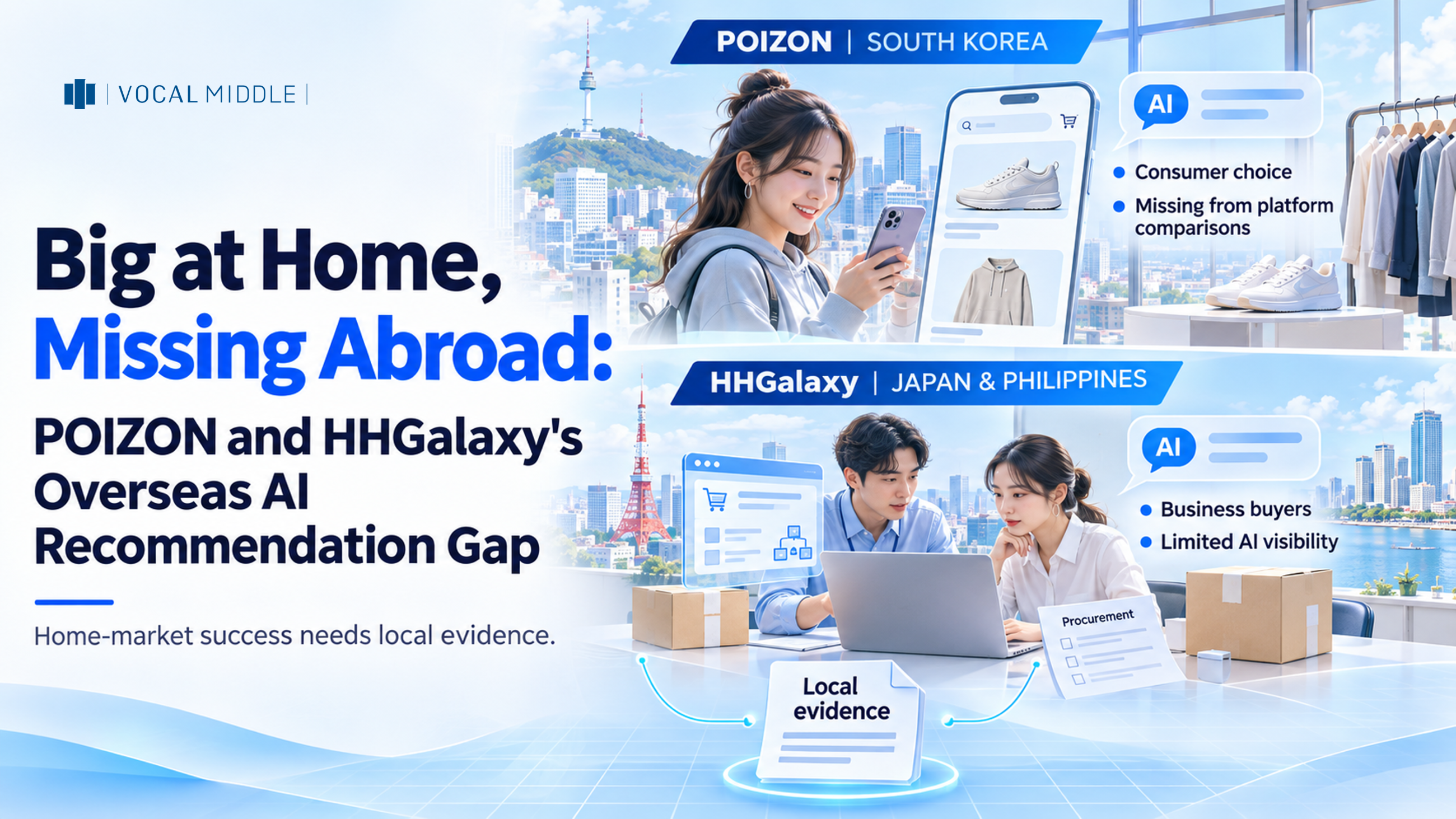
VM used I.Q. Lite to observe two kinds of cross-border e-commerce expansion. Dewu entered Korea as POIZON, where consumers choose a shopping platform; HHGalaxy entered Japan and the Philippines, where companies look for an e-commerce operations partner. Korean AI already recognises POIZON's authentication strength, but leaves it out of platform comparisons and luxury fashion. HHGalaxy does not yet appear in any AI recommendation, yet most questions in its markets have no provider recommended at all. This article sets out five observations and recommends that both add verifiable proof in the local language, then place it where consumers and business buyers, respectively, look.
In our main article, From Seen and Understood to Done Well: A Practical Guide to Brand Growth in the AI Era for 2027,, we used six I.Q. Lite reports to illustrate six growth challenges companies face across Asia-Pacific. This is a local-to-global case of cross-border e-commerce. Dewu is an established trend e-commerce platform in mainland China and entered Korea as POIZON. HHGalaxy built its e-commerce services experience in Taiwan and extended its services to brands and companies in Japan and the Philippines. The two do not compete. We look at them together because they represent two very different ways of going abroad: one must persuade consumers, the other must persuade corporate buyers.
The business question is how success in a home market is understood in a new one. Home-market experience is an asset, but not a guarantee abroad. Consumers and business buyers in a new market ask AI different questions, and AI looks for answers in different places. Brands need to know which existing strengths are already understood, and which need new evidence to be established.
We observed both from November 17 to 23, 2026. For POIZON, questions were asked in Korean in Korea on ChatGPT and Gemini, against Musinsa, StockX, Farfetch, Vestiaire Collective, Klekt, GOAT and others. For HHGalaxy, questions were asked in English, Filipino and Japanese in Japan and the Philippines on ChatGPT, against e-commerce operations providers such as AnyMind Group, etaily and transcosmos. Two very different situations emerged. AI recognises POIZON's authentication process, but when Korean consumers compare platforms, AI mostly thinks of competitors. HHGalaxy does not yet appear in AI recommendations at all, but in its markets most questions have no provider recommended either. That raises three questions worth exploring: which home-market strengths have travelled with the brand? What new evidence does the new market require? And where should that evidence sit for consumers versus business buyers?
When AI in Korea mentions POIZON, it describes a strict authentication process and a trustworthy buying environment, the very strengths Dewu built in its home market. In answers about POIZON alone, AI introduces it fully and positively, and buying and authenticating sneakers and limited releases is its strongest topic in Korea. The problem is that this recognition is narrow, and POIZON is mentioned far less often than competitors. The home-market strength has travelled with the brand, but becoming Korean consumers' default choice requires more Korean-language facts and word of mouth.
When Korean consumers ask AI which platform is safest for trend products, most answers recommend only Musinsa and other competitors, without mentioning POIZON. Yet in the few answers where POIZON and Musinsa are compared, the two perform closely. POIZON's problem is not losing the comparison, but not being in it. In these comparison questions, AI cites Musinsa's own website as a source of facts, while POIZON lacks equally clear Korean-language platform information. To get into the comparison, POIZON needs to give AI like-for-like platform information: authentication, returns, delivery and fees.
In questions about buying luxury and high-end fashion, AI answers did not mention POIZON at all. This is not a small gap at the edge of its sneaker strength, but a new category AI has not yet associated with POIZON. Consumers here care about brand trust and authenticity guarantees, and AI's citations show that encyclopedias and content platforms are key channels through which it learns about brands. To enter this category, POIZON needs evidence specific to luxury fashion, such as coverage in Korean fashion media and updated encyclopedia information, rather than carrying over its sneaker authentication story as it is.
When brands in Japan or the Philippines ask AI which e-commerce operations services to consider, HHGalaxy currently appears in no answer. The other side is more telling: in these business buyers' questions, the vast majority of answers recommend none of the providers observed, and English-language questions in the Philippines are entirely open. Japan already has early movers such as AnyMind Group and etaily, while the Philippines is almost unclaimed. For HHGalaxy, this is not a fight to take positions from competitors, but a window in which whoever gets known to AI first claims the ground first.
In POIZON's consumer market, AI cites blogs, video and encyclopedias. In HHGalaxy's business market, AI cites Japanese databases of e-commerce service providers, SaaS comparison sites and e-commerce platforms' partner directories. Business buyers want to confirm that the company exists, what services it offers, which platforms it works with and whether it can deliver. HHGalaxy's website does not yet appear in any source AI cites. The two kinds of expansion need different evidence in different places: consumers look at word of mouth and real-world proof; companies look at directories, cases and delivery capability.
The two companies face different buyers, but the first step is the same: turn the capabilities built in the home market into facts the new market can verify, in the local language. Then place that evidence where AI looks, according to the needs of consumers and business buyers.
The full data behind these five observations is in the two original reports, including topic analysis, competitive distribution and AI citation sources. Both reports are in Traditional Chinese.
→ Download the Dewu POIZON I.Q. Lite report (Korea)
→ Download the HHGalaxy I.Q. Lite report (Japan, Philippines)
Want to see how your brand appears across markets, languages and AI models first? Start with ximu.
→ Explore ximu
Does AI introduce your brand as the same brand in every market? An I.Q. strategic image diagnosis identifies which values should stay consistent and which should adapt by market. VM GEO and our PR consulting services then put the improvements into practice across content, media and channels.
→ Request a cross-market AI brand diagnosis
In VM's November 2026 I.Q. Lite monitoring in Korean, POIZON ranked fourth on the Seen & Trusted Index in ChatGPT and Gemini answers, with Musinsa first. AI recognises POIZON's authentication process, and sneaker buying and authentication is its strongest topic; but most platform comparison answers recommended only competitors, and AI did not mention POIZON at all in luxury fashion.
In VM's November 2026 I.Q. Lite monitoring, HHGalaxy did not yet appear in ChatGPT's answers to questions about e-commerce operations services in Japan and the Philippines. However, the vast majority of those answers recommended none of the providers observed, and English-language questions in the Philippines were entirely open, leaving room to claim the ground first.
AI builds answers in the new market's language from local blogs, encyclopedias, media, business directories and platform listings. The reputation and information a brand built at home do not automatically appear in these sources; the brand needs to re-establish verifiable facts and third-party evidence in the local language.
In consumer markets, AI more often cites blogs, video and encyclopedias, and weighs word of mouth and real experience. In business markets, AI more often cites business directories, SaaS comparison sites and platform partner listings, and weighs whether the company exists, its service scope and its delivery capability. The content and placement of evidence need to be planned separately for each.
I.Q. Lite is a brand AI image report generated automatically by ximu's multi-role AI agent system, built on VM | VOCAL MIDDLE's expertise in branding, public relations and market growth. For a given market, language, set of AI models and competitors, it maps brand visibility, competitive comparison, citation sources and priority improvements.
STI (Seen & Trusted Index) compares brand performance under specified monitoring conditions. It is an observed indicator in AI answers, not a conversion rate; business decisions still need to consider the questions asked, source credibility and real customer response.
You May Also Like