Every annual planning cycle begins with familiar questions: which market deserves more investment, which channel should receive the next allocation, and which campaign should come next? Yet as buyers increasingly turn to AI to research, compare and verify their options, a more consequential question comes first: how do people and AI actually understand your business?
Before you commit your 2027 marketing and business development budget, answer three questions:
Brand assets already exist in products, technical competence, service delivery, media coverage, customer relationships and market reputation. The task is to understand how those assets perform across human and AI decision environments—and where investment can make a commercial difference.
ximu is an AI-Native IMAGE Asset Governance Platform. It helps enterprises observe how brands are mentioned, compared and supported by sources across AI models, languages and markets. Start with a buying decision rather than a dashboard score.
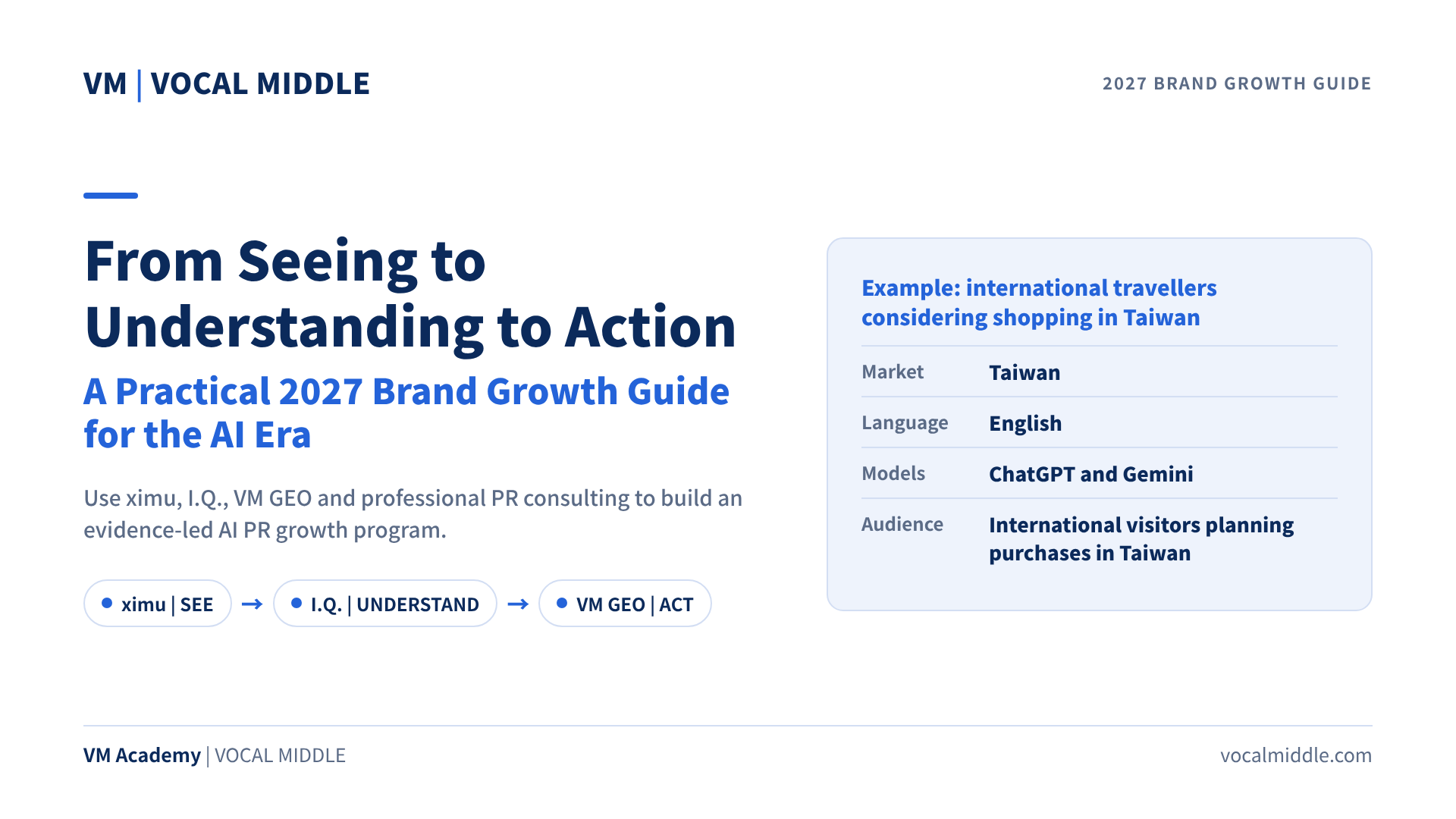
Example: international travellers considering shopping in Taiwan
|
Parameter |
Example |
|
Market |
Taiwan |
|
Language |
English |
|
Models |
ChatGPT and Gemini |
|
Audience |
International visitors planning purchases in Taiwan |
|
Topics |
Gifts, retail locations, brand comparisons and authentic products |
|
Competitors |
Your brand and three to five relevant alternatives |
|
Query categories |
Discovery, comparison, verification and purchase intent |
Hold the buying scenario constant when comparing models. Then change market or language one variable at a time. This reveals where differences may come from rather than hiding them inside a single average.
STI (Seen & Trusted Index) compares AI visibility and trust-related signals within a defined observation set. It is not a measure of realized sales or the whole market’s actual trust. Inspect the underlying responses and evidence before choosing an action.
I.Q. is VM’s strategic image intelligence and advisory report. It combines query intent, brand and competitor representation, STI and cited sources with the commercial question at hand. The output is a decision about which gap to address first.
|
What you observe |
What I.Q. explains |
What the business can do |
|
Missing from answers |
Is the gap product information, local relevance or third-party recognition? |
Improve verifiable product and service evidence |
|
Mentioned but not preferred |
Which competing proof is shaping recommendations? |
Address high-intent comparison questions |
|
Positioning is misunderstood |
Which sources repeat the wrong or outdated claim? |
Correct key facts and strengthen credible sources |
|
Markets show different patterns |
Is the difference driven by language, model or buyer intent? |
Adapt local evidence and channels |
Over the past three months, the VM team has worked across Taipei, Hong Kong, Singapore, Shanghai and Tokyo, speaking with businesses in technology, financial services, consumer retail, ecommerce and growth-stage sectors. Their questions repeatedly converge on six practical management challenges: How do established leaders defend their position? Where are the bottlenecks for international challengers? Why does the same brand receive different treatment across markets and AI models? And which changes merit commercial investment? The six I.Q. Lite reports below illustrate how businesses can turn market questions and AI evidence into decisions they can act on.
How I.Q. Lite Reports Are Produced | Human Expertise, Automated Analysis
The I.Q. Lite reports featured here are generated automatically by role-specific AI agents built into ximu. Their analytical methods draw on nearly two decades of multidisciplinary professional experience across the VM team, translated into specialist roles, evaluation criteria and coordinated workflows:
Once the market, language, models, brands and core queries are defined and the required data is available, ximu runs an end-to-end AI workflow: consolidating responses, interpreting intent, comparing brands and competitors, examining cited sources, prioritizing growth opportunities and producing the I.Q. Lite report. The analytical work is automated; the questions, methodology and standards of judgment are grounded in human expertise. That structure allows reports for different industries and markets to be produced consistently and at scale.
01 | New Balance: Taiwan and Hong Kong
Global to Global | Compare ChatGPT and Gemini across product positioning, competitor sets, buyer situations and cited sources.
The management task is to separate globally consistent brand assets from evidence and shopping needs that must work differently in each market.
→ Read the full I.Q. report | New Balance, Taiwan and Hong Kong
02 | Technology: ASUS ROG in the U.S. and USPACE in Taiwan
ASUS ROG: Global to Global, focused on gaming hardware comparisons, expert reviews and purchase intent. USPACE: Local to Local, focused on parking convenience, service coverage and trusted information.
Both are technology businesses. One competes across global markets; the other must keep winning customer decisions in its home market. Their evidence should be judged against different buyer situations.
→ Read the full I.Q. reports | ASUS ROG and USPACE
03 | Appier, Gogolook and KDAN: growth bottlenecks in Japan
Local to Global | Compare Japanese buyer questions across marketing technology, fraud prevention and digital document services.
Three issues stand out in the observed Japanese selection context: shortlist inclusion, attribution of local market assets to the right company, and the third-party evidence buyers rely on. The leapfrog opportunity is to solve questions competitors leave insufficiently answered.
→ Read the full I.Q. report | Taiwan startups in Japan|Appier, Gogolook and KDAN
04 | Financial services: SinoPac and Fubon Securities
Local to Local | Compare equivalent investment service needs, appropriate risk and fee information, institutional expertise and cited evidence in Taiwan.
For financial services, visibility must be read alongside accuracy, comparability and verifiable information; AI answers are not a substitute for financial advice.
→ Read the full I.Q. report | Taiwan investment services
05 | LANEIGE and La Roche-Posay: how leaders keep leading
Global to Local | Examine product needs, specialist evidence, established strengths and emerging competitive narratives in Taiwan.
Strong brands should focus on defending recommendation advantages, identifying emerging needs and extending their leadership rather than restarting awareness building.
→ Read the full I.Q. report | Beauty leaders in Taiwan
06 | Ecommerce expansion: Dewu in Korea and HH Galaxy in the Philippines
Local to Global | Examine whether home-market strengths transfer into new buyer needs and whether local service, partner and fulfilment evidence is sufficient.
Growth abroad depends on understanding the new market’s decision process, not reproducing the same home-market campaign.
→ Read the full I.Q. reports | Dewu and HH Galaxy
The ximu product site uses three stages—Diagnose, Act and Verify—to describe evidence-led growth. VM’s GEO service page details the underlying work: query collection, brand analysis, GEO pathway analysis, optimization and continued observation.
|
Stage |
Execution |
Evidence to review |
|
Diagnose |
Review buyer questions, brand comparisons, AI responses and cited sources |
Query set, answer samples, source analysis and baseline |
|
Act |
Improve verified facts, professional content, earned sources and local purchase support |
Content changes, third-party proof, channel execution |
|
Verify |
Repeat comparable observations and connect them with customer and business feedback |
STI trend, mentions, qualified enquiries and commercial outcomes |
Credible GEO is not answer manipulation. The work improves the facts and trusted evidence available to both AI systems and real buyers.
VM | VOCAL MIDDLE is an AI-Native PR Consulting Firm. PRaaS 2.0 integrates image asset monitoring, strategy, professional communication and ongoing governance across human and AI decision environments.
|
Business need |
Starting point |
Management output |
|
See how AI represents the brand |
ximu |
Multi-model and market baseline |
|
Understand the gap and priorities |
I.Q. |
Strategic diagnosis and investment priorities |
|
Improve sources and recommendations |
VM GEO |
Execution, retesting and continual adjustment |
|
Connect markets, media, expertise and channels |
PRaaS 2.0 and professional PR |
Ongoing human-and-AI brand governance |
AI PR is VM’s approach to public relations, built around IMAGE Asset Governance. It integrates human expertise, media and stakeholder relationships with how AI systems interpret brands, cite sources and form recommendations. This makes brand perception measurable and actionable, while keeping commercial outcomes grounded in real customer decisions.
The next 2027 brand-growth investment should deliver more than another visibility figure. It should yield a sharper market decision, a stronger course of action and better reasons for people and AI to understand, trust and choose the business. Start with one market, one audience and one consequential buying question.
VM Academy | VOCAL MIDDLE
You May Also Like