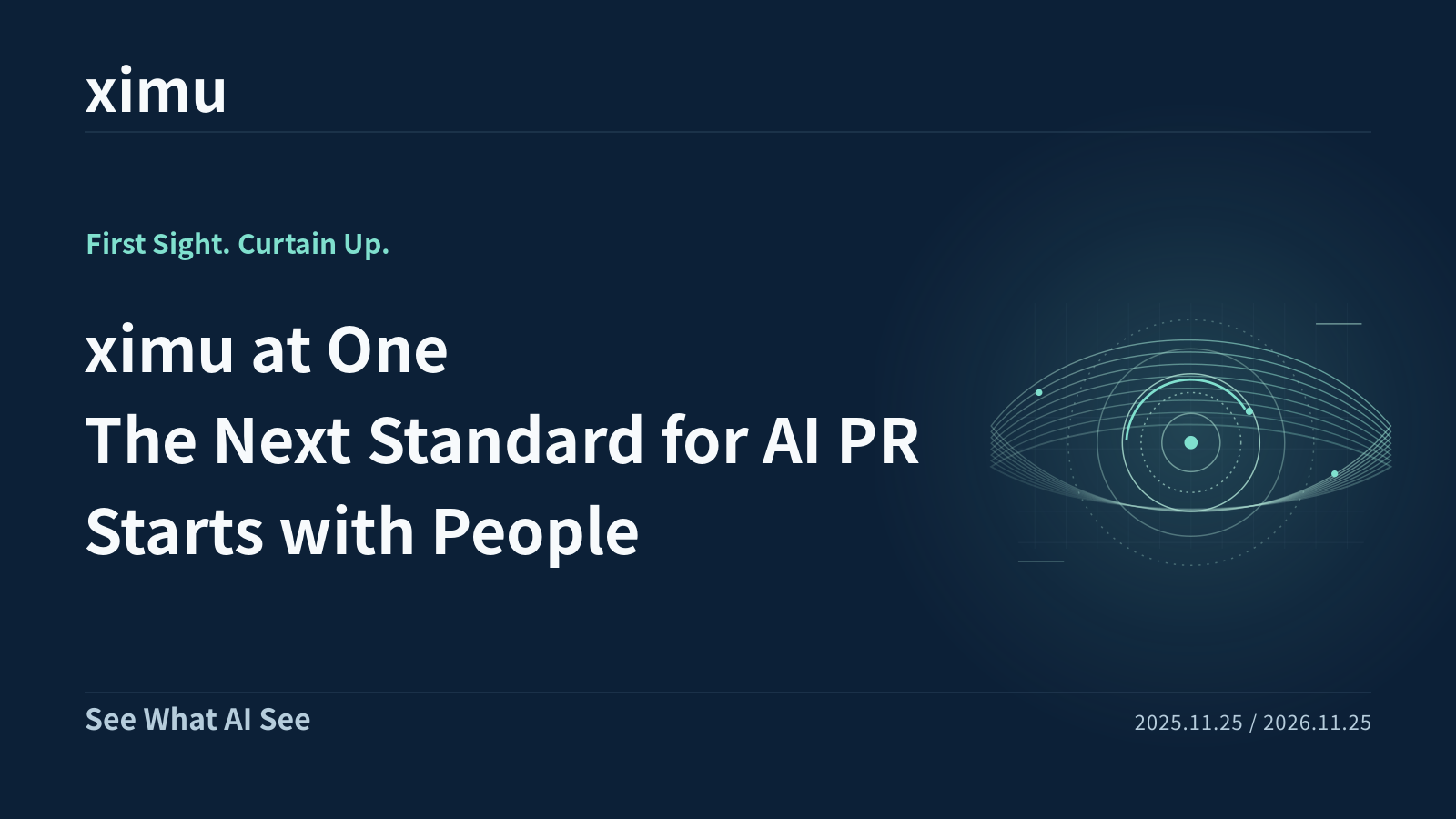
On 25 November 2025, ximu opened to the public for the first time as a beta, under the title First Sight. Curtain Up. VM's launch post asked one question: "Have you ever seen yourself through the eyes of AI?"
A year on, businesses can see how AI understands, introduces, trusts and recommends them. With that, the next question has surfaced: once you can see, who decides what to do? Who turns that judgement into action? And who confirms that the action actually changed anything?
That is why ximu's first anniversary is worth looking back on. The product lets businesses see a decision environment that was once hard to observe. AI PR takes this back to a larger question: how can an organisation continuously govern its IMAGE Asset, both in the human world and in the answers AI gives?
In 2017, VM introduced the concept of IMAGE Asset. The concern then was whether communications investment could leave lasting, usable evidence of trust, rather than dissipating when a campaign ended.
In 2024, VM completed its end-to-end AI architecture. In June 2025, it launched VM GEO as its entry service, and in November that year it brought ximu online.
This path gave the IMAGE Asset question a field that can actually be observed. When people use AI to learn about or compare companies, which evidence appears in the answers, and which critical information is left out?
VM defines this work as AI PR: Human × AI IMAGE Asset governance.
It rests on three essentials:
Under PRaaS 2.0 (PR as AI Solution), four components put these into practice:
Consider a service that is described accurately in Chinese-language answers in Taiwan, yet reduced to an outdated product description in English-language answers in another market. The fix is not necessarily another article. A consultant must first identify which sources are being cited and confirm whether the new information is sufficiently evidenced. Only then do they decide whether to update the website, add third-party material, or align messaging with partners. After the changes, the same comparable questions are asked again to see which answers have shifted and which have not. That is a completed loop.
Once systems can help monitor, compare and carry out initial analysis, businesses must answer a new set of questions. Which judgements must people own? Who in the organisation has the authority to decide, who verifies, and who is accountable for the outcome? Which processes should be handed to systems, and which checkpoints must remain?
Standards for recruiting, training, retaining and deploying talent will change too. Knowing how to use the tools is only the starting point. What matters more is developing people who can read evidence, spot blind spots, make trade-offs and take responsibility for decisions. These standards cannot be written as answers in advance. VM's next step is to test them in its own organisation and client projects, so that the standards grow out of real work.
In ximu's first year, VM answered one question: can businesses see themselves through the eyes of AI? The question for the year ahead is this: once they can see, do they have a way for people and systems to work together and carry change through to the end?
Revisit the 2025 ximu launch post | Explore ximu
About VM | VOCAL MIDDLE
VM | VOCAL MIDDLE is an AI-Native PR Consulting Firm. Through PRaaS 2.0, it integrates AI systems with professional PR expertise to help organisations govern their IMAGE Asset, so they are seen, understood and trusted in decisions made by people and AI.
You May Also Like