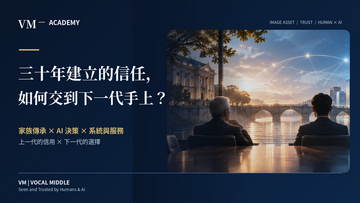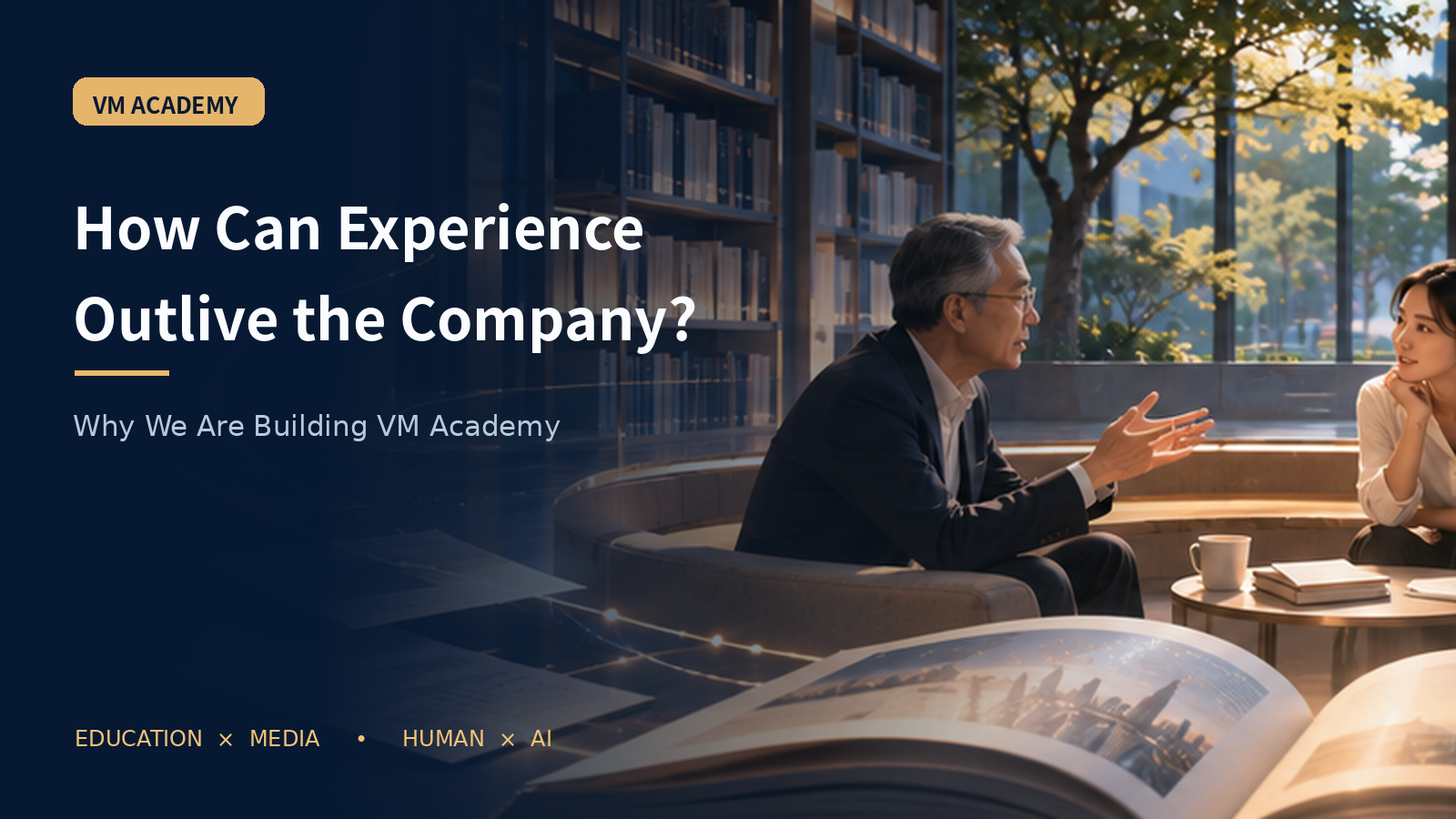
A business can hand over shares, job titles and facilities. What it cannot simply include in a succession checklist is the judgment its leaders developed over thirty years.
Earlier this week, we explored the transfer of trust across generations: how the credibility built by founders can continue to be understood and chosen by new executives, younger clients, new markets, and people increasingly using AI to research and compare potential partners. The answer is more demanding than another corporate profile. Knowledge once carried through personal relationships needs new language, verifiable evidence and opportunities for genuine conversation.
The same challenge faces professional-services firms. An experienced adviser may know why a crisis should not be answered immediately; a client lead may know when publicity is the wrong investment; a founder may understand why one market is worth entering and another promise should never be made. When that judgment exists only in one person’s memory, even a successful business can struggle to pass on what makes it valuable.
VM|VOCAL MIDDLE has operated for twelve years. We are not a large company, but we have always believed that a company’s responsibility can be bigger than its headcount: not merely to deliver work for clients, but to make what we have learned in the market available for others to understand, question, apply and, eventually, surpass. This belief is why we are gradually building VM Academy.
What one generation leaves the next should not amount to, “This is how we have always done it.” The assumptions, constraints, discarded alternatives and consequences of a decision also deserve to be explained.
For younger professionals, such decisions cannot be fully taught by a textbook. For experienced leaders, a new generation’s questions are not necessarily a rejection of established practice. Different markets, working methods and technologies make yesterday’s sound decisions worth revisiting. Protecting what remains valuable and innovating where necessary are complementary responsibilities.
If education consists only of a speaker giving answers to a room, succession remains a one-way instruction. We are more interested in a harder possibility: Can experienced people speak openly about their trade-offs while younger people gain the right to challenge, understand and eventually form judgments of their own?
That is why, since 2019, we have continued to host our PR Strategy Open House. Real business issues, multidisciplinary perspectives and conversations without predetermined answers give students access to the thinking of business leaders long before they have spent years in the workplace. In 2023, our year-end gathering brought industry leaders, educators and young people into the same conversation. The point was not a bigger stage, but a fairer distribution of the right to ask and answer questions.
VM Academy did not appear in 2026 as a newly branded course business. Its foundations go back further.
In 2019, we began bringing real PR problems to students through strategy open houses, practical engagement and our emerging-talent initiatives. At our eighth anniversary in 2022, VM made its sustainability commitments more explicit. Our Love, On Air initiative brought together environmental action, the application of professional communications capabilities for social benefit, and long-term investment in young people and future leaders. Giving young people meaningful access to the business world is part of our responsibility to society, not a photogenic annual event.
Each year, we have continued to address that responsibility from a different angle. In 2024, our conversation about the “teammates behind influence” brought practitioners from PR, digital and creative disciplines together. In 2025, we explored resilience, leadership and international standards. In 2026, as AI materially changes work processes and organizational roles, we are asking business leaders to discuss the difficult decisions they are making now.
We have come to believe that the lasting assets are not event counts. They are the questions carefully posed, the experiences open to verification, and the new understanding produced through dialogue. A company that preserves these assets does not have to begin from zero with each new generation.
Education and media appear to serve different purposes. For the stewardship of professional knowledge, they are mutually reinforcing capabilities.
| Education | Media | |
| Core question | How does experience become judgment that others can practise? | How does experience become public knowledge that others can examine and cite? |
| Methods | Problem framing, facilitation, case analysis, dialogue, practice and feedback | Observation, research, interviews, editing, publication and public discussion |
| Value | Professional capability and better decisions | Accumulating perspectives, reliable information and industry dialogue |
Media helps knowledge be discovered and understood; education allows knowledge to be tested and used. A well-sourced essay can begin a meaningful seminar. A question raised during that seminar may become the subject of the next research piece. Knowledge becomes durable when editorial work, learning, practice and feedback form a continuing loop.
For us, Media does not mean posting more often on social networks, nor does it imply that we already operate a fully developed independent media enterprise. It means developing a serious editorial and public-knowledge capability: choosing questions that matter, checking claims, representing different perspectives, and preserving hard-earned experience for people who will arrive later. Education deserves equally rigorous standards. Repurposing a slide deck into a course does not, on its own, make an academy.
VM Academy is beginning to connect activities we already undertake—strategy open houses, founder essays, consultant interviews, professional exchanges and practical AI PR exercises—within a clearer knowledge architecture. Those are our existing foundations. A fully developed catalogue of learning products, courses or certifications remains a direction to validate, not an accomplished claim.
AI radically accelerates the creation, synthesis and reuse of information. It also exposes an old weakness of professional organizations: much of their most valuable experience remains trapped in meeting rooms, individual memories and unstructured files.
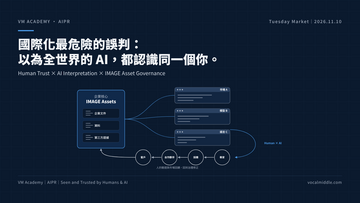
Our view of AI PR is grounded in the governance of image assets: how people understand and evaluate a company; how AI retrieves, reconstructs and represents it; and how those processes interact when trust and choice are formed. The work requires more than producing content. It requires responsible sources, preserved context, an understanding of stakeholders, and a continuing connection between monitoring, insight, planning and execution in a Human × AI environment.
The same principle applies to VM itself. If a business’s thirty years of credibility deserve protection, a consulting firm’s twelve years of accumulated professional judgment deserve to be organized, published and passed on. Protection need not mean keeping knowledge locked away. It means making facts, methods and responsibility traceable. Innovation means enabling those who follow to understand the foundations and then propose something better.
VM’s methodology did not begin with generative AI. In 2017, we introduced our seven-stage I.M.P.U.L.S.E. strategy-first PR methodology, linking information, monitoring, processing, the application of professional judgment, planning, strategy, and execution with evaluation. Today’s AI tools expand the reach and speed of those activities; they do not remove the obligation to define problems carefully and remain accountable.
VM Academy is therefore not a sales channel disguised as a classroom for ximu, IQ or GEO. These tools and services can support evidence-gathering and judgment in real cases. Education, however, must make people capable of framing independent questions, comparing options and reaching conclusions—including conclusions that challenge our own.
VM Academy is gradually organizing two complementary paths.
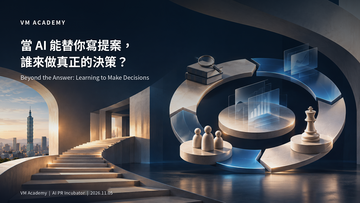
Incubator is designed for students, early-career professionals and people entering from different disciplines. It carries forward the principle that a person’s first consequential judgment should be made in an environment where learning is possible.
Participants start with a business problem, identify stakeholders, examine credible evidence, compare responses, explain trade-offs, and revise their thinking after feedback. It is not an employment guarantee, but an opportunity to develop abilities useful across careers.
Accelerator is intended for people who already bring industry knowledge, management experience or professional relationships. They need not become beginners again. They can bring their own questions and expertise to joint exploration of AI PR, cross-market collaboration and new ways of delivering services. This is a developing path of professional cooperation—not a fully launched franchise or certification scheme with guaranteed outcomes.
Across both paths, the goal is not to distribute new titles. It is to improve people’s ability to understand business, evaluate evidence, coordinate different disciplines and stand behind their decisions. We use Business Manager to describe the ability to define commercially significant problems and allocate resources, and Producer to describe the ability to connect research, content, specialists, technology and market action. These are capabilities to cultivate together, not two new names for a business card.
On December 11, 2026, VM will host its annual PR Strategy Open House: “A Year with AI: What Business Leaders Really Want Newcomers to Know.” This year’s concept and programme were led by Mia, who chose to put three questions into one evening: How has work changed since AI entered the company? What difficult choices have business leaders had to make this year? How should newcomers enter a workplace where AI is already a colleague?
The first question reveals what is happening inside organizations. The second asks leaders to be candid about judgment and difficulty. The third returns agency to young people as they decide where and how to begin. This is education shaped through media-quality editorial thinking: questions with genuine public value, curated so that different generations can encounter and challenge one another. Mia is doing more than managing an event; she embodies the editorial, organizational and producer capabilities we hope more practitioners will develop.
Our founder has led these year-end conversations for years, connecting company leaders with young people. It is therefore especially meaningful to see a new generation of editors and producers reshape the tradition through their own judgment. The most valuable inheritance is not a founder’s set of answers, but the ability of others to keep asking better questions.
A good company ought to do two things simultaneously: deliver today’s work with professionalism and accountability, while turning what it has learned into an asset that remains useful tomorrow. It should not have to become a global conglomerate before investing in people, public knowledge and conversations across generations.
Our company may be small, but our ambition need not be. We have methods, judgment and the ability to execute; we should also be willing to expose those methods to public discussion and constructive challenge so that the next generation can improve upon them. This is not a new department built to decorate a brand. It is a more durable form for values we have held for years.
VM Academy is both a way of respecting experience and an invitation to create what comes next.
Students and early-career professionals can begin with our published work and strategy open houses. Experienced advisers, educators, journalists and specialist partners are equally welcome to explore how professional knowledge can become lasting public value and new capability.
VM Academy is a professional-knowledge and talent-development platform initiated by VM|VOCAL MIDDLE. Building on years of PR strategy open houses, youth empowerment, advisory practice and industry dialogue, it connects original content, public issues, practical learning and cross-generational exchange through Education × Media. It is gradually developing Incubator and Accelerator pathways to turn experience into transferable judgment and professional capability.
Founded in 2014, VM|VOCAL MIDDLE is an AI-Native PR Consulting Firm. We bring together PR consulting, data science, AI technology and cross-market partnerships to advance IMAGE Asset Governance, helping organizations build understanding and trust in a Human × AI decision environment. Seen and Trusted by Humans & AI. Trust · Influence · Resonance.
Relevant VM services (these are not Academy course offerings)
Sources and further reading
You May Also Like