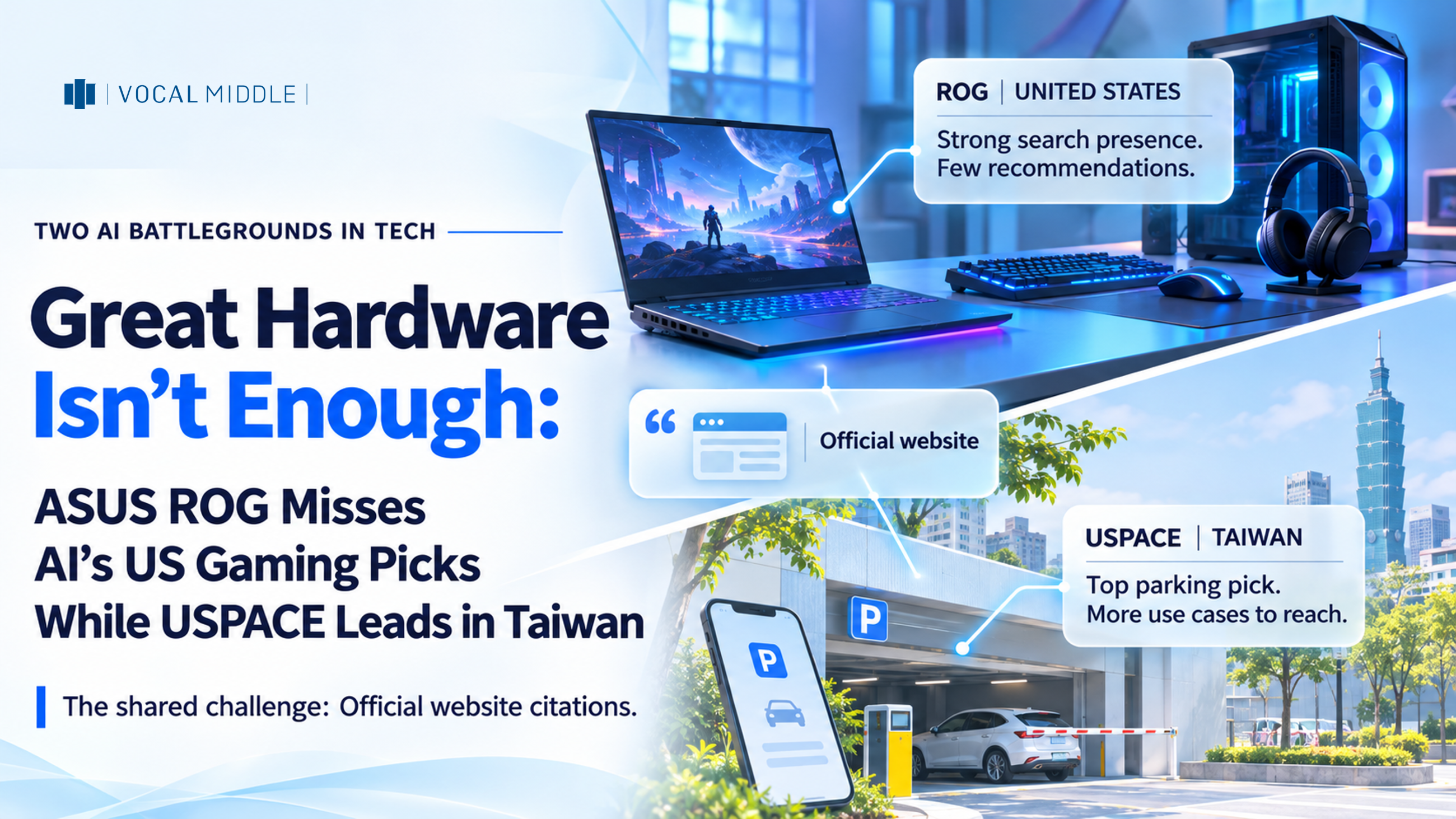
VM used I.Q. Lite to observe how ChatGPT and Gemini answer questions from US gamers and Taiwanese parking users. ROG has a strong search footprint in the US, yet rarely makes AI shortlists for gaming PCs. USPACE ranks first in Taiwan, but family and safety scenarios, and many questions no brand has claimed, remain open. This article sets out five observations and recommends that both brands turn their official sites into sources AI can cite, then add expert reviews and credible usage evidence respectively.
In our main article, From Seen and Understood to Done Well: A Practical Guide to Brand Growth in the AI Era for 2027, we used six I.Q. Lite reports to illustrate six growth challenges companies face across Asia-Pacific. The technology case pairs two brands from the same industry facing very different business decisions. ASUS ROG is a global-to-global case: it must defend product competitiveness in the US, a key global gaming market. USPACE is a local-to-local case: it must turn real usage advantages in its home market of Taiwan into a credible choice for consumers.
US gamers ask AI which gaming PC performs best and whether it suits streaming or game development. Taiwanese drivers ask which parking service is convenient, safe and family-friendly. The questions share nothing, but both come right before a purchase. Who AI recommends at that moment, and whose information it cites, decides whether a brand makes the shortlist.
From November 17 to 23, 2026, we observed ChatGPT and Gemini in each market. For ROG, questions were asked in English in the US, against Alienware, HP, Acer, Razer and Lenovo. For USPACE, questions were asked in Traditional Chinese in Taiwan, against Autopass, local parking operators, and bank credit cards that offer parking benefits. Two very different situations emerged. ROG's problem is not how it performs when mentioned, but how rarely it is mentioned at all. USPACE is already AI's first choice, but it is compared with a wider set of alternatives than expected, and many questions have no brand in the answer. Three questions are worth exploring: why has search strength not turned into AI recommendations? Whose information does AI trust when judging tech products and services? And how can a leading brand extend its lead into questions no one has claimed yet?
ROG's official site has substantial organic traffic and backlinks, and people searching for the brand or a model find it easily. But when US gamers ask AI which gaming PC is worth buying, most answers recommend only competitors, and ChatGPT barely mentions ROG at all. Assets built for the search era do not automatically become recommendations in the AI era. Brand and model pages serve people who already know ROG; AI answers people who are still comparing. ROG needs category comparisons and scenario content that explain why to choose it, not more model pages.
In the few answers where ROG appears alongside competitors, it performs on par with the leaders, and AI describes it positively. The problem is that these chances are rare: most answers leave ROG out of the comparison from the start. This is an entry problem, not a capability problem. ROG does not need to reshape its image; it needs to give AI enough third-party grounds to include it. For gaming PC questions, AI cites reviews and best-of lists from expert tech media far more than brand websites. Getting into those reviews is getting onto AI's shortlist.
Gaming PC use cases are widening. Gamers ask not only about performance, but whether a machine can game and stream at the same time, or handle video editing and game development. In these scenarios AI barely mentions ROG, while competitors already hold the ground. These are among the fastest-growing and most purchase-ready questions for high-performance PCs. If ROG does not answer them with scenario-based benchmarks, AI will keep citing competitors, and ROG will be absent at the starting point of the next wave of buyers' decisions.
In Taiwan, USPACE ranks first on most measures, and AI consistently recognises its parking-plus-car-wash bundles, monthly plans and profession-specific options. What stands out is what AI compares it with: not only car park operators and parking apps, but also bank credit cards that offer parking benefits. Consumers are not choosing a car park in front of AI; they are choosing how to solve parking. USPACE needs to explain clearly when an integrated service is better value and less hassle than a monthly pass, an app or a credit card perk.
USPACE has a solid home ground, but in family convenience and parking safety scenarios, competitors such as Autopass are recommended first more often, and on Gemini a competitor leads the recommendation order. The bigger opportunity lies elsewhere: many parking questions currently have no brand in the AI answer at all. These do not need to be won from competitors; if USPACE is first to provide plan comparisons, usage cases and third-party evidence AI can cite, it can claim them first. For parking questions, AI mostly cites parking information platforms and lifestyle content sites, and cites USPACE's own site mainly when the brand itself is mentioned. That also needs strengthening.
The two brands face different situations, but the first step is the same: make clear, comparable and verifiable facts available to AI from official sources. Then allocate resources according to each brand's market position.
The full data behind these five observations is in the two original reports, including topic analysis, platform differences, competitive distribution and AI citation sources. Both reports are in Traditional Chinese.
→ Download the ASUS ROG I.Q. Lite report (US)
→ Download the USPACE I.Q. Lite report (Taiwan)
Want to see how your brand appears across markets, languages and AI models first? Start with ximu.
→ Explore ximu
Does AI introduce your brand as the same brand in every market? An I.Q. strategic image diagnosis identifies which values should stay consistent and which should adapt by market. VM GEO and our PR consulting services then put the improvements into practice across content, media and channels.
→ Request a cross-market AI brand diagnosis
In VM's November 2026 I.Q. Lite monitoring of English-language questions in the US, ASUS ROG ranked third on the Seen & Trusted Index in ChatGPT and Gemini answers, behind Alienware and HP. Most answers recommended only competitors, and ChatGPT barely mentioned ROG; but when ROG appeared alongside competitors, it performed on par.
In VM's November 2026 I.Q. Lite monitoring of Traditional Chinese questions in Taiwan, USPACE ranked first on the Seen & Trusted Index in ChatGPT and Gemini answers, performing best on parking and car wash bundles. In family convenience and parking safety scenarios, competitors were still more often recommended first.
Search traffic mostly comes from people who already know the brand and search for its name or models, while AI answers people who are still comparing. When recommending, AI cites expert reviews, comparison articles and structured facts; a brand without them may be missing from AI shortlists despite strong search rankings. ASUS ROG in the US is one example.
Organise the official site as an easy-to-extract source of facts: a one-sentence positioning, like-for-like specification or plan comparisons, use cases, pricing and terms. At the same time, get into the third-party sources AI already trusts, such as expert review media or industry information platforms, and retest under the same conditions. VM calls this process diagnose, act and validate.
I.Q. Lite is a brand AI image report generated automatically by ximu's multi-role AI agent system, built on VM | VOCAL MIDDLE's expertise in branding, public relations and market growth. For a given market, language, set of AI models and competitors, it maps brand visibility, competitive comparison, citation sources and priority improvements.
STI (Seen & Trusted Index) compares brand performance under specified monitoring conditions. It is an observed indicator in AI answers, not a conversion rate; business decisions still need to consider the questions asked, source credibility and real customer response.
You May Also Like