AI PR is the governance and influence discipline that connects enterprise AI capabilities, business outcomes, and stakeholder understanding.
It is not the use of AI to write press releases. Nor is it a communications function added after an AI project has already been deployed.
AI PR needs to enter much earlier.
It helps organizations frame the problem AI is expected to solve, understand the people affected by the transformation, design the division of responsibility between humans and machines, and establish governance appropriate to a specific industry, task, risk profile, and business objective.
Once a solution has been implemented, AI PR translates technical capability and operational outcomes into meaning that executives, employees, customers, investors, partners, regulators, and society can understand, trust, and act upon.
AI PR is therefore more than communications.
It is the governance layer required to move an organization from AI deployment to sustainable adoption, commercial growth, and stakeholder trust.
On July 21, 2026, OpenAI introduced its ChatGPT for small business program.
The initiative combines virtual training, in-person AI academies, workflow guides that can be uploaded directly into ChatGPT Work, and plugins, skills, and resources from partners including Dropbox, Shopify, Intuit, Slack, Atlassian, and Wix.
OpenAI positions ChatGPT Work as an agent capable of operating across applications, files, and workflows, completing multi-step tasks and turning objectives into finished work. The company also states that the agent can take on work that might otherwise have been outsourced, left unfinished because of limited resources, or handled as one of the many responsibilities of a business owner.
The significance is not that the market has gained another AI product.
The more important shift is that the unit of AI adoption is changing:
From individual accounts to organizational workflows.
From occasional prompting to persistent agents.
From standalone tools to connected business systems and partner ecosystems.
Organizations will increasingly buy not only model capability, but an operating method that can be embedded directly into the business.
As drafting, research, information processing, administrative coordination, and basic execution become increasingly automated, the value of undifferentiated execution hours will decline.
Professional value will move upstream to problem framing, industry judgment, workflow design, systems integration, data governance, risk management, and accountability for outcomes.
Many AI transformation initiatives remain focused on model selection, tool deployment, systems integration, agent development, and workflow automation.
These capabilities matter. But they are similar to building a road.
A road can be constructed quickly, yet without a destination, traffic rules, clear accountability, and an agreed definition of value, an organization may simply travel in the wrong direction more efficiently.
A complete AI transformation needs to address at least four layers.
Organizations must first understand the needs of customers, employees, industries, and stakeholders before deciding where AI should intervene.
Is the problem caused by insufficient information?
Is it the result of a badly designed process?
Is responsibility fragmented or unclear?
Which tasks should be delegated to AI, and which judgments must remain human?
Without upstream problem framing, organizations risk automating a broken process rather than solving the underlying problem.
Human–AI collaboration does not mean allowing AI to generate an output and asking a human to approve it.
It requires a redesign of the operating model.
AI is suited to processing large volumes of information, executing repetitive tasks, conducting preliminary analysis, running simulations, and generating materials.
Humans must retain judgment over context, values, risk, ethics, accountability, and stakeholder consequences.
The relationship also requires clear data permissions, quality standards, review points, approval mechanisms, and ownership of the final outcome.
Models can be purchased. Organizational capability has to be built.
AI governance cannot be reduced to a single company-wide usage policy.
Financial services, insurance, technology, retail, tourism, healthcare, and professional services operate under very different data sensitivities, decision risks, regulatory expectations, and stakeholder relationships.
Even within the same company, marketing, finance, customer service, sales, and human resources should not necessarily share identical permissions and review processes.
Directed governance means defining AI permissions, human intervention, quality controls, and accountability according to a particular industry, task, audience, risk, and commercial objective.
It establishes:
What AI is allowed to do.
What AI should not do.
When human intervention is mandatory.
Who remains accountable for the outcome.
AI should not be limited to reducing time and cost.
The more strategic question is how AI-enabled efficiency can become new service capacity, stronger customer value, additional revenue, and a more defensible market position.
Without this layer, an AI initiative may accelerate individual tasks without changing what the company can offer, whom it can serve, or how it grows.
These questions may appear to belong to digital transformation, organizational development, or management consulting.
Yet they all converge on one fundamental issue:
How does an organization understand people—and how does it enable people to understand the organization?
AI changes the way employees work, the way customers experience services, the way executives make decisions, and the way external markets assess a company’s capabilities and risks.
Different stakeholders ask different questions.
Executives focus on revenue, efficiency, responsibility, and risk.
Employees want to know whether their roles, evaluation criteria, and career prospects will change.
Customers care about whether the service is more useful, accurate, secure, and trustworthy.
Investors evaluate whether AI investment can create a durable competitive advantage.
Partners assess whether the organization has the ability to co-deliver and scale.
Regulators and society examine transparency, fairness, accountability, and impact.
These questions cannot be resolved with a press release after the system goes live.
AI PR must participate across the transformation cycle:
Upstream, it helps define audiences, frame problems, and identify risk.
In the middle, it informs the human–AI operating model, governance principles, and growth objectives.
Downstream, it translates outcomes into influence that stakeholders can understand, trust, and act upon.
Finally, it feeds market responses back into data, strategy, and workflows.
AI PR is not a promotional accessory to an AI project.
It is the governance and influence layer that enables AI capability to be understood, responsibly adopted, and converted into business and social value.
This is not merely a theoretical position.
During a recent Hong Kong market visit facilitated by Alibaba Cloud International, VM engaged with four distinct partner profiles: a long-established SaaS distributor with approximately four decades of market experience, a digital marketing group, an enterprise AI implementation consultancy, and a coworking platform with access to the startup ecosystem.
These organizations possessed channel strength, customer relationships, technology, systems integration capabilities, or consulting expertise. Yet they were confronting a shared challenge: they needed not only to transform their own businesses, but also to provide a more complete generation of AI solutions to their clients.
The traditional SaaS distributor, for example, had substantial offline market strength but recognized that its relationships with emerging AI SaaS categories were not necessarily visible within the semantic structures used by AI systems.
This illustrates an important divide.
A company’s real-world scale, reputation, and channel strength do not automatically become visibility, citation, or recommendation within machine-mediated decision environments.
Digital marketing and AI consulting partners also quickly identified the importance of closed generative ecosystems, including AI search experiences within Xiaohongshu.
Such environments can carry strong commercial intent and shorter conversion paths, yet they cannot be addressed by simply applying a generic open-web search or GEO methodology.
The market response points to the same conclusion:
Technology partners may already know how to build a solution, deploy an agent, or integrate a system. What they often require is a stronger upstream capability for problem framing, audience understanding, and directed governance—and a stronger downstream capability for trust, communications, and stakeholder influence.
This is the incremental value AI PR can bring to the broader transformation ecosystem.
VM|VOCAL MIDDLE structures AI PR through three connected layers.
Together, they answer three practical questions:
How does AI currently see us?
What needs to change?
How do we turn that change into trust, growth, and influence?
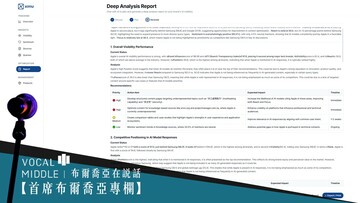
ximu answers: How do AI systems currently understand, describe, compare, and recommend the organization?
ximu is VM’s AI-native image asset governance platform.
It observes how brands and competitors appear across AI models, personas, and question contexts, turning an otherwise abstract question—“What does AI think of our brand?”—into measurable evidence.
Through indicators including STI, the Seen and Trusted Index, as well as Visibility, Reach, Position, Focus, and Sentiment, organizations can identify:
Where the brand is absent from strategically important questions.
Whether AI systems understand the company’s intended position accurately.
Why competitors are more likely to be surfaced or recommended.
Whether real-world expertise, reputation, and channel strength have been translated into machine-readable trust assets.
ximu is not simply a reporting dashboard.
It provides the decision visibility organizations need in an AI-mediated market:
See What AI See.
VM GEO answers: What must change for the organization to be accurately understood, cited, and recommended by generative systems?
Generative Engine Optimization is not merely a traffic acquisition exercise, nor is it a process of inserting keywords into content.
It examines how generative systems establish semantic relationships, select sources, compose answers, and determine which organizations are credible enough to cite or recommend.
Based on gaps identified through ximu, VM GEO develops:
Semantic positioning.
Content and authority asset deployment.
Connections between the brand and strategically important industry topics.
Optimization across open and closed generative ecosystems.
Directed growth for specific markets, audiences, and business objectives.
GEO is fundamentally a long-term trust engineering discipline.
It translates the expertise, cases, channels, and credibility an organization has accumulated in the physical market into assets that AI systems can identify, understand, and use.
PRaaS 2.0 answers: How do AI insights and optimization become business action, public trust, and sustained market influence?
VM defines PRaaS 2.0 as PR As AI Solutions.
Its purpose is not to replace public relations consultants with AI.
It uses AI and data to strengthen human judgment and evolves traditional PR from campaign-based communications into a continuous system for governing image and reputation assets.
At this layer, human consultants remain responsible for:
Industry and commercial judgment.
Stakeholder and issue analysis.
Strategy and narrative design.
Risk, ethics, and accountability.
Media, communications, and content execution.
Directed influence across markets and topics.
Outcome evaluation and strategic adjustment.
AI can accelerate analysis and execution. But strategic choices, contextual understanding, ethical judgment, and final responsibility must remain human.
VM’s AI PR architecture can be expressed as a continuous operating cycle:
ximu reveals the current reality
→ VM GEO establishes direction and executes directed optimization
→ PRaaS 2.0 provides human governance and stakeholder influence
→ Market responses and AI performance return to ximu
→ Strategy, content, and workflows are adjusted again
The complete value chain is:
Data intelligence
→ Upstream problem framing
→ Human–AI collaboration
→ Directed governance
→ Solution design
→ Commercial growth
→ Stakeholder influence
→ Data feedback
This moves AI PR away from the end of the enterprise value chain.
Instead, it becomes infrastructure connecting problem definition, solution design, organizational adoption, commercial conversion, and market trust.
AI solution providers, digital transformation firms, cloud companies, systems integrators, and consultancies often possess strong technical and delivery capabilities.
They can build systems, connect data, deploy agents, redesign processes, and support technical transformation.
VM does not seek to replace those capabilities.
VM completes the upstream and downstream dimensions of the service:
Upstream, it helps define the problem, the audience, the semantic environment, and the industry context.
In the solution layer, it embeds human–AI collaboration, directed governance, and growth objectives.
Downstream, it uses ximu, GEO, PR, and stakeholder governance to ensure that transformation outcomes are understood, trusted, and converted into market impact.
For ecosystem partners, this creates four forms of value:
A more complete solution portfolio.
Greater project depth and customer value.
Recurring governance opportunities beyond one-time implementation.
Stronger adoption, organizational alignment, and market influence.
When a partner builds the engine, VM helps define the destination, design the navigation and governance system, and ensure that the market understands why the journey matters.
AI PR is still an emerging category.
Its definition should not be determined solely by the traditional PR industry, nor can it be left entirely to model providers, platforms, or technology vendors.
The category must combine:
AI and data capability.
Business transformation and commercial judgment.
Human behavior and stakeholder understanding.
Public relations, trust, and social influence.
Cross-market, cross-language, and cross-cultural governance.
VM’s ambition is to become a representative advocate, practitioner, and standards builder for AI PR across Asia-Pacific.
This does not mean attempting to own the category.
AI PR must be built collaboratively by cloud platforms, AI solution companies, transformation partners, consultancies, enterprise clients, and professional services firms.
VM’s role is to complete a missing layer in that ecosystem—so that AI deployment produces not only efficiency, but also governance, growth, trust, and influence.
Models, agents, and tools will continue to become widely available.
The next stage of competition in AI professional services will not be defined by who can build the greatest number of agents.
It will be defined by who can place those agents inside a system with:
A clear direction.
A mature human–AI division of responsibility.
Governance principles.
Accountability.
Commercial growth.
Stakeholder trust.
AI can complete a task.
Organizations still need people to decide:
Which tasks are worth completing.
How they should be completed.
What value completion should create.
Who must understand, trust, and act upon the result.
Tools will become abundant.
What remains scarce is the ability to connect upstream understanding, technical capability, commercial outcomes, and market influence into a closed loop.
That is the strategic role of AI PR.
Traditional PR manages communications, reputation, and trust between an organization and its stakeholders. AI PR adds machine-mediated environments to that responsibility. It governs how an organization is understood, cited, and recommended by generative systems while also contributing to problem framing, human–AI collaboration, and accountability during AI transformation.
No. AI-assisted content production is only a change in tooling. AI PR is a broader governance and influence discipline covering measurement, problem definition, human–AI workflows, GEO, stakeholder understanding, risk, communications, and market feedback.
GEO focuses on how organizations are understood, cited, and recommended by generative engines. AI marketing generally focuses on acquisition, conversion, personalization, and marketing efficiency. AI PR addresses governance, trust, stakeholders, reputation, and social influence. Within VM’s framework, GEO is an essential execution layer of AI PR, but it is not the entire discipline.
ximu measures and diagnoses how AI systems currently perceive an organization. VM GEO uses that intelligence to improve semantic positioning, content, authority, and generative visibility. PRaaS 2.0 provides human strategy, governance, communications execution, and stakeholder influence. Results then return to ximu for continuous improvement.
Technology providers are typically strong in systems, data, integration, and agent deployment. Their clients also need upstream problem and audience definition, as well as downstream organizational adoption, stakeholder trust, and market influence. AI PR completes these dimensions and increases the commercial value of the overall transformation.
No. AI can improve monitoring, analysis, information processing, and execution. Industry judgment, context, ethics, risk, strategic choice, and final accountability remain human responsibilities. The purpose of AI PR is to build a more mature human–AI operating model.
VM|VOCAL MIDDLE is seeking AI solution, digital transformation, cloud, systems integration, and consulting partners across Asia-Pacific. (Contact Us)
Our objective is not to replace existing solutions.
Through ximu, VM GEO, and PRaaS 2.0, we aim to complete the upstream problem-framing and governance capabilities, as well as the downstream trust and influence capabilities, required to create more complete, sustainable, and commercially valuable AI transformation solutions.
Founded in 2014, VM VOCAL MIDDLE positions itself as an “IMAGE Architect” — an AI-native PR consulting firm built around AI-driven strategy and transformation.
Guided by the philosophy of Strategy-First | Data-Driven | AI-Empowered, VM transforms traditional strategic communications into measurable and sustainable IMAGE Assets through its proprietary PRaaS 2.0 (PR as AI Solution) framework, putting the core values of Trust · Influence · Resonance into practice.
In response to the rise of the generative AI era, VM developed its core infrastructure platform, ximu — an AI-native IMAGE Asset governance platform designed to help brands become seen, trusted, and preferentially cited within AI semantic systems.
The platform was co-developed alongside leading algorithm engineers from top academic institutions including National Taiwan University, Fudan University, and East China Normal University, with the mission of redefining how brands establish authority and visibility in AI-driven environments.
At the same time, VM GEO, built upon VM’s proprietary I.M.P.U.L.S.E. methodology and Silicon Valley AI search logic, was jointly developed by an international consulting team with academic backgrounds from institutions including National Taiwan University, Stanford University, New York University, and Tsinghua University.
Together, these systems enable brand governance in the AI era to evolve beyond communications — into a true discipline of trust engineering.
You May Also Like