
AI is transforming how consumers discover, compare and choose brands, shifting competition from search visibility to AI-mediated trust and recommendation. In this Hong Kong Economic Times interview, VM Founder and CEO Joseph Tang and ximu Product Lead Vitas Zhang explain why SEO remains an essential foundation, but GEO is becoming increasingly important. The real challenge is not controlling AI-generated answers, but governing the sources AI systems encounter, interpret and cite. Through ximu and the Seen & Trusted Index, brands can better understand how they are represented by AI—and identify what must change to improve visibility, credibility and recommendation.

As enterprises embed AI into their workflows, the market needs more than stronger models or more agents. It needs a complete system that can answer why AI should be adopted, how it should be governed, how it creates growth, and how it can be correctly understood by both humans and machines. VM defines AI PR as the discipline of IMAGE Asset Governance across human and AI decision environments. Through ximu, VM GEO, and PRaaS 2.0, it creates a complete loop from IMAGE Assets and Directed Governance to sustained market influence.

Over the past three days, through introductions facilitated by Alibaba Cloud International, I held a series of intensive meetings in Hong Kong with four prospective partners, each representing a distinct position in the market: a leading SaaS distributor with four decades of industry experience, an established digital marketing group, an emerging enterprise AI implementation consultancy, and a coworking platform with deep connections across the startup ecosystem. Across these in-depth conversations, one insight became particularly clear: at this moment of accelerating technological change, businesses share a remarkably similar sense of urgency—and aspiration—about the AI era. They are not only considering how to reposition their own organizations and communications strategies for the next cycle. They are equally determined to identify new AI-era solutions that can unlock growth for their clients.
As AI becomes a primary entry point for high-net-worth individuals seeking wealth management advice, the rules of competition for private banking and family office services are rapidly evolving. This edition of the AI TRUST Brand Influence Report uses CTBC Bank as its benchmark brand and applies ximu together with the Seen & Trusted Index (STI) to analyze how brands compete across both the human and AI worlds. The report explores how AI is redefining trust, reshaping decision-making journeys, and creating a new competitive landscape for wealth management.
Historically, airline competition was defined by route networks, service quality, market share, and passenger reviews. Today, as more consumers turn to AI to plan journeys, compare airlines, and seek travel recommendations, a new layer of competition is emerging. According to the International Air Transport Association (IATA), international passenger demand among Asia-Pacific airlines increased by 10.9% in 2025, making the region one of the fastest-growing aviation markets in the world. As cross-border travel continues to accelerate, AI is increasingly becoming a key gateway through which travelers discover, evaluate, and select airline brands. AI does not simply replicate market rankings. Instead, it interprets, prioritizes, and recommends brands based on its own knowledge framework and the information available to it. As a result, an airline's position in the market does not necessarily translate into the same position in AI-generated recommendations. Among the many Asian airline brands, we selected Singapore Airlines as the core subject of this study. As one of the world's leading airline brands, Singapore Airlines has consistently ranked among the industry's top performers. According to Skytrax, it ranked second globally in 2025, behind only Qatar Airways. As a benchmark for premium airline service in Asia, Singapore Airlines also represents a challenge increasingly shared by established brands: as AI becomes a growing influence on consumer decision-making, can a brand still be seen, understood, and recommended by AI? To answer this question, the study uses ximu to analyze queries related to Asian airline recommendations, covering decision-making scenarios such as travel planning, airline comparison, business travel, and in-flight experience. Combined with Google Trends, OpView, and publicly available market data, the research examines the gap between human perception and AI recommendation, revealing how brand influence differs across the two worlds. This report does not seek to answer which airline is the best. Instead, it explores a more important question: As consumers increasingly rely on AI to plan their journeys, will the airline preferred by travelers also be the airline preferred by AI?
Brand competition has traditionally been measured by market share, sales performance, and share of voice. Today, as more consumers rely on AI to discover products, compare brands, and seek purchase recommendations, a new competitive landscape is emerging. AI does not simply mirror market rankings. Instead, it interprets and recommends brands based on its own knowledge framework and available information sources. As a result, market leaders may not necessarily be AI leaders. Among the many AI PC brands in the market, HP was selected as the focal point of this study. According to Gartner, HP is the world's second-largest PC brand, holding a 21.3% global market share, while AI PCs already account for 44% of its shipments. More importantly, HP represents a challenge facing many enterprises today: when the rules of competition change, can a brand still be seen, understood, and recommended by AI? Using ximu, this study analyzes key AI PC-related queries across brand discovery, product comparison, and purchase decision scenarios. Combined with insights from Google Trends, OpView, and public market data, the research examines the gap between human perception and AI recommendation. This report is not designed to determine which brand ranks first in the market. Instead, it seeks to answer a more important question: As consumers increasingly rely on AI to make decisions, will the brands that lead in the human marketplace remain the brands most recommended in the AI landscape?
In the global battlefield of innovation and entrepreneurship, venture capital firms and accelerators have long operated within a highly competitive and deeply opaque information environment.The traditional pathways of brand building are now facing three major survival challenges amid digital transformation: Lack of Cross-Border Authority: In the global competition for resources, the absence of digital authority will lead to the loss of international startup talent and capital. Fragmented Decision-Making Information: The difficulty of quantifying accelerator performance traps founders and LPs in an environment of informational opacity and declining trust. Fragile Brand Assets: Overreliance on isolated media moments causes visibility to rapidly disappear once news momentum fades.
Open ChatGPT. Ask it: "Where should I take my kid for a weekend in Shanghai?" It will hand you a clean, well-structured list. Locations, transit, restaurants, things to watch out for, even a backup plan if it rains. It reads like advice from a local friend who knows the ropes. But have you ever stopped to ask—where does it know all this from? Not Disney's official site. Not Ctrip. Not Dianping. It's Xiaohongshu. It's a note some mom posted two years ago, with weather tips, parking advice, and the pitfalls she stepped into on the ground. The model never tells you who it read. But its answers have a texture. And that texture is the texture of UGC.
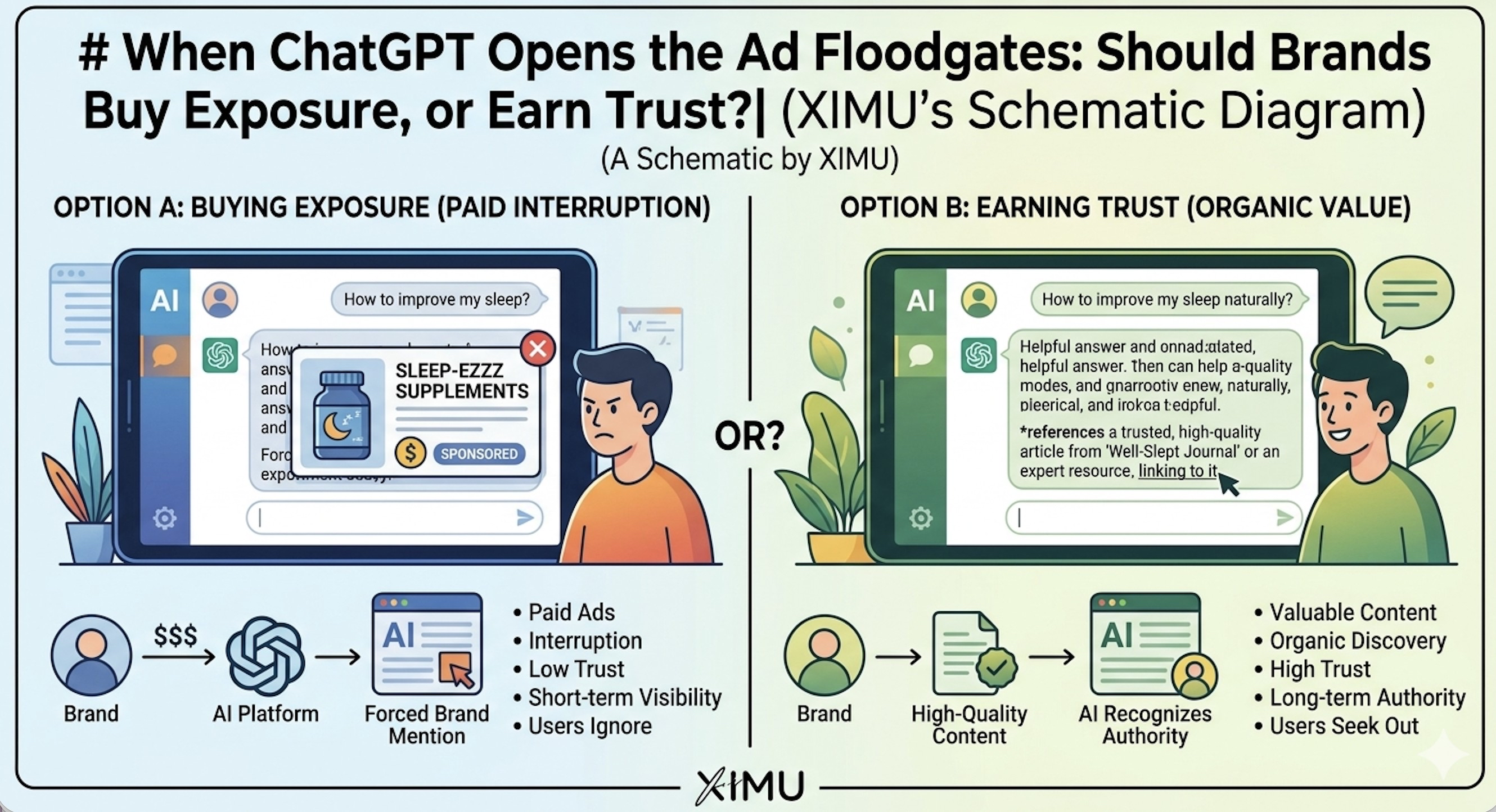
This is a watershed moment. OpenAI's full rollout of its advertising platform to enterprises worldwide is more than a commercial milestone — it marks a deep fracture in the AI industry's trajectory: AI products are now splitting into two distinct paths, attention monetization and productivity monetization.
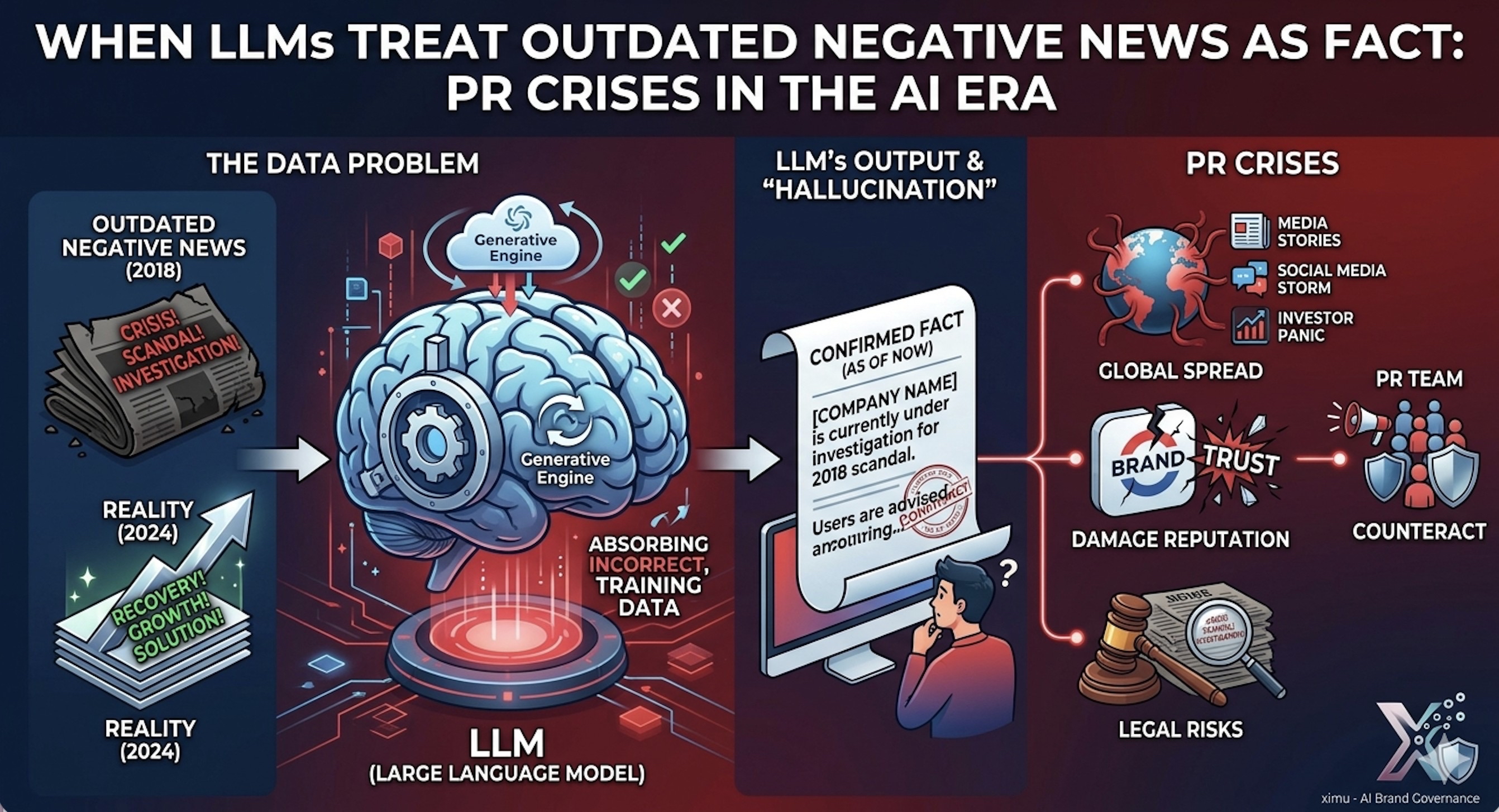
If you opened ChatGPT today and asked, "I'm considering working with Company X — are they trustworthy?" what would you get back? Most likely, a measured, balanced response citing multiple sources. It sounds fair. But buried inside might be a sentence like this: "The company faced media scrutiny several years ago over a controversy that raised consumer concerns." To the AI, that's just a retrieved factual statement. To the brand, that controversy may have long since blown over — officially clarified, internally addressed, and put to rest.