Planning & Production: VM GEO & ximu Core Team
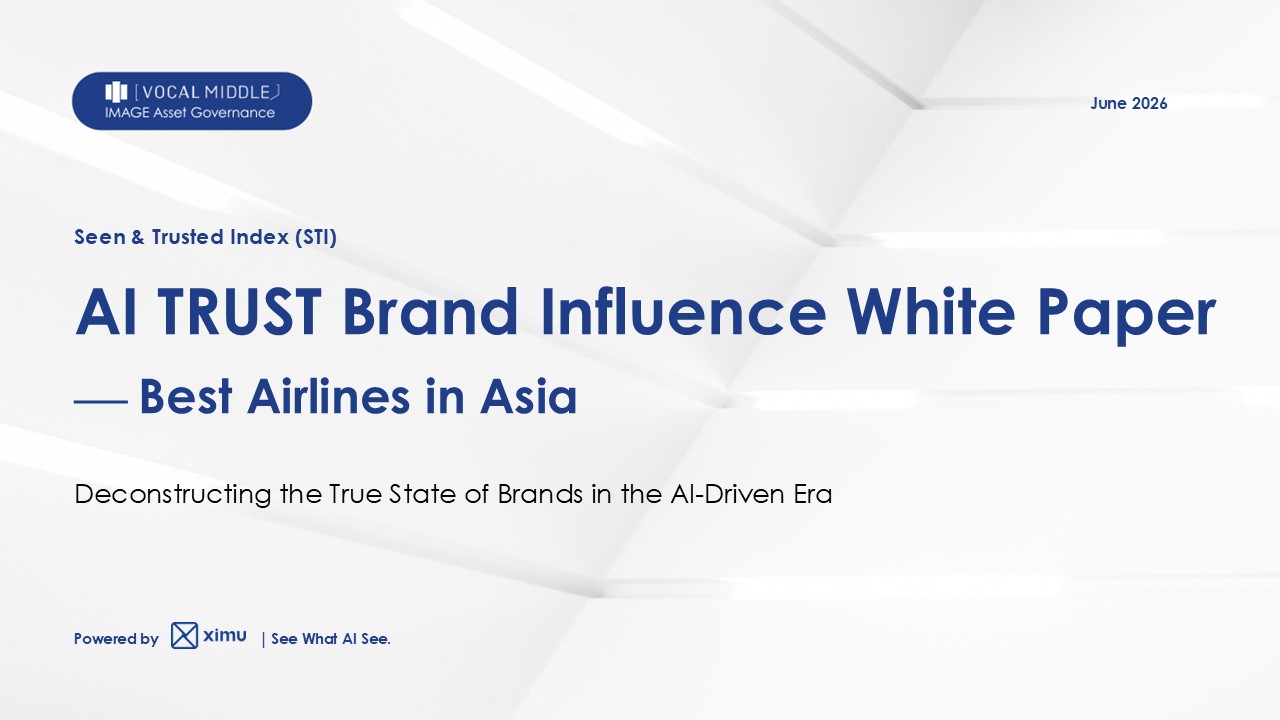
Historically, airline competition was defined by route networks, service quality, market share, and passenger reviews. Today, as more consumers turn to AI to plan journeys, compare airlines, and seek travel recommendations, a new layer of competition is emerging.
According to the International Air Transport Association (IATA), international passenger demand among Asia-Pacific airlines increased by 10.9% in 2025, making the region one of the fastest-growing aviation markets in the world. As cross-border travel continues to accelerate, AI is increasingly becoming a key gateway through which travelers discover, evaluate, and select airline brands.
AI does not simply replicate market rankings. Instead, it interprets, prioritizes, and recommends brands based on its own knowledge framework and the information available to it. As a result, an airline's position in the market does not necessarily translate into the same position in AI-generated recommendations.
Among the many Asian airline brands, we selected Singapore Airlines as the core subject of this study.
As one of the world's leading airline brands, Singapore Airlines has consistently ranked among the industry's top performers. According to Skytrax, it ranked second globally in 2025, behind only Qatar Airways. As a benchmark for premium airline service in Asia, Singapore Airlines also represents a challenge increasingly shared by established brands: as AI becomes a growing influence on consumer decision-making, can a brand still be seen, understood, and recommended by AI?
To answer this question, the study uses ximu to analyze queries related to Asian airline recommendations, covering decision-making scenarios such as travel planning, airline comparison, business travel, and in-flight experience. Combined with Google Trends, OpView, and publicly available market data, the research examines the gap between human perception and AI recommendation, revealing how brand influence differs across the two worlds.
This report does not seek to answer which airline is the best. Instead, it explores a more important question:
As consumers increasingly rely on AI to plan their journeys, will the airline preferred by travelers also be the airline preferred by AI?
By: Tang Yao Chung(Joseph), Founder & CEO
Many people still associate PR with press releases, media outreach, and event execution. That perception is understandable — those approaches genuinely worked in the previous era. But if you’ve started noticing that brands are investing more effort while the world no longer responds according to the old rules, then you are standing at the threshold of an industry transformation.
In the AI era, PR is no longer just Public Relations. It has evolved into Trust, Influence Governance, and Industry Resonance — and that is where the new competitive landscape begins.
In the past, people understood the world through clicks. After 2025, people increasingly understand the world through AI search. When someone asks AI, “Who should I trust?”, the answer it gives becomes the true representation of your brand in the world.
The problem is: most companies cannot see that “original script.”
They do not know how AI understands them, nor whether AI is willing to recommend them.
The next era of competition is no longer about SEO or media visibility. It is about being Seen & Trusted by AI — ensuring that both humans and AI are willing to place your brand inside the answer.
That gap is precisely the industry-scale opportunity VM is building toward.
To this day, there is still no truly AI-Native PR Firm in the world. Our positioning is clear: the world’s first PR consulting firm built with AI as its native foundation.
We use PR as the mechanism to define brand standards for the AI era and solve the most fundamental challenges behind business growth.
This vision was not built overnight.
In 2017, we introduced the concept of IMAGE Assets.
By 2024, we completed our full AI infrastructure architecture.
As we evolved the IMAGE Asset methodology into a complete AI-driven operational chain, we also introduced a new generation of service architecture:
PRaaS 2.0 — PR as AI Solution.
This is the AI-native IMAGE Asset Governance framework we created for enterprises.
In June 2025, we launched VM GEO as an entry-level solution, connecting the entire chain from monitoring, analysis, and strategy to optimization.
At the same time, we identified a major gap in the market: brands lacked a measurable standard for the AI era.
So we decided to build the first one.
In November, we officially launched ximu, our first AI-native product.
For the first time, brands could truly “see themselves through AI’s eyes.”
ximu functions like an intelligent navigation system for the AI era, helping brands understand how they are interpreted, introduced, trusted, and recommended across AI systems.
It answers the three most important questions for modern enterprises:
You can passively allow AI to write your story for you.
Or you can proactively shape how AI introduces your brand to the world.
The next generation of brand competition is ultimately simple:
Seen and Trusted by Humans & AI.
And VM is building the standards behind this new era of trust.
By: Zhang How Wei (Vitas), Chief Growth Officer
Dear Enterprise Leaders,
As decision-makers responsible for both business operations and brand governance, have you begun to sense that the communication landscape is being fundamentally reshaped — and that your brand may require an entirely new framework for long-term growth?
The reality is this:
Brands are now facing a deeply structural risk that remains widely underestimated.
Companies continue investing heavily in communications, content, and PR, yet are gradually losing control over how their brands are actually understood.
The issue is no longer whether brands are communicating enough.
The issue is that the interpreters are no longer just humans — they are now AI systems as well.
Today, most enterprises are experiencing three major challenges:
First, brands are constantly being “interpreted” by AI — often without realizing it.
Whether press releases, whitepapers, or case studies are absorbed by large language models, how they are processed, and how they are ultimately reconstructed and delivered to users remain largely invisible to enterprises.
As search and decision-making increasingly shift toward AI-assisted interactions, failing to be correctly understood effectively means losing influence at critical decision-making moments.
Second, the trust mechanism itself has fundamentally changed.
Most enterprises are familiar with how trust is built between humans, and continue applying the same logic to AI systems. However, AI trust is not built through emotion or relationships.
It is built through citation structures, semantic consistency, and source authority.
The risk is not that companies are doing too little.
The risk is that they are navigating a new world using an outdated map.
Third, a growing disconnect now exists between content investment and actual influence.
Everyone is producing content, yet very few can answer the most important questions:
This is precisely where ximu becomes measurable infrastructure for the AI era.
By continuously monitoring how leading large language models respond to brands, ximu translates AI perception into interpretable indicators.
It helps enterprises understand their positioning, authority, and information influence pathways within AI ecosystems — allowing brands to reclaim their place between user questions and AI-generated answers.
This whitepaper marks VM VOCAL MIDDLE’s first official publication built around ximu intelligence and data analysis.
Recognizing that brands now compete not only against local competitors, but also against global players entering local markets — while many enterprises simultaneously pursue international expansion — this whitepaper analyzes industries through broader competitive brand categories.
(And of course, we are equally capable of focusing on your specific target market.)
Looking ahead, we will continue publishing quarterly whitepapers focused on 3–5 industries where AI is expected to generate significant influence, including:
Through continuous monitoring, longitudinal analysis, and increasingly refined research depth, we aim to support enterprise leaders in making clearer and more verifiable decisions in an AI-driven era.
Founded in 2014, VM VOCAL MIDDLE positions itself as an “IMAGE Architect” — an AI-native PR consulting firm built around AI-driven strategy and transformation.
Guided by the philosophy of Strategy-First | Data-Driven | AI-Empowered, VM transforms traditional strategic communications into measurable and sustainable IMAGE Assets through its proprietary PRaaS 2.0 (PR as AI Solution) framework, putting the core values of Trust · Influence · Resonance into practice.
In response to the rise of the generative AI era, VM developed its core infrastructure platform, ximu — an AI-native IMAGE Asset governance platform designed to help brands become seen, trusted, and preferentially cited within AI semantic systems.
The platform was co-developed alongside leading algorithm engineers from top academic institutions including National Taiwan University, Fudan University, and East China Normal University, with the mission of redefining how brands establish authority and visibility in AI-driven environments.
At the same time, VM GEO, built upon VM’s proprietary I.M.P.U.L.S.E. methodology and Silicon Valley AI search logic, was jointly developed by an international consulting team with academic backgrounds from institutions including National Taiwan University, Stanford University, New York University, and Tsinghua University.
Together, these systems enable brand governance in the AI era to evolve beyond communications — into a true discipline of trust engineering.
You May Also Like