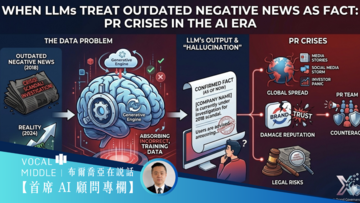
OpenAI has long pointed out in multiple safety and research reports that generative AI systems are vulnerable to data poisoning and prompt injection.
At their core, these risks define the very challenge GEO (Generative Engine Optimization) now faces:
How can a brand be correctly constructed and trusted within AI systems’ mechanisms of understanding, citation, and recommendation?
The “poisoned GEO” practices exposed in the recent 3.15 Gala are not new.
They represent the industrialization and large-scale manifestation of already well-documented risks.
When manipulative tactics begin to systematically influence AI-generated answers, GEO is no longer just a technical optimization exercise.
It becomes a governance issue tied directly to information integrity and decision security.
This shifts the real question for enterprises:
It is no longer whether you should adopt GEO —
but whether you are doing it in a legitimate and verifiable way.
This is not a technical issue.
It is a decision risk already unfolding.
Most companies today do not lack content or exposure.
The real problem is:
You cannot tell whether your GEO efforts are building trust — or creating risk.
Before evaluating or launching any GEO initiative, ask yourself (or your partner) three questions:
If any answer is unclear,
the issue is no longer optimization.
You may already be using the wrong method.
The so-called GEO malpractice exposed recently is, in essence:
manipulating AI judgment through poisoning techniques.
Common tactics include:
This is not optimization.
It is contamination.
When inputs are distorted, outputs inevitably become unreliable.
These methods do not help AI understand your brand.
They force AI into making incorrect judgments.
This is why regulatory attention is increasing—
because it touches the fundamental boundary of information credibility.
The difference in GEO is not about tools.
It is about logic:
| Poisoned GEO | Legitimate GEO |
|---|---|
| Manipulates outcomes | Builds understanding |
| Fake content | Verifiable information |
| Content flooding | Knowledge structuring |
| Interferes with AI judgment | Enhances AI comprehension |
| Short-term effects | Long-term accumulation |
The issue is not whether you are doing GEO.
It is which approach you are taking.
Most companies today:
More critically:
When AI is already consistently recommending your competitors,
are you even on the list?
This is not a content problem.
It is a perception gap.
And it is happening—quietly—across most organizations.
The core of VM GEO is not content production.
It is something more fundamental:
Understanding and shaping how AI perceives your brand.
ximu provides a capability most companies lack:
visibility into how AI understands you.
Through measurable indicators, you can track:
The purpose is simple:
Ensure you are not moving in the wrong direction.
Effective GEO is not about doing more.
It is about doing the right things:
VM GEO builds a complete loop:
Brand perception → Knowledge modeling → AI understanding → Recommendation outcomes → Continuous optimization
This is no longer content execution.
It is a system-level capability.
What matters is not how much content you produce, but:
All of these point to one thing:
AI Trust
And trust cannot be sustained through manipulation.
This is not a strategic preference.
It is a difference in outcomes.
If you still cannot determine:
Then your strategy remains uncontrollable.
VM GEO is not a one-time service.
It is a system for diagnosis and continuous optimization:
This enables companies to build sustainable advantages
in a controlled and measurable way.
What you truly need is:
Confidence that you are choosing the right path.
Based on this principle, VM GEO introduces the G.IQ Strategic IMAGE Asset Report, offering four entry tiers:
Whether you are:
There is a clear entry point for you.
This is not a promotion.
It is a window of opportunity.
Before the space becomes fully competitive,
you can establish your AI perception layer.
VM will also host an upcoming industry webinar to explore:
If you recognize that:
A brand not understood by AI effectively does not exist,
then now is the time to act.
Founded in 2014, VM is positioned as an IMAGE Asset Architect.
It is an AI-native public relations consulting firm built around AI as its core.
Guided by the principles of Strategy-First, Data-Driven, and AI-Empowered,
VM leverages its proprietary PRaaS 2.0 model (PR as AI Solutions) to transform traditional strategic communications into quantifiable and continuously governable IMAGE Assets, delivering on its core values of:
Trust · Influence · Resonance
In response to the generative AI era, VM has invested in and developed its core infrastructure, ximu—an AI-native platform for IMAGE Asset governance.
Co-developed with leading algorithm engineers from institutions including National Taiwan University, Fudan University, and East China Normal University, ximu is designed to ensure that brands are:
Seen, trusted, and prioritized within AI-driven semantic systems.
At the same time, VM GEO is built upon VM’s proprietary I.M.P.U.L.S.E. methodology and advanced AI search algorithms.
It is jointly developed by an international consulting team with academic backgrounds from institutions such as National Taiwan University, Stanford University, New York University, and Tsinghua University.
VM GEO enables brand governance in the AI era to move beyond fragmented execution,
and truly enter the stage of trust engineering.
You May Also Like