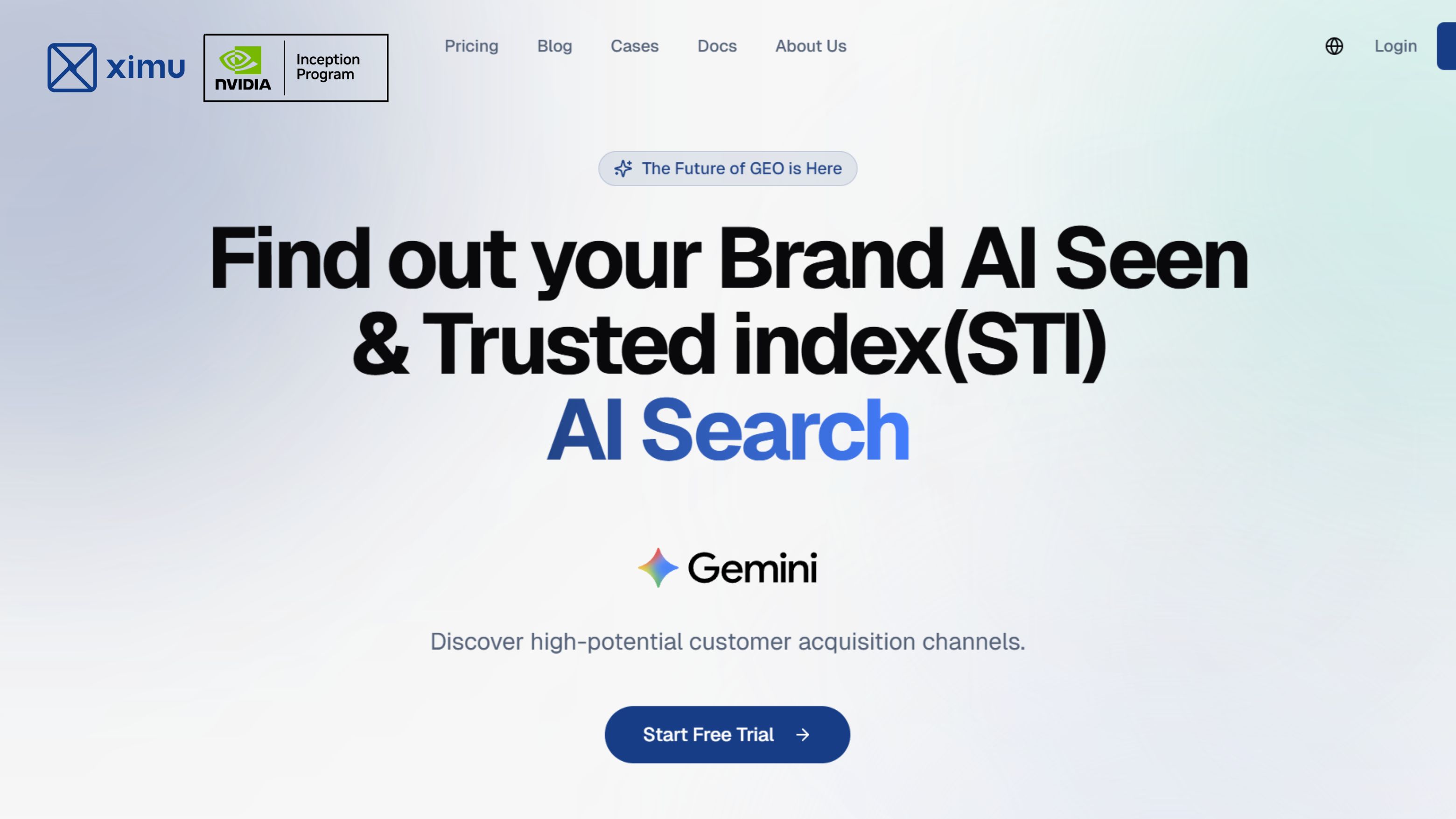
ximu has recently been officially accepted into the NVIDIA Inception Program.
Beyond the initial excitement, however, a deeper question immediately came to mind:
What does this actually mean—for us, and for brands more broadly?
From a company development perspective, joining a global AI ecosystem program is certainly positive news. But I prefer to see it as a small window into understanding the AI era itself.
Companies like NVIDIA function almost like a “seismograph” for the AI industry.
They sit at the intersection of computing infrastructure, model development, and startup ecosystems. As a result, when entirely new categories of applications begin to emerge, signals of those shifts often appear within these networks first.
In that sense, ximu becoming part of this ecosystem is a subtle but very clear signal:
a new category of problems is emerging in the age of AI—and the industry is starting to notice.
The question itself is surprisingly simple:
When more and more information in the world is organized, summarized, and even generated by AI, what form will brand existence take?
In the past, we rarely needed to ask this.
Brands existed in advertising, media coverage, search results, and social discussions.
Their presence was fundamentally built on human-to-human information flows.
But with the rise of AI, the way information moves is changing.
Increasingly, information is now read by AI first, and only then seen by humans.
Many people interpret this as merely a matter of technological efficiency. But the deeper implication is far more interesting:
Brands now need to be understood by machines—not just by people.
A recent example illustrates this shift clearly.
OpenClaw, which has rapidly gained attention in the open-source community, did not necessarily introduce an entirely new capability. What it did was make an emerging trend much more visible:
AI is evolving from an information tool into an action agent.
When AI systems can call tools, organize data, and complete tasks autonomously, they are no longer just answering questions. They are beginning to read and interpret the world on behalf of humans.
One of the most interesting consequences of this shift is that:
the first reader of many brand-related pieces of information in the future may not be a human—but an AI system.
This may sound like a minor detail, but it changes many things.
For example:
In the past, these factors mainly affected media understanding and search rankings.
In the AI era, however, they directly influence how models remember and represent a brand.
In other words, brands are gaining a new dimension:
machine memory.
In the future, brands will not only exist in markets and in consumer memory. They will also exist within the semantic spaces of AI models.
This presence does not emerge automatically.
It is built through the accumulation of:
over time.
What ximu aims to do is to observe and understand this new dimension.
The questions we focus on include:
Today, these questions may still feel somewhat forward-looking.
But if AI continues to become a primary entry point for information, they may soon become fundamental practices of brand management.
Looking back at ximu joining the NVIDIA Inception Program, I see it less as a milestone and more as a small footnote in a larger historical shift.
It reminds us that AI is not only transforming tools.
It is quietly reshaping some of the most fundamental aspects of our information world:
And what we are exploring today is precisely this new space.
Founded in 2014, VM | VOCAL MIDDLE is an AI-Native PR Consulting Firm built on the belief that trust and influence can be engineered through AI.
Guided by Strategy-First | Data-Driven | AI-Empowered and Trust · Influence · Resonance, VM designs end-to-end IMAGE Asset Architectures that govern brand reputation and amplify long-term resonance across markets.
In response to the rise of generative AI, VM has invested in developing our core infrastructure: ximu, an AI-native IMAGE Asset Governance platform designed to ensure that brands are seen, trusted, and preferentially referenced within AI semantic systems.
Through its proprietary metric STI (Seen & Trusted Index), ximu quantitatively evaluates a brand’s visibility and trustworthiness across large language models (LLMs), helping organizations build a durable digital moat in the age of AI.
You May Also Like