Generative AI now searches, compares and even recommends options on people's behalf. How a company appears to a decision-maker is no longer shaped only by news coverage and social media. Public relations has more influence than ever, and that influence is harder to control. So how should we redefine the role of AI PR in this environment?
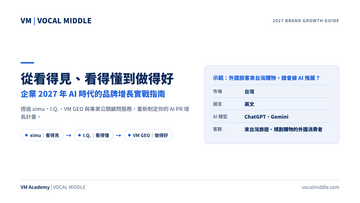
This is the big question VM | VOCAL MIDDLE has been pursuing all year. In 2026, VM officially became an AI-native PR consultancy, moving from PR to AI PR. Over the past two weeks, we offered a first answer in two essays:
This essay takes the next step. Our view is that the answer to AI PR can't be found inside the PR industry alone. When a company's story may be reshaped by journalists, creators, customers, search indexes and AI answers, the value of PR is ultimately tested by the people who rely on it: organizations in transition, individuals working alongside AI, and the next generation preparing to enter the workforce.
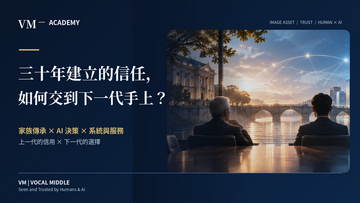
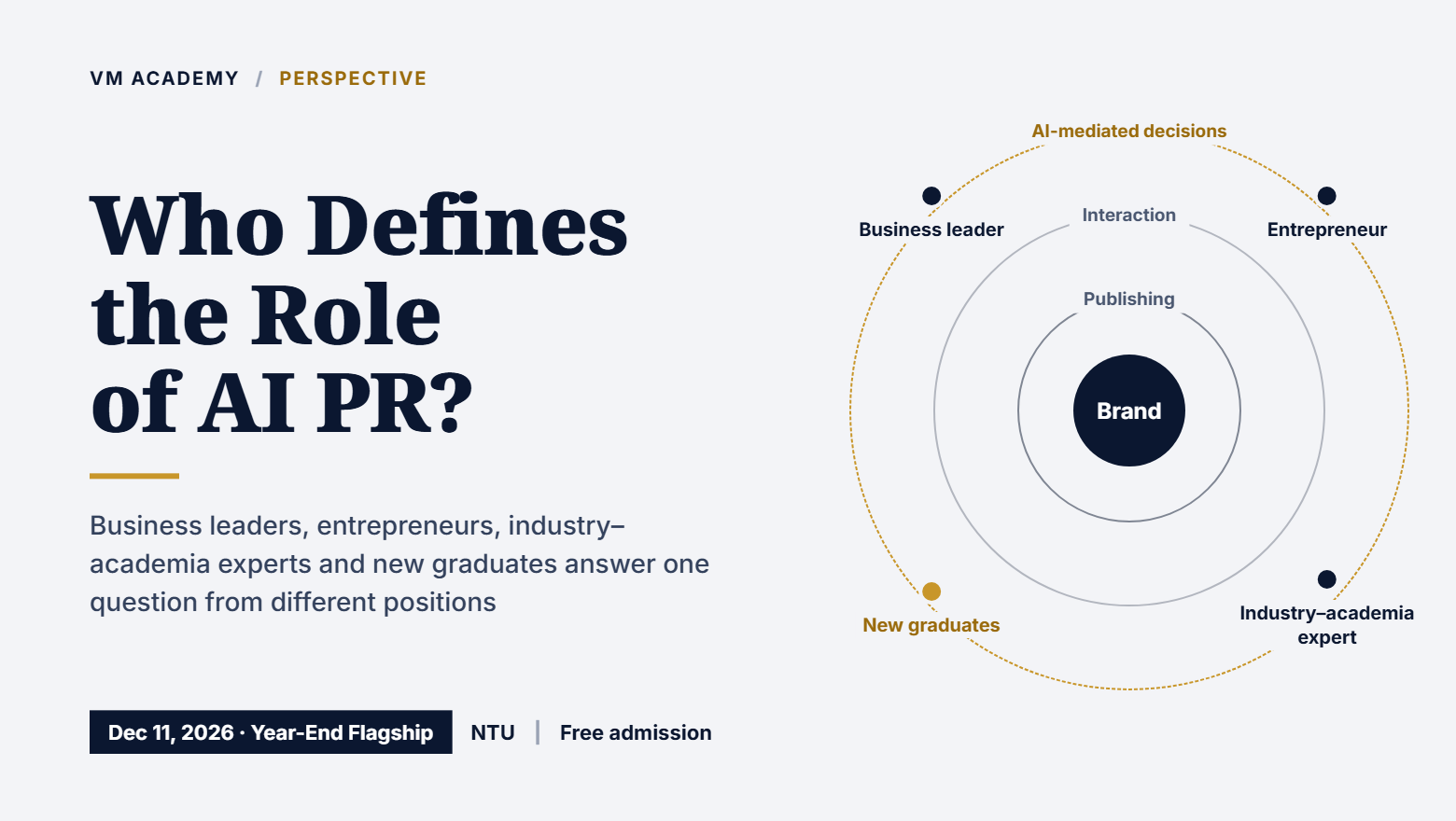
That is the starting point for this year's VM Year-End Flagship Event. On the evening of Friday, December 11, 2026, VM Academy will host "A Year Walking with AI: Year-End Real Talk from Leaders to New Graduates" at the College of Management, National Taiwan University. Admission is free and seats are limited (register here).
For the first time, we are deliberately looking at the same AI transformation from three different positions: the enterprise, the individual professional, and the bridge between industry and education. We will examine its impact on people and what comes next. Our three guest speakers each stand in one of these positions.
Saying PR has more influence than ever is easily misread as "share of voice matters more now." We mean almost the opposite.
Generative AI now searches, organizes, compares, explains and even recommends options for its users. By the time a procurement manager, investor or job seeker makes a decision, the information in front of them may already have been reorganized by many human and machine nodes. Any one of those nodes can become a decision-maker's evidence, misunderstanding or source of trust.
Influence therefore now forms across three layers at once: publishing, interaction, and AI-mediated decisions. All three coexist, and companies must manage all three. What has grown is not the weight of any single exposure. It is the weight of understanding how trust forms, and taking responsibility for it.
PR professionals who still measure themselves by press releases, placements and impressions risk mistaking tool efficiency for professional progress. AI makes output cheap. What remains scarce is judgment: which problems are worth solving, what evidence to offer to whom, and through which nodes to build credible signals.
In most companies, AI transformation starts not with choosing technology but with reorganizing. Companies in transition redesign workflows and roles; AI-native companies run lean from day one. As headcount shrinks, each remaining role is expected to carry more judgment, not less.
For PR, this is the first thing to redefine. When a company's internal decision chain changes, PR can't start by asking "what should we announce?" It must first ask: which business outcome does the company want to change? Who has the authority to decide, who can veto, and who bears the cost?
This is what we call the Business Manager: someone accountable for the business problem first, who then chooses the PR tools to address it. Sometimes the most valuable advice is to clarify product positioning, close an evidence gap, or even pause a campaign that isn't ready.
On December 11, Henry TING, Director of Digital Technology at Uni-PROSPERiTY Lifestyle Corp., will speak from his experience in large-scale retail. Formerly CIO of ETMall (Eastern Home Shopping) and COO of BabyHome, and named an IDC 2022 CIO of the Year, he is now leading an end-to-end transformation from eCommerce, mobile apps, cloud and data to AI. He will share how a company spanning online and offline retail is reorganizing its structure and operations for the AI era.
What we hope to hear from this perspective are the real trade-offs inside a large organization, not the idealized picture in a transformation deck.
The second position is the individual.
Hana CHANG, co-founder of Bounty Hunter and ETHTaipei and former COO of Perpetual Protocol, has spent recent years practicing "one person plus an AI team." From requirements and design to development and marketing, she divides the work among AI agents with different specialties to build and run mojo, a GLP-1 weight-management app. She will share how work is being redistributed, and which judgments and responsibilities people must keep.
This question goes straight to how we define the Producer. A Producer doesn't do all the work. A Producer defines the brief, breaks down the script, assembles the right people and agents, and lets different specialists achieve influence together.
A Producer must first know what can't be outsourced: problem definition, stakeholder judgment, core positions, the standard of evidence, and final accountability. Data gathering, format conversion, some first drafts and routine monitoring can be shared with specialist teams and AI.
One person leading an AI team is this division of labor at its most extreme. It makes one thing clear: AI expands the power each person can direct, but it does not bear the consequences of anyone's choices.
The third position is where talent comes from.
Janice LAI, former Managing Director of NEC Taiwan, has spent more than 30 years in the IT industry. She has served as Vice President at Dell and Managing Director of SAP Taiwan, leading major changes including privatization, strategic acquisitions and global transformation. Today she is an adjunct professor at National Taiwan University's School of International Political Economy [TBC: official English name], an adjunct lecturer in the Department of Business Administration at National Chengchi University, and a coaching advisor to Business Weekly's CEO Academy [TBC: official English name]. Drawing on hiring experience at multinational groups, she will discuss which capabilities matter most and how students can start building them at university.
This is also the question VM Academy wants to answer. If the core of PR has expanded from execution to business judgment and producing influence, developing talent can't mean adding another course on tools.
VM Academy's Incubator track is for students, early-career professionals and career changers. It lets "making your first judgment call" happen somewhere you can learn from it: identifying who cares, finding reliable data, proposing options, explaining trade-offs, and revising after feedback. It is not a bootcamp that guarantees a job. It helps more people build professional thinking they can use across different careers.
Companies and campuses often describe the "talent gap" in their own terms. It takes someone who has stood at both lecterns to describe that gap concretely.
Seen together, these three positions lead us to redefine the AI PR role in three ways. These views come from VM's consulting practice and are still being tested.
What all three share is accountability. AI expands our capacity to observe and process; people remain responsible for context, ethics, business judgment and the final call.
The value of PR can extend from Publicity to Perception, and further to Behaviour. But whether behavior or revenue actually changed because of PR still needs its own measurement design. Share of voice or AI mention rates can't simply stand in for it.
These ideas did not appear with the 2026 AI boom.
This year, ximu, VM's AI-Native IMAGE Asset Governance Platform, helped clients observe and understand how AI presents their companies, and won Best AI Product/Service at the 2026 PR Awards Asia-Pacific. IQ / I.Q. Lite, VM GEO and PRaaS 2.0 are the diagnostic, governance and advisory services we are building step by step.
When we say we are "ready," we mean our methods, judgment and means of execution are in place, not that we have redefined the market. Cross-market, multilingual and scalable decision infrastructure is still a direction we are working toward. AI has changed efficiency and what we can observe, but it has not removed the need to define problems and take responsibility.
This year's Year-End Flagship Event, "A Year Walking with AI: Year-End Real Talk from Leaders to New Graduates," was curated end to end by Mia. She brought three questions that truly need discussing into one evening: How does work change once AI joins the company? How did leaders get through this year? And with AI as a colleague, how should new graduates enter the workforce?
The evening is led by Joseph TANG, Chief Bourgeois and Founder & CEO of VM, who will join the three guest speakers on stage and open up about VM's year-long shift from PR to AI PR. In the spirit of VM Academy's Education × Media approach, we hope the conversation won't stay in the room, but becomes public knowledge that others can test and cite. For the full program and registration, see the event page on Accupass.
The role of AI PR won't be decided by any single job title, platform or model. It needs organizations in transition to name their real trade-offs, individuals working with AI to define the limits of their responsibility, and the next generation to bring their own questions to a place where judgment can be learned.
This is a big question. We are ready to offer our answer, and on December 11 we will let people from every position challenge it directly.
Event details
VM Academy is a professional knowledge and talent development platform launched by VM | VOCAL MIDDLE. Building on years of PR Strategy Unboxed sessions, youth empowerment, consulting practice and industry dialogue, it connects original content, public issues, hands-on learning and cross-generational exchange through Education × Media, and is gradually developing its Incubator and Accelerator tracks.
Founded in 2014, VM | VOCAL MIDDLE is an AI-Native PR Consulting Firm. Guided by Strategy First, Data Driven and AI Empowered, it focuses on IMAGE Asset Governance, helping companies be seen, understood and trusted in decision environments shaped by both humans and AI.
Seen and Trusted by Humans & AI.
You May Also Like