When businesses start researching, choosing, and acting with AI, do we need to reinvent the PR consultant?
A public relations consultant proudly tells a client: “Great news—we secured coverage in ten media outlets.” The client replies: “Wonderful. Then why couldn't I find us when I asked an AI assistant to recommend suppliers yesterday?”
It sounds like a joke. It is also an emerging business problem.
For decades, influence meant knowing whom to engage: journalists, customers, employees, regulators, investors, and industry partners. Every group has its own interests and relationships. A PR consultant interprets these contexts and helps organisations become understood and trusted when it matters.
Today, another participant has entered the information environment: AI. It does not attend press conferences or become loyal after dinner with a CEO. Yet it may help investors research companies, procurement teams compare vendors, consumers evaluate choices, or managers prepare decisions.
If AI increasingly mediates how people learn and decide, whom should PR engage—and how should influence work? That question opens a new conversation about AI PR.
The Reuters Institute's Digital News Report 2026 illustrates the shift across Asia. In Singapore, 87% of respondents accessed news online, 59% via social media and 11% via AI chatbots. In Japan, established newspapers remain significant, but social and video platforms increasingly challenge traditional information gateways. Sources: Singapore | Japan
These are findings about news consumption—not evidence that AI already governs every commercial decision. Their relevance is that information pathways differ dramatically across markets. A buyer in Tokyo, a partner in Singapore and an investor in Hong Kong may investigate the same company through very different systems and sources.
Traditional stakeholder mapping remains essential: who has influence, who has an interest, and whose trust matters? But it now needs a further dimension. How do people acquire information? Through which sources, platforms and AI systems does that information become perception, comparison and ultimately choice?
An investor might consult an assistant before reading an annual report. A procurement manager might begin with an AI-generated shortlist. A graduate might ask an assistant about an employer's culture before applying. These are plausible decision journeys that demand closer research, not universal descriptions of behaviour.
AI is not necessarily a stakeholder in the same ethical or legal sense as a person or institution. It may have no independent interest, intent or accountability. Yet it can become an influential information intermediary between human stakeholders. This makes the modern influence network dynamic: people, organisations, content, verifiable evidence, digital platforms and AI systems interact.
Room One: Inside the business. Leaders, employees, sales, marketing, HR, legal and AI tools coexist. Does the company understand its own identity? Do internal commitments match external records? Would different teams receive consistent and well-supported answers about the organisation? External communications problems can originate here.
Room Two: Direct relationships with the outside world. Customers, journalists, shareholders, suppliers, public institutions, communities and industry bodies all matter. Core PR expertise remains indispensable: listen, understand expectations, build relationships, make evidence accessible and earn trust across competing interests.
Room Three: Conversations that happen without the company present. A customer compares brands using AI. An analyst compiles research. A buyer investigates vendors. A candidate asks about workplace culture. The organisation cannot know or directly participate in every such exchange. AI answers may draw on owned websites, journalism, third-party assessments and historical records. Precisely because this room cannot be controlled, accuracy, corroboration, updated information and authentic long-term relationships matter more.
The three rooms continually affect one another. Internal promises become external action; external experiences become public information; public information may shape AI-mediated answers and the next person's judgement. The new PR discipline must understand how influence travels among all three rooms—not merely how to send messages out of the first.
If the influence network changes, so must those entrusted with understanding and navigating it. AI PR is not merely using generative tools to write releases, assemble media lists or draft slides. Those capabilities improve productivity. They do not, by themselves, redefine professional responsibility.
For VM, AI PR means applying public relations expertise to help organisations build understanding, trust and influence across human, AI and human–AI decision environments, addressing emerging business problems through stakeholder engagement and evidence-based judgement.
The AI PR consultant is an observer of networks—seeing how markets, languages, platforms and AI systems change the way stakeholders encounter an organisation.
The consultant is a solver of business problems—asking whether a client needs awareness, clarity, credibility or a stronger reason to be chosen, rather than assuming more exposure solves everything.
The consultant is a producer of influence—bringing together researchers, journalists, subject experts, creative specialists, data, AI agents and cross-market partners toward a shared business outcome.
And the consultant is a business manager—accountable for priorities, trade-offs, responsible resource allocation, delivery and evaluation.
This emerging professional need not be the person who uses AI most fluently. Their distinction lies in asking better questions, testing evidence, orchestrating diverse capabilities and taking responsibility for judgement in a complex human–AI environment. It is not simply one more skill. It is a newly expanded professional boundary.
When VM | VOCAL MIDDLE was founded in 2014, we challenged the operating model of conventional public relations services. Why should consulting depend so heavily on individual intuition? Why could expertise not be made transferable through methods? Why could data science, process design and modern management not become core to professional service delivery?
We began with a combination of PR expertise, consulting thinking and data science, designing processes, collaborative teams and management systems. It was an attempt at disruptive innovation in how a PR firm operates—not a claim that we predicted today's AI technologies.
Our founding proposition was simple: use public relations to solve clients' business problems. Coverage counts and event scale were never sufficient end goals. We kept asking how stakeholders' perceptions generate trust, and how that trust influences organisational growth and decisions. These questions shaped VM's consulting approaches and our thinking about IMAGE Assets.
Twelve years later, AI has changed the tools, the environment and the complexity of the problem. The central proposition endures: we used PR to solve business problems then; we now apply PR to solve the new business problems of the AI era.
VM is extending that approach through AI PR, IMAGE Asset Governance and human–AI collaboration. Future possibilities—including authorised AI-agent action and new ways to assess brand trust—remain areas for exploration, not established standards or guaranteed capabilities.
If we once wanted to rethink how a PR firm operates, we now want people from different generations and disciplines to rethink what the profession can become.
Our past began by opening the black box. Since 2019, VM's PR Strategy Open House has invited emerging talent to examine how consultants frame problems, develop strategies and evaluate outcomes. Expertise grows when it can be shared, questioned and challenged.
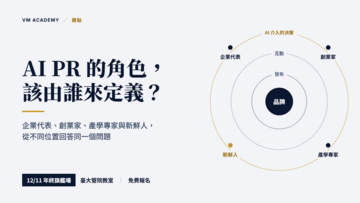
Today, we bring generations into the AI conversation. On 11 December 2026, VM Academy will host its final flagship PR Strategy Open House of the year: A Year with AI: Year-End Reflections from Business Leaders to New Professionals. Graduating students and early-career professionals are invited to explore what changes when AI can produce the first draft—and which forms of human judgement matter more than ever. Official registration and eligibility: https://www.accupass.com/event/2611040257361130470182
Tomorrow, the dialogue becomes broader. In 2027, VM Academy plans to develop Accelerator / Future Salon, a new initiative for experienced PR professionals, communications leaders, scholars, industry specialists and interdisciplinary practitioners to explore AI PR's boundaries, stakeholder networks, methods and professional standards. This is a planned initiative, not an event with a confirmed schedule.
We welcome dialogue with peers, competitors, partners and anyone interested in communications, business, data science and AI. A new profession cannot be established simply because one company gives it a new name. It needs real business questions, tested methods and open debate.
What exactly is an AI PR consultant? We have an evolving answer. We want to hear yours. The next network of influence is already taking shape; let us define the next PR profession together.
Incubator | PR Strategy Open House — 11 December 2026, 19:00–22:00 (registration 18:30), free.
https://www.accupass.com/go/vm-academy-20261211
Accelerator | Future Salon — Planned for 2027. We welcome PR peers and cross-disciplinary experts to connect:
https://www.vocalmiddle.com/en/contact
VM Academy | VOCAL MIDDLE
2020|Founder column (in Chinese)
2023|IMAGE Asset white paper (in Chinese)
2025|Consultant interview: Vitas (in Chinese)
Reuters Institute 2026|Digital News Report 2026: Singapore
Reuters Institute 2026|Digital News Report 2026: Japan
About VM
Founded in 2014, VM | VOCAL MIDDLE is an AI-Native PR Consulting Firm combining public relations expertise, consulting thinking, data science and AI technology. Through IMAGE Asset Governance and AI PR consulting, VM helps organisations develop understanding, trust and influence across markets and human–AI decision environments.
Seen and Trusted by Humans & AI. · Trust · Influence · Resonance.
You May Also Like