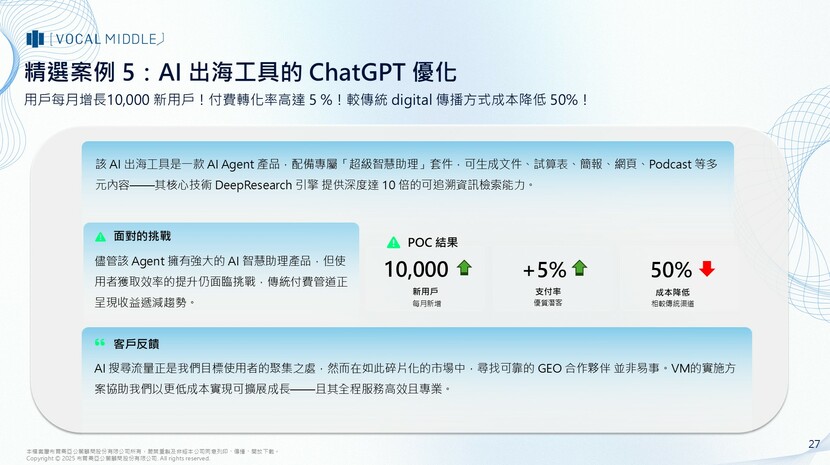
An undisclosed AI agent startup wanted clear public information for its launch. The VM GEO project team organized the research engine and multiple output formats around user tasks, then planned a proof of concept using acquisition, paid conversion and cost measures. This case presents the product positioning and evaluation framework as its documented strategic deliverables.
At launch, the AI agent startup wanted prospective users to understand the work its tool could handle when considering options through ChatGPT. The project focused on product value and proof-of-concept planning. Research, information retrieval and content generation were connected to practical tasks, while new users, paid conversion and cost defined the evaluation directions. The communication objective was to provide a clear basis for product consideration and an assessment structure that distinguished the stages between discovery and payment.
An AI tool can offer research, writing and multiple output formats, yet a capability list leaves users to decide which task it actually serves. The original case therefore organized value around the research engine and outputs such as documents, spreadsheets, presentations, web pages and podcasts. Evaluation required a separate distinction: appearing in an AI answer, attracting a visit, registering a user and converting a payment describe different events. A proof of concept can connect these questions with specific measures and scopes. The strategic choice was to define the product story and evaluation structure together, rather than use one recommendation position to stand for the entire acquisition process.
Organize capabilities around user tasks
Research and traceable retrieval provided the main explanation, with documents, spreadsheets, presentations, web pages and podcasts connected to practical work.
Define distinct acquisition and payment measures
POC planning covered new users, paid conversion and cost, distinguishing discovery, use and payment as separate stages of evaluation.
The case organized product information around the research engine and multiple output formats and proposed three categories for POC evaluation: new users, paid conversion and cost. This framework separates the work the tool can support from the way acquisition and payment are assessed. The strategic deliverables presented here are the product explanation and evaluation structure for launch communications.
1.Why did the AI startup undertake this project?
It needed a clear launch account of its research and output capabilities and a framework for assessing acquisition and payment.
2.What did the VM GEO project team deliver?
The team organized capabilities around tasks and planned POC measures for new users, paid conversion and cost.
3.Why separate AI mentions from paid conversion?
An answer mention, visit, registration and payment are different stages that require different measures.
4.Which deliverables does this case present?
It presents the research and output narrative and a POC structure covering acquisition, paid conversion and cost.
5.How does this case relate to AI PR?
The case addresses product understanding in AI-assisted discovery, aligning capabilities, tasks and evaluation measures into a coherent account of the tool.
Related Service:VM GEO
Related Industry Case:Related technology case
Insight / Methodology:PR strategy insights