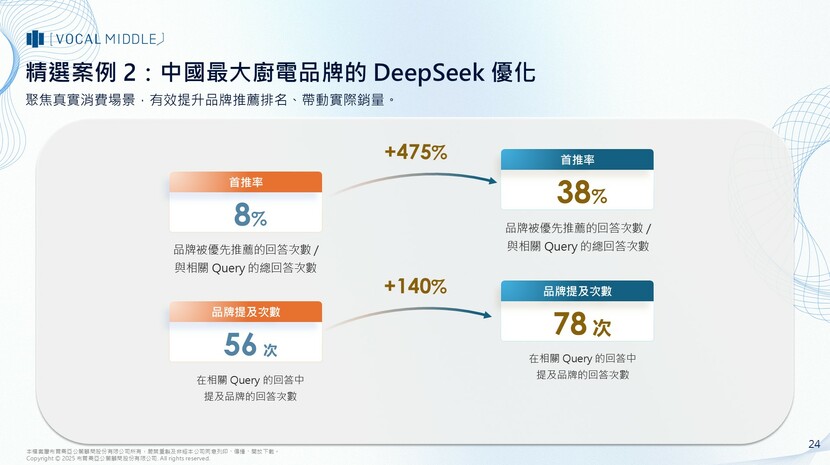
An undisclosed kitchen appliance brand in China wanted AI answers to connect its products with practical needs. The VM GEO project team organized content around space, cooking and cleaning. The original case reports first-recommendation share moving from 8% to 38%, and brand-mention answers from 56 to 78; the changes are 30 percentage points and approximately 39.3%, respectively.
Kitchen appliance decisions involve performance, available space, use patterns and after-sales service. The project aimed to turn existing product information into content that addressed practical selection questions, giving DeepSeek a clearer account of the relationship between the brand and specific needs. The VM GEO project team structured scenarios and used first-recommendation share and the number of answers mentioning the brand to examine its presentation. The stated objective concerns content and observed recommendation answers within the case’s query scope.
Product specifications describe capability, but they do not automatically answer how a household would use it. Kitchen size, cooking frequency and cleaning preferences can give the same specification different relevance across queries. The case addressed that relationship by organizing information around needs and use. Measurement also required two separate concepts: first-recommendation share describes the proportion of relevant answers prioritizing a brand, while mention count describes answers that name it. One concerns recommendation order and the other occurrence. Their interpretation must remain within the original case’s query observations, with product content and use scenarios forming the communication context.
Organize features around kitchen scenarios
Content linked kitchen layout, cooking efficiency and cleaning needs with product characteristics so that selection questions had a concrete context.
Track recommendation order and mentions separately
The team used first-recommendation share and brand-mention answer counts to review presentation and adjust the scenario content.
The existing case page reports DeepSeek first-recommendation share moving from 8% to 38%, an increase of 30 percentage points and a relative increase of 375% from the 8% baseline. Answers mentioning the brand rose from 56 to 78, an increase of 22 or approximately 39.3%. These figures describe the query observations reported on the original page and accompany the project’s scenario-based content work.
1.Why did the appliance brand undertake this project?
It wanted product information to address kitchen layout, cooking and cleaning questions and to examine its presentation in relevant DeepSeek answers.
2.What did the VM GEO project team deliver?
The team organized scenario content and tracked first-recommendation share separately from the number of answers mentioning the brand.
3.How do scenarios differ from feature lists?
They explain how a feature relates to a particular space or practical need, organizing the information around a user’s question.
4.How should the figures be read?
The move from 8% to 38% is 30 percentage points or 375% relative growth. The move from 56 to 78 answers is 22 additional answers or approximately 39.3% growth.
5.How does this case relate to AI PR?
The work addresses how a brand is presented in AI-assisted selection, connecting product information with identifiable needs and examining recommendation answers.
Related Service:VM GEO
Related Industry Case:Related technology case
Insight / Methodology:PR strategy insights